GEOMAGNETIC STORM WATCH (G2): Geomagnetic storms are possible tomorrow when two CMEs might hit Earth. A new NOAA model shows the two CMEs leaving the sun on Aug. 5th, then merging to form a single 'cannibal CME' that delivers a glancing blow to Earth on Aug. 8th. Cannibal CMEs are famous for causing strong geomagnetic storms, and even a glancing blow can be effective. In this case, storm levels could reach category G2 (Moderate) with a slight chance of escalating to G3 (Strong). Aurora alerts: SMS Text


ANOTHER X-CLASS SOLAR FLARE: Earth is dodging some big solar storms. For the second time in 3 days, departing sunspot AR3386 unleashed a powerful X1-class solar flare. NASA's Solar Dynamics Observatory recorded the extreme ultraviolet flash on Aug. 7th at ~2100 UT:

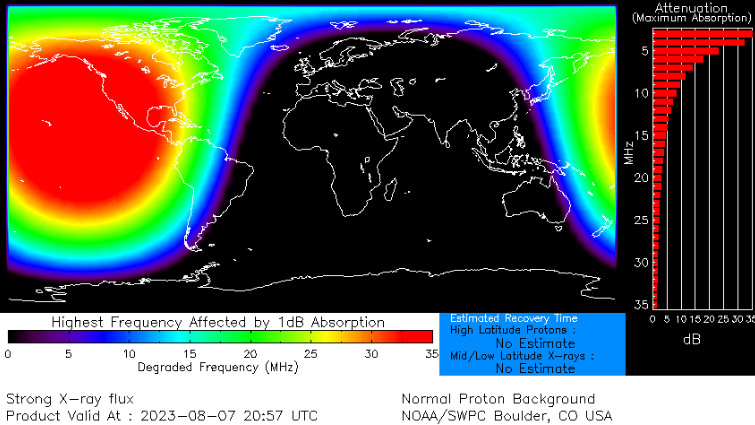
Radiation from the flare caused a deep shortwave radio blackout over the Pacific Ocean (map), and in the hours ahead we can expect to see a ferocious CME emerging from the blast site. The CME will not hit Earth. It is just outside our planet's strike zone.
Realtime Space Weather Photo Gallery
Free: Spaceweather.com Newsletter
DANGEROUS BUT BEAUTIFUL: Observing Venus this week may be one of the most dangerous things you can do with a telescope. The planet is only 12 degrees from the blinding sun. The results, however, are undeniably beautiful:
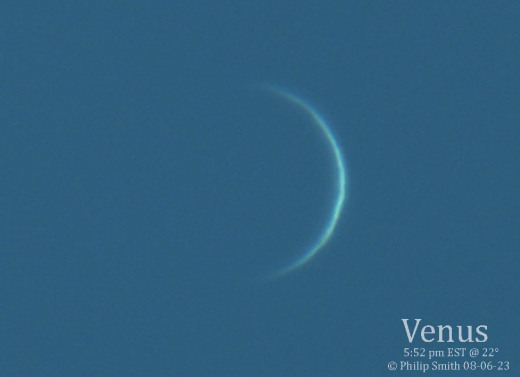
Philip Smith took this picture in broad daylight on Aug. 6th from his home in Manorville, NY. "This is exactly how it looked," he says. "The colors have not been altered."
Like the Moon, Venus has phases, and at the moment it is a marvelously thin crescent. This happens during a special time called "inferior conjunction" when Venus passes between the sun and Earth. This year's inferior conjunction is less than a week away on Aug. 13th--so now is primetime for catching the crescent.
Smith explains how he did it: "The hardest part was finding Venus with the sun so nearby. I put solar filters on my telescope and started with the sun to get a good sharp focus. Then I had the telescope go to Venus. I took off the finder scope's solar filter first and put my hand behind it to make sure the sun was not in its path. Then I removed the main telescope's solar filter--and all was good!"
At closest approach on Aug. 13th, Venus and the sun will be separated by a little more than 7 degrees. This means careful daytime shots of Venus will be possible throughout the conjunction. Got a picture? Submit it here.
more images: from Mariano Ribas of Buenos Aires, Argentina; from Daniel Mello of Rio de Janeiro, Brazil; from Robert Spellman of Apple Valley, CA; from Bum-Suk Yeom of Iksan, South Korea; from Philippe Tosi of Nîmes, France
more observing tips: from Sky & Telescope
Realtime Space Weather Photo Gallery
Free: Spaceweather.com Newsletter
THE CRESCENT VENUS PENDANT: Are you looking for a far-out gift? Nothing says "I love you" like a Venus Pendant from the edge of space. This one flew to the stratosphere onboard a cosmic ray research balloon on Jan. 8, 2022:
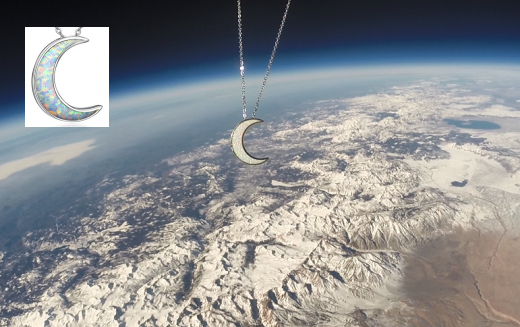
You can have it for $142.95. The opal crescent is framed by sterling silver with a matching hypoallergenic chain. It comes with a greeting card showing the pendant in flight and telling the story of its journey to the stratosphere.
Why is it a crescent? Because Venus itself was a crescent on the date of the flight. On Jan. 8, 2022, the second planet was at inferior conjunction with the sun. From Earth it looked like a slender crescent--the most beautiful phase of the Goddess of Love.
Far Out Gifts: Earth to Sky Store
All sales support hands-on STEM education
Realtime Noctilucent Cloud Photo Gallery
Free: Spaceweather.com Newsletter
Realtime Aurora Photo Gallery
Free: Spaceweather.com Newsletter