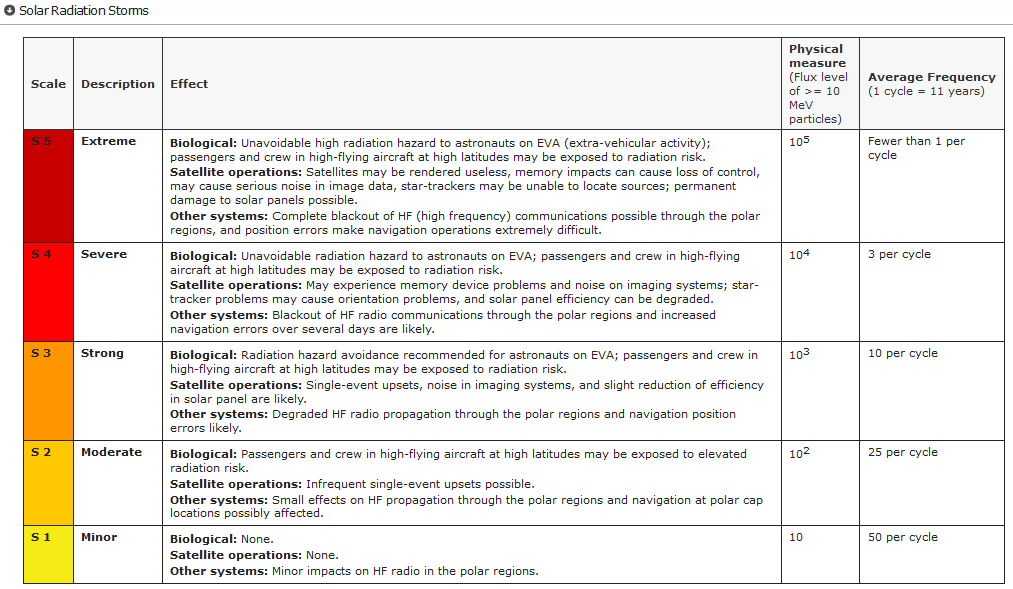
MINOR SOLAR RADIATION STORM IN PROGRESS: Energetic solar protons are hitting Earth's upper atmosphere today. They were accelerated in our direction by a recent series of X- and M-class solar flares. The main effect of this solar radiation storm (category S1) is a shortwave radio blackout inside the Arctic Circle (map). The storm is expected to last another 24 to 48 hours. Aurora alerts: SMS Text


THE GREAT SOLAR STORM OF MARCH 1940: This story is shocking. On March 24, 1940, a solar storm hit Earth so hard it made copper wires in the United States crackle with 800 volts of electricity. A New York Times headline declared that a "sunspot tornado" had arrived, playing havoc with any signal that had to travel through metal wires.
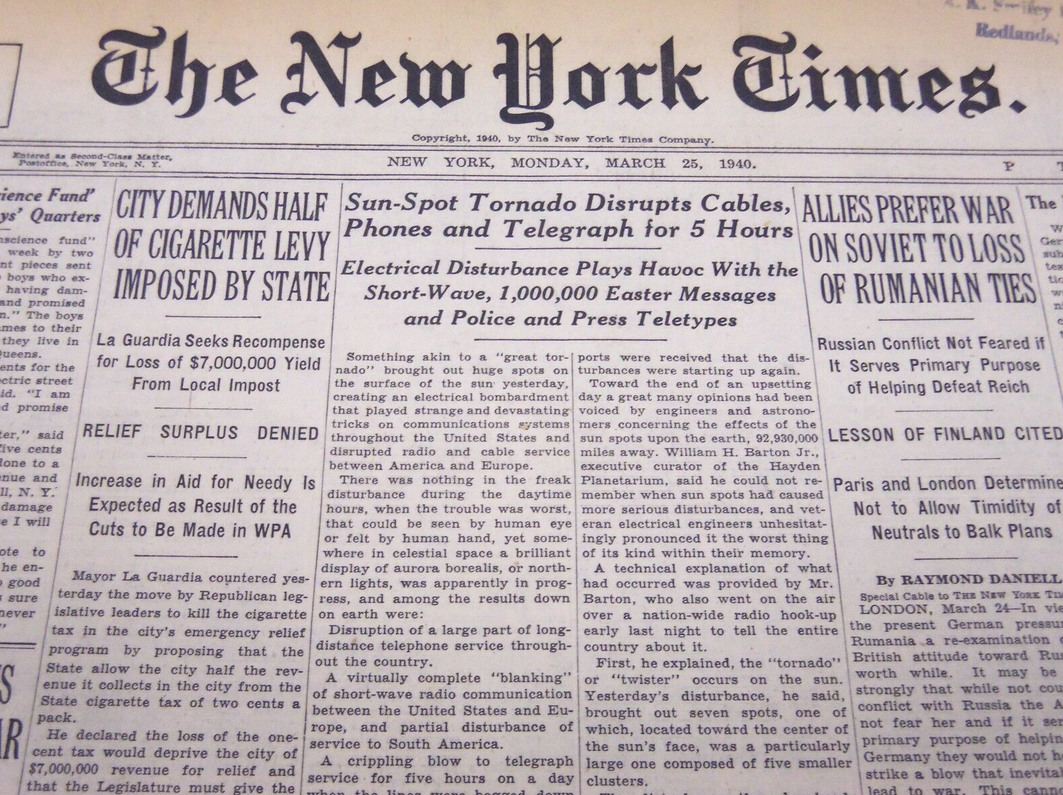
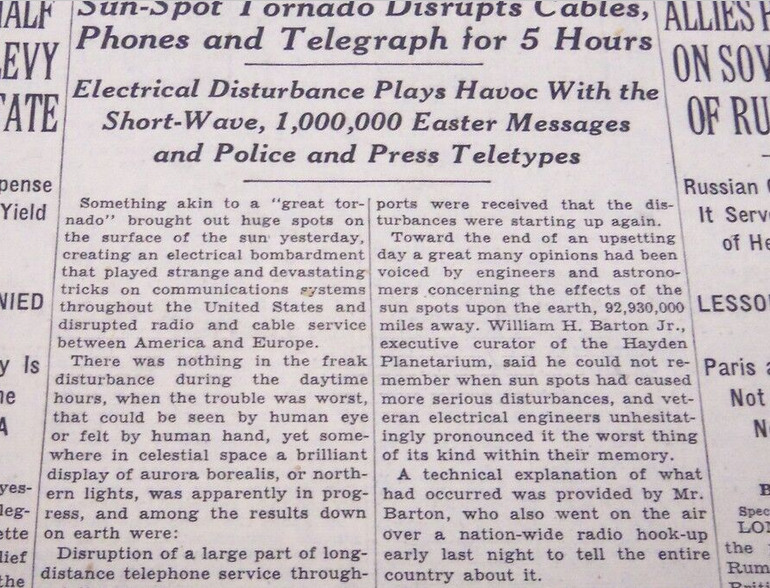
"For a few hours it completely disrupted all long-distance communication," wrote astronomer Seth B. Nicholson in a recap of the event for the Astronomical Society of the Pacific. Radio announcers seemed to be "talking a language no one could understand." The New York Times reported that more than a million telephone and teletype messages had been garbled: "Veteran electrical engineers unhesitatingly pronounced it the worst thing of its kind within their memory."
So why have you never heard of this storm? Even in 1940 it was fairly quickly forgotten. World War II was underway in Europe, and the USA was on the verge of joining. People had other things on their minds.
Modern researchers, however, are paying attention. A team led by Jeffrey Love of the USGS Geomagnetism Program just published a new study of the event in the research journal Space Weather. Their work confirms that it was no ordinary solar storm.
"It was unusually violent," says Love. "There were very rapid changes in Earth's magnetic field, and this induced big voltages in long metal wires."
Love and colleagues learned about the voltages from old engineering reports. In 1940, the United States was cross-crossed by copper wires hundreds to thousands of miles long. They were not for power distribution; electrical systems were still mostly regional. Instead the wires were used for communications such as telephone calls and telegrams. When the "sunspot tornado" hit Earth, electricity began to move through the system. Technicians jotted down some of the voltages they saw--and the numbers were incredible.
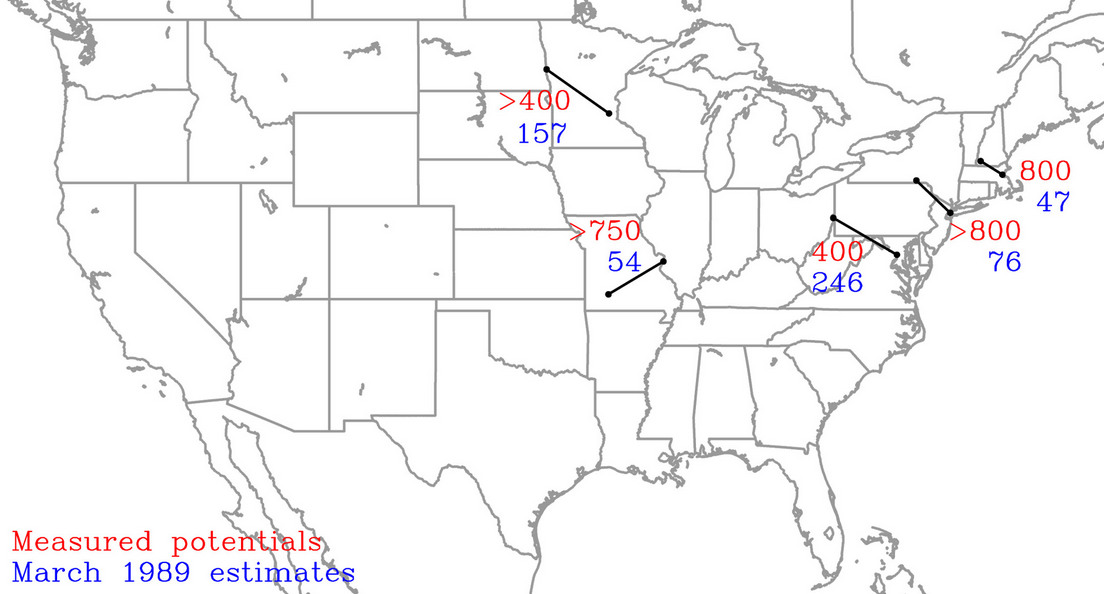
Above: Solar storm voltages in March 1940 (red) vs. the Quebec Blackout of March 1989 (blue)
"Records show 400 V in Minnesota, 750 V in Missouri, and more than 800 V in Massachusetts," says Love. "These are 10 times greater than long-wire voltages recorded during the Great Quebec Blackout in March 1989."
What caused the high voltages? Love's team examined old magnetogram records from the date of the storm and found evidence that two coronal mass ejections CMEs hit Earth only 1.82 hours apart. The double blow rattled Earth's magnetic field in a complicated way most single CMEs do not.
"This could be a harbinger of things to come," says Love. Modern studies show that as many as 5 CMEs leave the sun every day during Solar Maximum. With Solar Cycle 25 underway and intensifying, a double hit could definitely happen again.
A similar storm today might not significantly impact communications; we live in the wireless age of cell phones. Electricity is another matter. Modern power systems depend on long wires to shuttle electricity across the country. A repeat of 1940 could interfere with their operations. Love notes that the 1940 voltages exceed NERC power-grid industry benchmarks for 100-year storms. As a result, some modern power grids might not be ready to handle the shock of another 1940 event.
Read Love's original research here: here.
Realtime Space Weather Photo Gallery
Free: Spaceweather.com Newsletter
LIMITED EDITION ASTRONAUT SNOOPY: Everybody loves Snoopy. For the fan in your life, consider the gift of Astronaut Snoopy. On July 30th, 2023, this limited edition Funko Pop figurine flew to the stratosphere onboard an Earth to Sky Calculus cosmic ray research balloon.

You can have it for $119.95. Snoopy comes with a greeting card showing the space beagle in flight and telling the story of his trip to the stratosphere and back again. All sales support cosmic ray monitoring and hands-on STEM education.
Far Out Gifts: Earth to Sky Store
All sales support hands-on STEM education
SPACEX TEARS ANOTHER HOLE IN THE IONOSPHERE: On Monday night, Aug. 7th,, SpaceX launched 15 more Starlink satellites from the Vandenberg Space Force Base in California. En route to orbit, the Falcon 9 rocket tore a hole in the ionosphere. Dennis Mammana photographed the telltale red glow from Borrego Springs, CA:
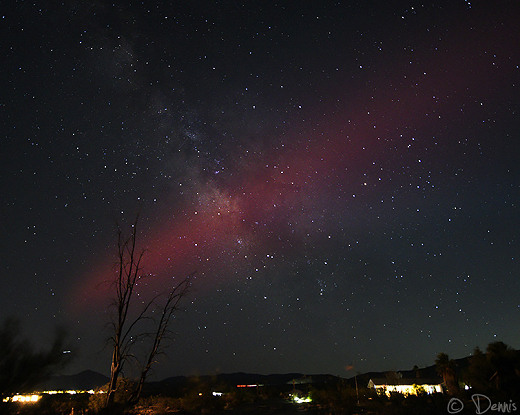
"It crossed the Milky Way, forming a giant X in the night sky," says Mammana.
The red light in Mammana's photo is *not* rocket exhaust. Instead, it is the afterglow of a charge exchange reaction between rocket exhaust (mostly water) and gases in the ionosphere. The reaction quenched local ionization by as much as 70%, essentially erasing the ionosphere along the rocket's path.
Once rare, ionospheric holes are increasingly common due to record numbers of rocket launches. Not every launch makes one. A rocket has to burn through the F-layer of the ionosphere to initiate the reaction; many rockets cut off their engines before that. Even so, with SpaceX launching dozens of Starlink satellites every week, the red glow of ionospheric holes is becoming routine.
This time-lapse movie from Jeremy Parez of Flagstaff Arizona also captured some of the icy water vapor (pale blue) that fueled the reaction:
"The red ionosphere interaction occurred again and showed up very well photographically," says Perez.
So far as we know, ionospheric holes do no lasting harm. Ham radio operators may notice them when shortwave signals fail to skip over the horizon, shooting through holes instead of bouncing back to Earth. Sudden GPS errors can also result from the anomalies. However, these effects are shortlived. The holes are repaired as soon as the sun comes up again, exposing the ionosphere to normal amounts of ionizing radiation.
more images: from Drew Evans of Flagstaff, Arizona; from Jeremy Perez of Flagstaff, Arizona; from David Blanchard of Flagstaff, Arizona; from Mike Lewinski of Crestone, Colorado; from Lance Benner of Mt. Wilson, California;
Realtime Space Weather Photo Gallery
Free: Spaceweather.com Newsletter
Realtime Noctilucent Cloud Photo Gallery
Free: Spaceweather.com Newsletter
Realtime Aurora Photo Gallery
Free: Spaceweather.com Newsletter