A VERY GOOD PERSEID METEOR SHOWER: Forecasters are predicting the best Perseid meteor shower in years this weekend. On Saturday night, Aug. 12-13, Earth will pass through a stream of debris from Comet 109P/Swift-Tuttle, causing dozens of meteors per hour to streak out of the constellation Perseus. The nearly New Moon will make the display unusually easy to see from dark-sky sites. Book a campsite and enjoy the show: Observing tips.
Dan Bush photographed this bright Perseid, an early arrival on Aug. 11th, using an automated camera in Albany, Missouri:
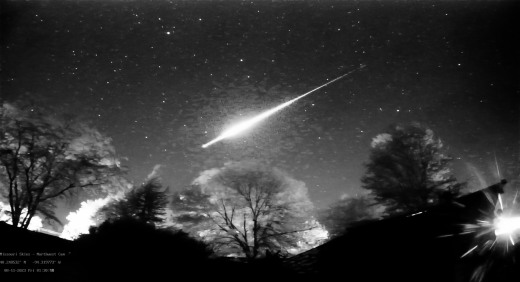
"It flashed across the sky around 1:30 a.m.," says Bush. "There were other Perseid meteors but none as bright as this one."
Realtime Meteor Photo Gallery
Free: Spaceweather.com Newsletter
SOLAR CYCLE UPDATE: This website, Spaceweather.com, began in 1997 with the first stirrings of Solar Cycle 23 (SC23). The timing was right. In the years that followed, SC23 produced the strongest solar flare of the Space Age (X45), the infamous Halloween Storms of 2003, and multiple episodes of Northern Lights as far south as Texas and California. Could it happen again? New Solar Cycle 25 is heading in the same direction:
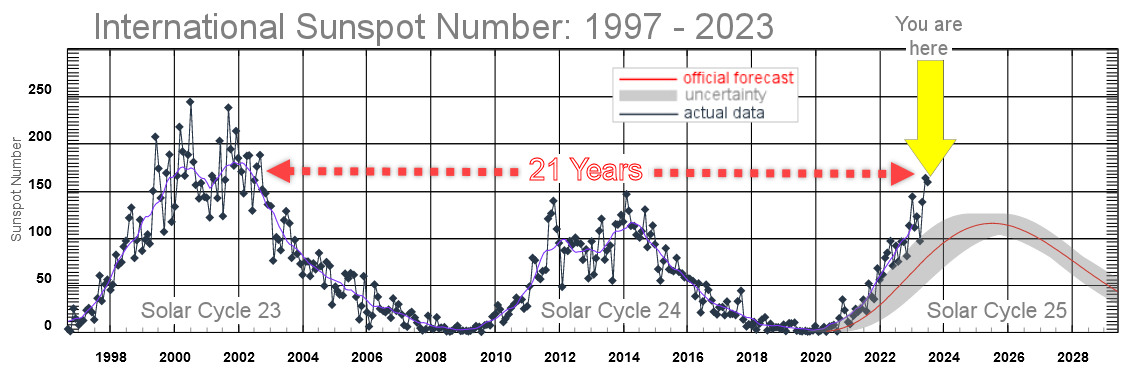
This summer, sunspot counts have hit their highest values in more than 20 years, sharply exceeding official forecasts and putting them squarely in the ballpark of Solar Cycle 23. It's just like old times.
With Solar Max not expected for another year (or more), sunspot counts should continue to increase, further widening the gap between Solar Cycle 25 and its historically weak predecessor Solar Cycle 24. If, indeed, Solar Cycle 25 does leapfrog Solar Cycle 24 and land in the vicinity of Solar Cycle 23, we can expect at least 3 to 5 years of high solar activity in the years ahead. Stay tuned. Solar flare alerts: SMS Text
Realtime Space Weather Photo Gallery
Free: Spaceweather.com Newsletter
VOYAGER GOLDEN RECORD ORNAMENT: This is a must-have Christmas ornament for space fans: The Voyager Golden Record. Last Oct. 15th, the students of Earth to Sky Calculus launched it to the stratosphere onboard a cosmic ray research balloon:
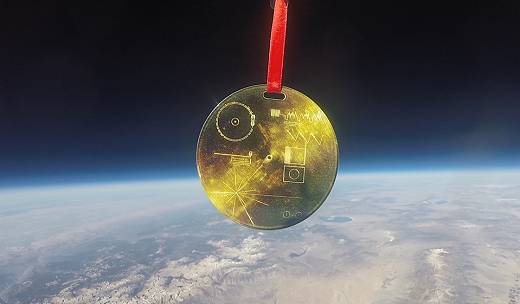
You can have it for $129.95. The 4-inch aluminum disk is imprinted with instructions intended for extraterrestrials, telling them how to play the phonographs now sailing through interstellar space onboard NASA's Voyager probes. Having touched the edge of space, it's the closest thing on Earth to an actual Golden Record.
The students are selling these unique ornaments to support their cosmic ray ballooning program. Each one comes with a greeting card showing the ornament in flight and extra materials decoding the markings on the disk.
Far Out Gifts: Earth to Sky Store
All sales support hands-on STEM education
Realtime Noctilucent Cloud Photo Gallery
Free: Spaceweather.com Newsletter
Realtime Aurora Photo Gallery
Free: Spaceweather.com Newsletter