QUIET WITH A CHANCE OF FLARES: The sun has gone quiet with a sudden (and almost certainly temporary) drop in the sunspot number. However, there is still a chance of flares. Remaining sunspot AR3395 has a 'delta-class' magnetic field that harbors energy for X-class explosions. Solar flare alerts: SMS Text
PERSEID METEOR RECAP: The annual perseid meteor shower peaked over the weekend with maximum rates near 75 meteors per hour, according to the International Meteor Organization. Juan Carlos Casado photographed more than 50 of them from Sant Llorenç de la Muga, Girona, Spain:
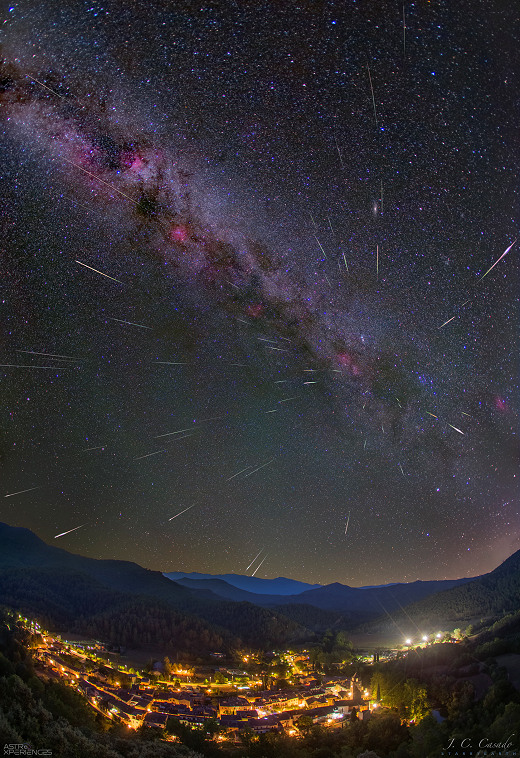
"This image is a composite that summarizes the maximum of 2023 Perseid meteor shower," says Casado. "I took more than 1200 photos, which I examined one by one to extract the Perseid meteors. When combining the photos, I compensated for Earth's rotation to show the effect of a radiant located in the constellation Perseus."
"In the forground is the medieval town of Sant Llorenç de la Muga," he continues. "Sant Llorenç in Catalan means Saint Lawrence, and the Perseids are known in Spain as the 'tears of Saint Lawrence' in memory of the martyr who is commemorated on August 10 of each year."
more images: from Dan Bush of Albany, Missouri; from Jeremy Perez of Lake Mary, Arizona; ; from Radu Anghel of Motoseni, Romania; from Martin McKenna of Lough Fea, N. Ireland; from Craig Heden of Cottonwood, California ; from James Champagne of Logan, Utah;
Realtime Perseid Photo Gallery
Free: Spaceweather.com Newsletter
THE INFERIOR CONJUNCTION OF VENUS: How do you observe a planet using your telescope when that planet is only 7 degrees from the blinding sun? Yesterday, Philip Smith of Manorville, New York, solved the problem using cardboard:

"My friend said it looks like the front of the Hubble Space Telescope," says Smith. "Next I plan to paint it black."
Smith used the DIY sunblocker to photograph yesterday's inferior conjunction of Venus. The second planet was so close to the sun, it was impossible to point the unshadowed telescope at Venus without stray sunbeams getting into the optics.

"I briefly tried draping a sweatshirt in front of the telescope, but the fabric started to smolder and smoke," says Smith. "Cardboard worked much better."
Astronomers around the world watched the conjunction, which revealed Venus as an exquisitely slender crescent. Each observer solved the "sunbeam problem" in their own way. Browse the Venus photo gallery to see the results.
Realtime Venus Photo Gallery
Free: Spaceweather.com Newsletter
VOYAGER GOLDEN RECORD ORNAMENT: This is a must-have Christmas ornament for space fans: The Voyager Golden Record. Last Oct. 15th, the students of Earth to Sky Calculus launched it to the stratosphere onboard a cosmic ray research balloon:
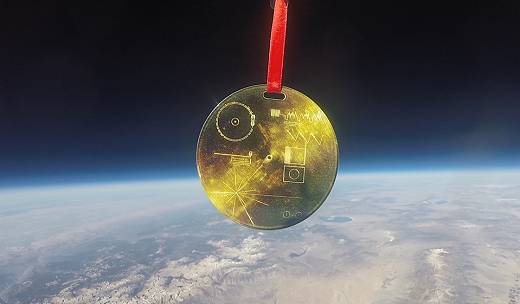
You can have it for $129.95. The 4-inch aluminum disk is imprinted with instructions intended for extraterrestrials, telling them how to play the phonographs now sailing through interstellar space onboard NASA's Voyager probes. Having touched the edge of space, it's the closest thing on Earth to an actual Golden Record.
The students are selling these unique ornaments to support their cosmic ray ballooning program. Each one comes with a greeting card showing the ornament in flight and extra materials decoding the markings on the disk.
Far Out Gifts: Earth to Sky Store
All sales support hands-on STEM education
Realtime Space Weather Photo Gallery
Free: Spaceweather.com Newsletter
Realtime Aurora Photo Gallery
Free: Spaceweather.com Newsletter