QUIET WEEKEND: Although the sunspot number remains high, we should not expect any strong flares this weekend. All eight sunspot groups on the solar disk have stable magnetic fields, which are unlikely to explode. Solar flare alerts: SMS Text
SUNSPOTS MAKE CLOUDS ON NEPTUNE: A new paper published Aug. 17th in the research journal Icarus offers dramatic proof that solar activity can affect planetary weather. The big surprise: That planet is Neptune, 2.5 billion miles from the sun. Twenty-six years of images taken by the Hubble Space Telescope show bright clouds forming in sync with the 11-year solar cycle:
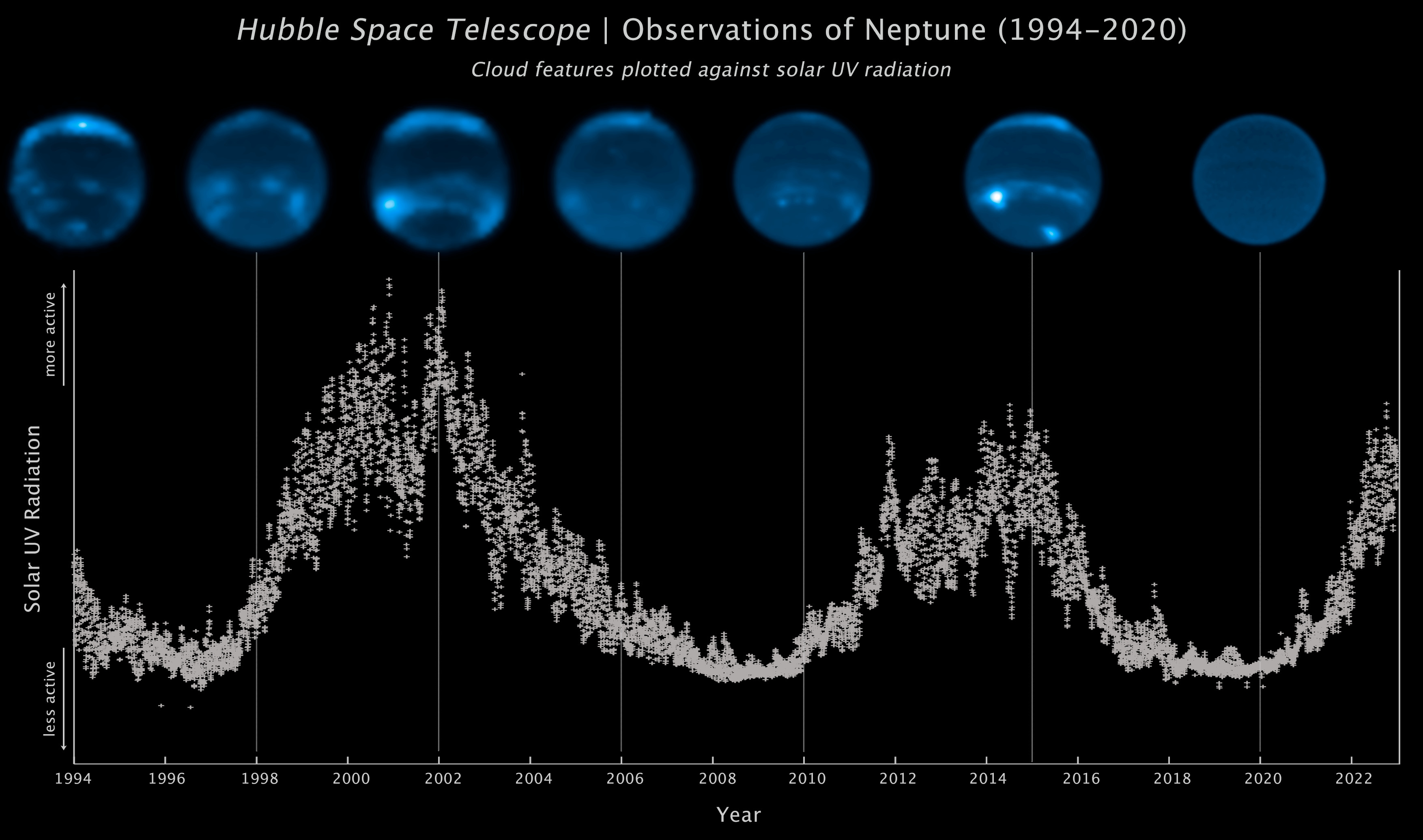
The connection between Neptune and solar activity is surprising to planetary scientists because Neptune is our solar system's farthest major planet and receives only 0.1% of the sunlight Earth receives. Yet Neptune's cloudy weather seems to be driven by solar activity, and not the planet's four seasons, which each last approximately 40 years.
"This is extremely exciting and unexpected," says Erandi Chavez, a graduate student at Harvard-Smithsonian's Center for Astrophysics, who led the study when she was a student at UC Berkeley.
The research team confirmed Hubble's results using data from the Webb Space Telescope, the Keck Observatory, and the Lick Observatory. The link between sunspots and Neptune's clouds appears to be solar ultraviolet (UV) radiation, which peaks when sunspot counts are high.

"Our findings support the theory that the sun's UV rays, when strong enough, may be triggering a photochemical reaction that produces Neptune's clouds," says Imke de Pater, emeritus professor of astronomy at UC Berkeley and a senior co-author of the study.
Based on the data so far, it seems to take about two years for Neptune's clouds to fully form once the solar cycle reaches its peak. Solar Cycle 25 is rising now with a peak expected in 2024. This means Neptune's cloudy season is about to begin--a development amateur astronomers may be able to observe. Stay tuned.
Realtime Space Weather Photo Gallery
Free: Spaceweather.com Newsletter
FANTASTIC DRAGON SPACE PENDANT: Are you looking for a far-out gift? Consider the Fantastic Dragon Space Pendant. This one hitched a ride onboard an Earth to Sky Calculus cosmic ray research balloon, reaching an altitude of 117,524 ft:
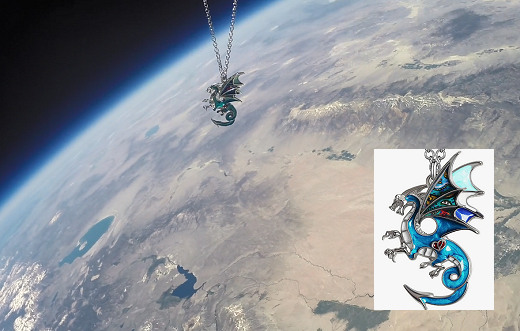
You can have it for $124.95. The pendant is hand-crafted with colorful enamel inlaid on a hypoallergenic dragon exoskeleton. It makes a great gift for anyone who loves fantasy and dragonlore.
The students are selling space pendants to support their cosmic ray ballooning program. Each one comes with a greeting card showing the pendant in flight and telling the story of its trip to the stratosphere and back again.
Far Out Gifts: Earth to Sky Store
All sales support hands-on STEM education
Realtime Space Weather Photo Gallery
Free: Spaceweather.com Newsletter
Realtime Aurora Photo Gallery
Free: Spaceweather.com Newsletter