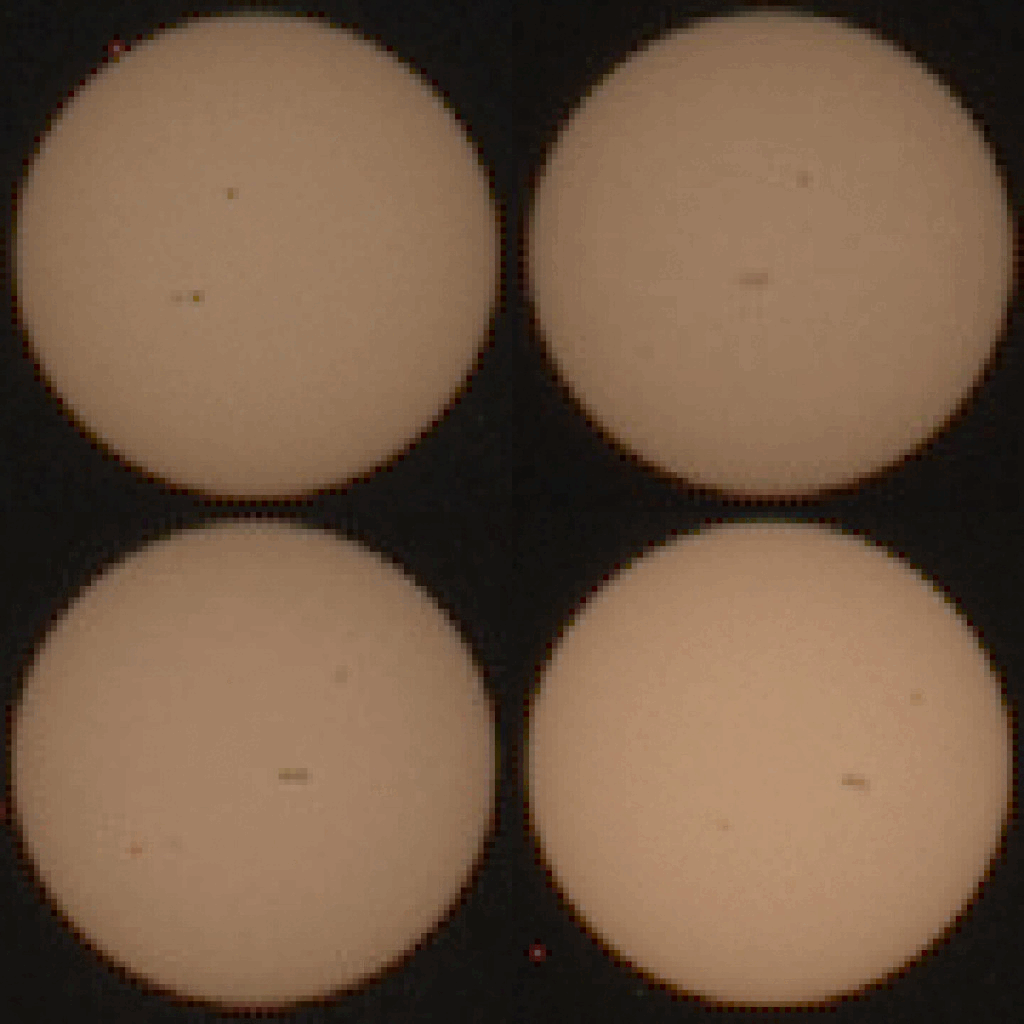
A SUNSPOT BIG ENOUGH TO SEE FROM MARS: Every day on Mars, NASA's Perseverence rover looks up at the sun to see how bright it is. A dimming sun can herald an approaching dust storm. Over the weekend, the rover saw something extra: A big sunspot. This animation shows the sunspot crossing the solar disk over Jezero crater from Aug. 17th to 20th. Here on Earth we can expect to see the sunspot rotate into view later this week, potentially bringing an uptick in solar activity. Solar flare alerts: SMS Text
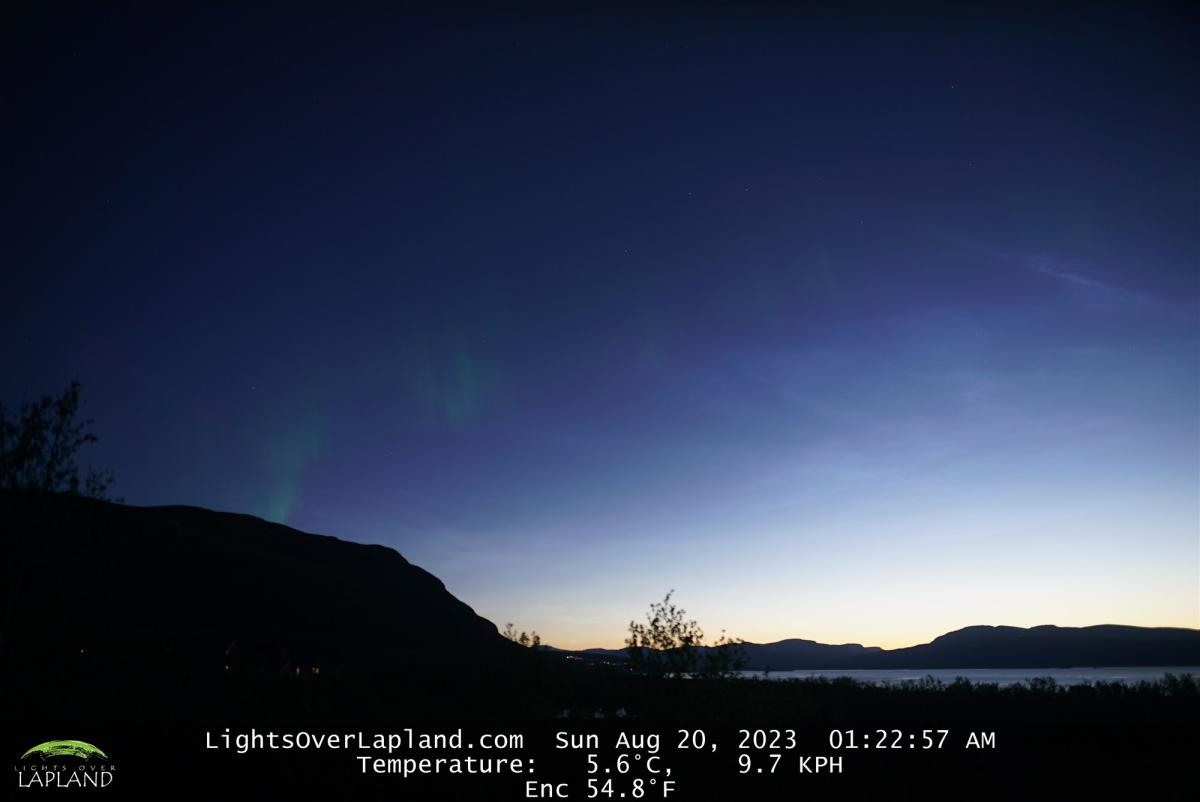
ARCTIC AURORA SEASON BEGINS EARLY: A fast stream of solar wind hit Earth over the weekend, sparking a rare display of August auroras around the Arctic Circle. "On Saturday, Aug. 19th, I got to see my first Northern Lights of the season," reports Göran Strand, who sends this picture from Östersund, Sweden (latitude +63N):

In the Arctic, August auroras are extra-special because the glow of the Midnight Sun has not yet faded away. This gives observers a chance of see a mix of colors: Twilight blue and geomagnetic green. "Blue night-sky auroras are so beautiful with a warm horizon at the bottom," notes Strand.
More than 200 km inside the Arctic Circle, an automated camera at the STF Turiststation in Abisko, Sweden, photographed the same display. "This is the earliest we have seen auroras in at least 17 years," says Chad Blakley of Lights over Lapland. "Our automated camera has been in operation since 2005-2006. I checked the archives. Aug. 19, 2023, is the earliest display on record, edging out Aug. 20, 2013 by a single day."
The early start to aurora season highlights the increasing strength of Solar Cycle 25, now racing toward a Solar Max expected as early as next year. Earth's magnetosphere is buzzing with energy, and it only takes a single stream of solar wind to light up our planet's poles. Note to Arctic sky watchers: Be alert for green+blue in the weeks ahead as the Midnight Sun fades to black. Aurora alerts: SMS Text
Realtime Aurora Photo Gallery
Free: Spaceweather.com Newsletter
FANTASTIC DRAGON SPACE PENDANT: Are you looking for a far-out gift? Consider the Fantastic Dragon Space Pendant. This one hitched a ride onboard an Earth to Sky Calculus cosmic ray research balloon, reaching an altitude of 117,524 ft:
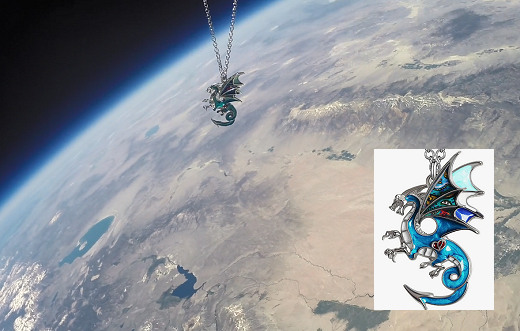
You can have it for $124.95. The pendant is hand-crafted with colorful enamel inlaid on a hypoallergenic dragon exoskeleton. It makes a great gift for anyone who loves fantasy and dragonlore.
The students are selling space pendants to support their cosmic ray ballooning program. Each one comes with a greeting card showing the pendant in flight and telling the story of its trip to the stratosphere and back again.
Far Out Gifts: Earth to Sky Store
All sales support hands-on STEM education
COMET NISHIMURA AND THE ESKIMO NEBULA: Hyperbolic Comet Nishimura continues to fall into the solar system. On Aug. 19th it passed by the Eskimo Nebula. Bill Williams captured the conjunction just above the roof of his house in Florida's Chiefland Astro Village:
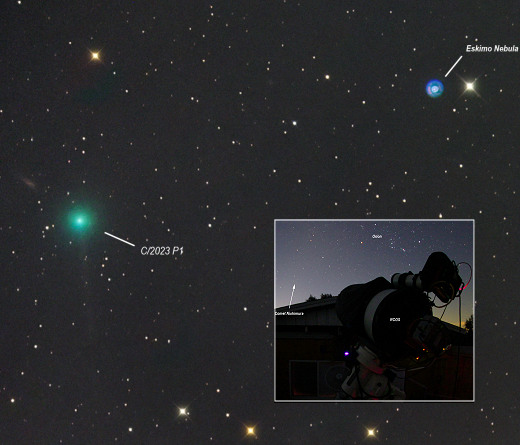
"I read about newly-discovered Comet Nishimura (C/2023 P1) on Spaceweather.com, so I decided to take the challenge of capturing it--although my observatory roof slides east and usually blocks low altitude pre-dawn objects," says Williams. "However, I was thrilled when not only did Comet Nishimura show up but also the Eskimo Nebula just 18 arc minutes away!!"
"Astronomical twilight was already underway when I started observing, so to accelerate the capture I took 2-minute LRGB images (binned 3x3)," he continues. "I do not know what percentage of my telescope actually captured photons from the comet, but we got a nice view of the roof gable, too. A thin ion tail also showed up! You don't know unless you try!"
Comet Nishimura is visiting the inner solar system for the first and last time. When it passes by the sun inside the orbit of Mercury on Sept. 18th, the sun's gravity will slingshot it back into deep space. It is expected to become a naked eye object (3rd magnitude) in mid-September. Take a look! Sky maps: Aug. 20, 21, 22, 23, 24, 25. Ephemeris: from JPL.
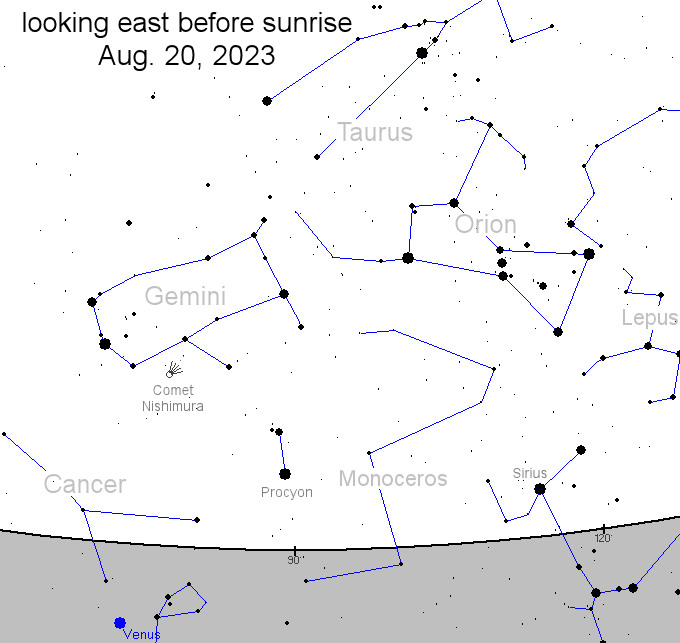
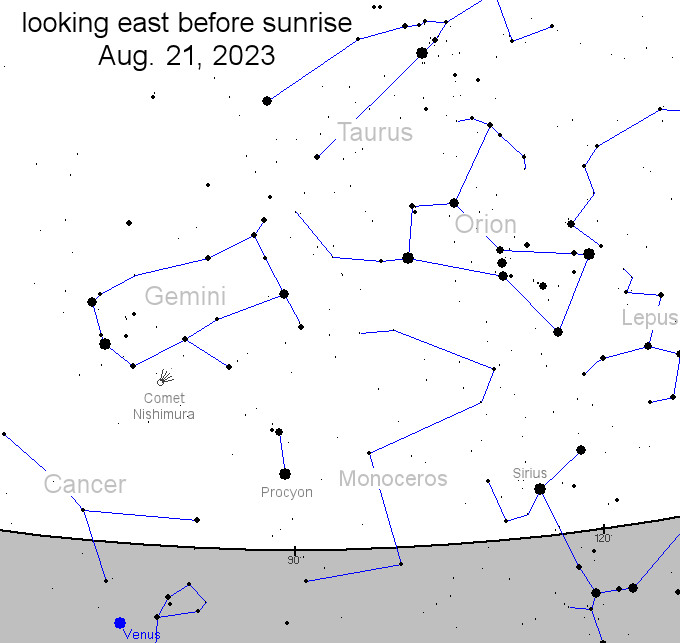
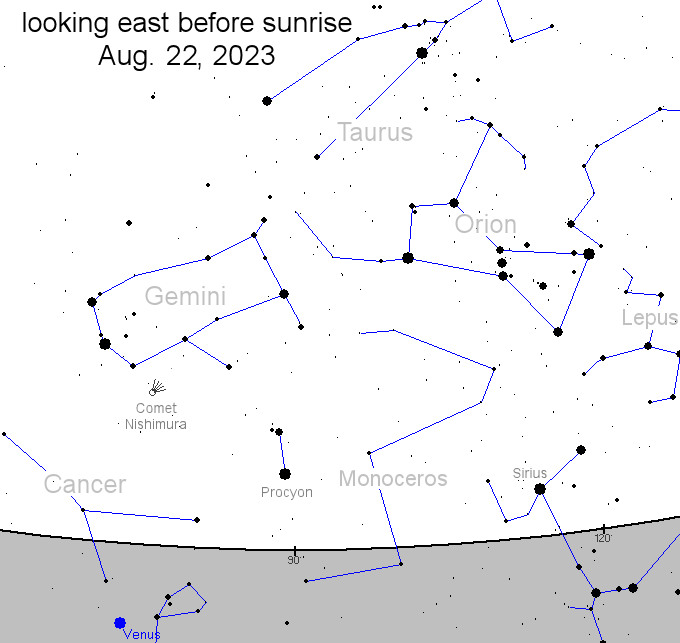
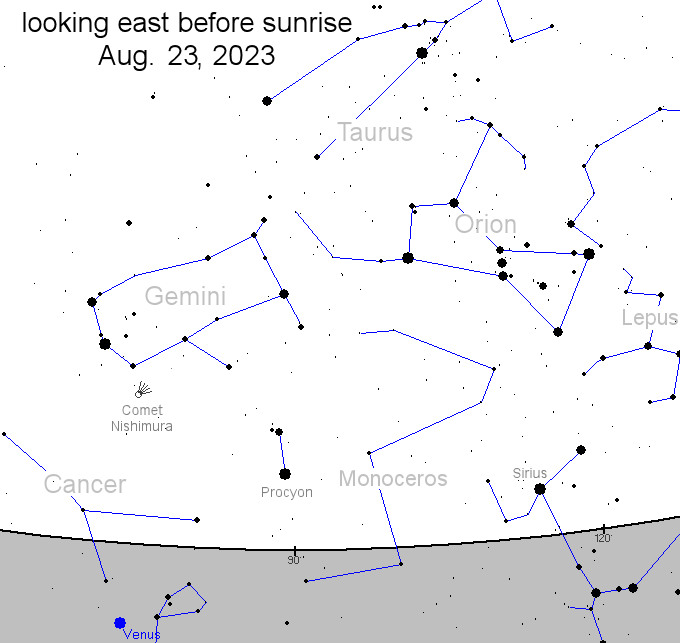
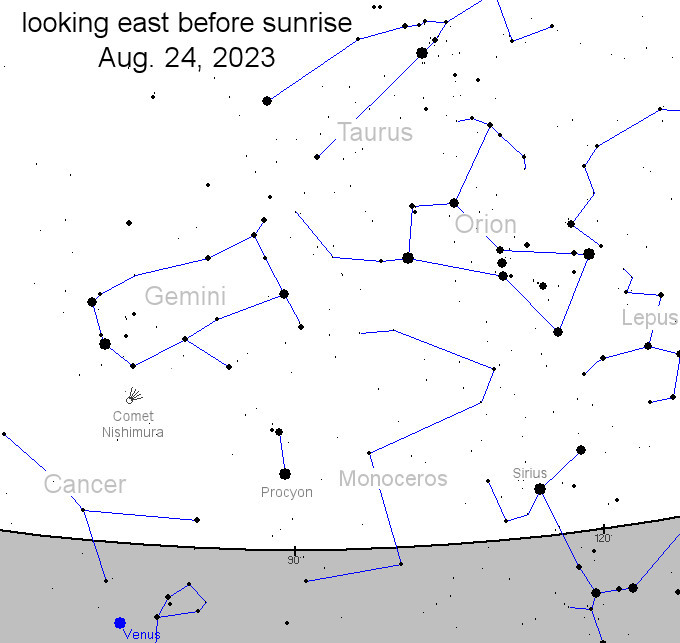
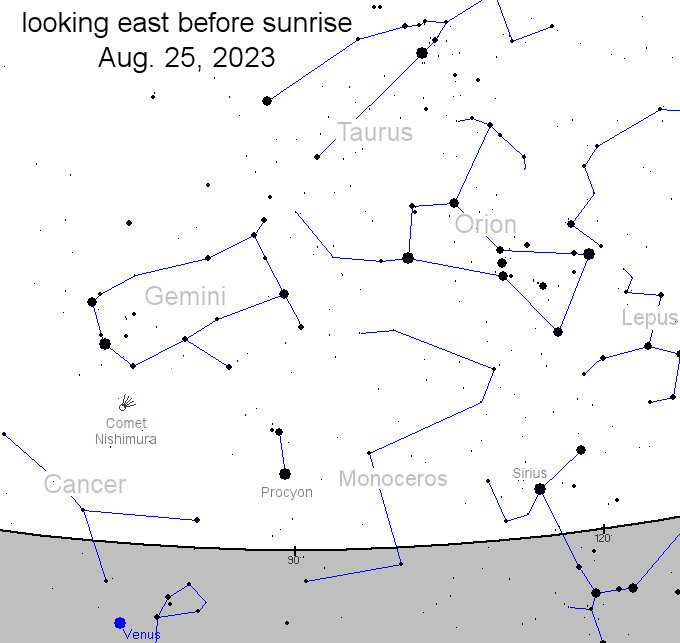
more images: from Robert Forrest of Market Harborough, UK; from Graziano Ventre of Bellagio Via Lattea, Italy; from Johnny Barton of Robinson, TX
Realtime Space Weather Photo Gallery
Free: Spaceweather.com Newsletter
Realtime Space Weather Photo Gallery
Free: Spaceweather.com Newsletter