TODAY'S FORECAST CALLS FOR QUIET, BUT... There are eight sunspot groups on the Earthside of the sun--a large number that would normally herald strong solar activity. In this case, however, the forecast calls for quiet. All eight sunspot groups have stable magnetic fields that pose no threat for strong flares. BUT! A large sunspot is emerging, which would change everything. Keep reading....
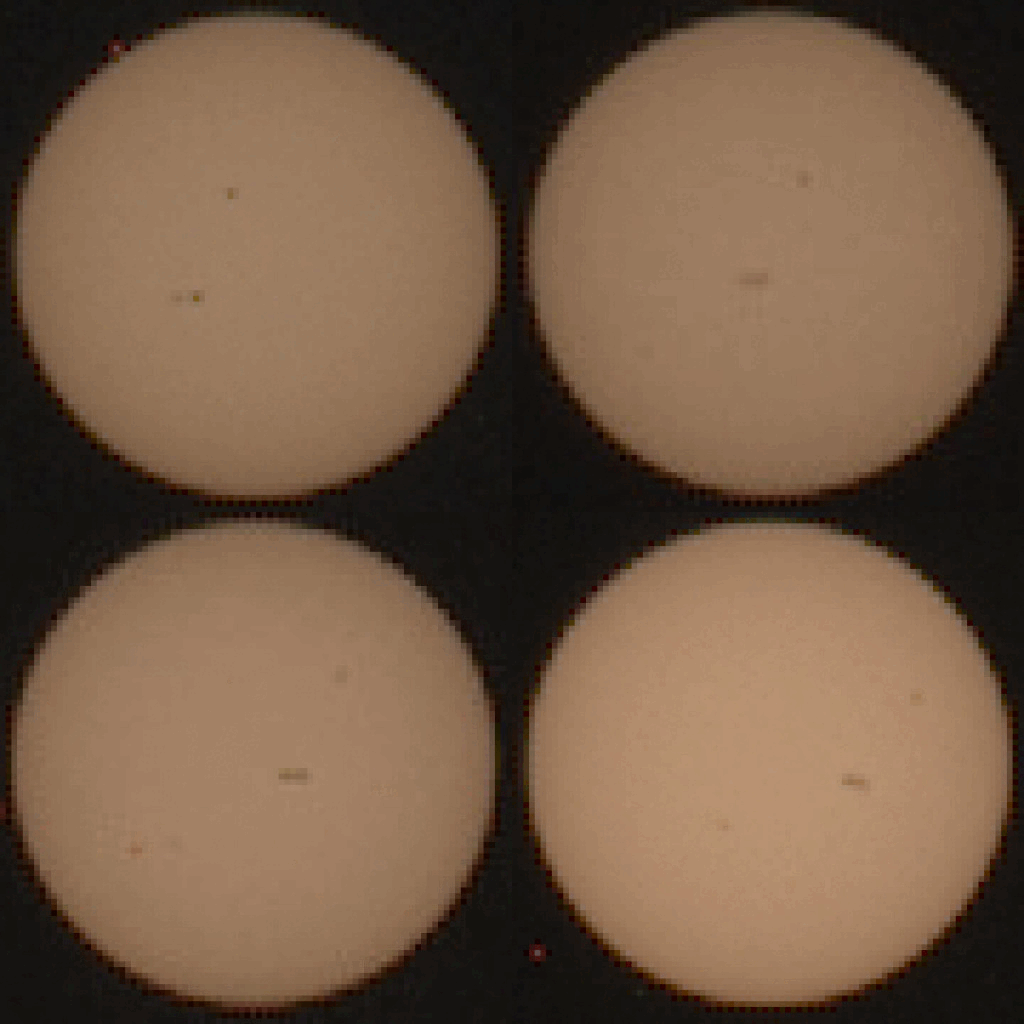
A LARGE SUNSPOT IS EMERGING: NASA's Perseverance Mars rover saw it first. Last week, the rover's MASTCAM spotted a large sunspot crossing the farside of the sun. Now it is emerging over the sun's eastern limb where we can see it from Earth. The new sunspot seems to be connected to another sunspot across the sun's equator. Watch this:
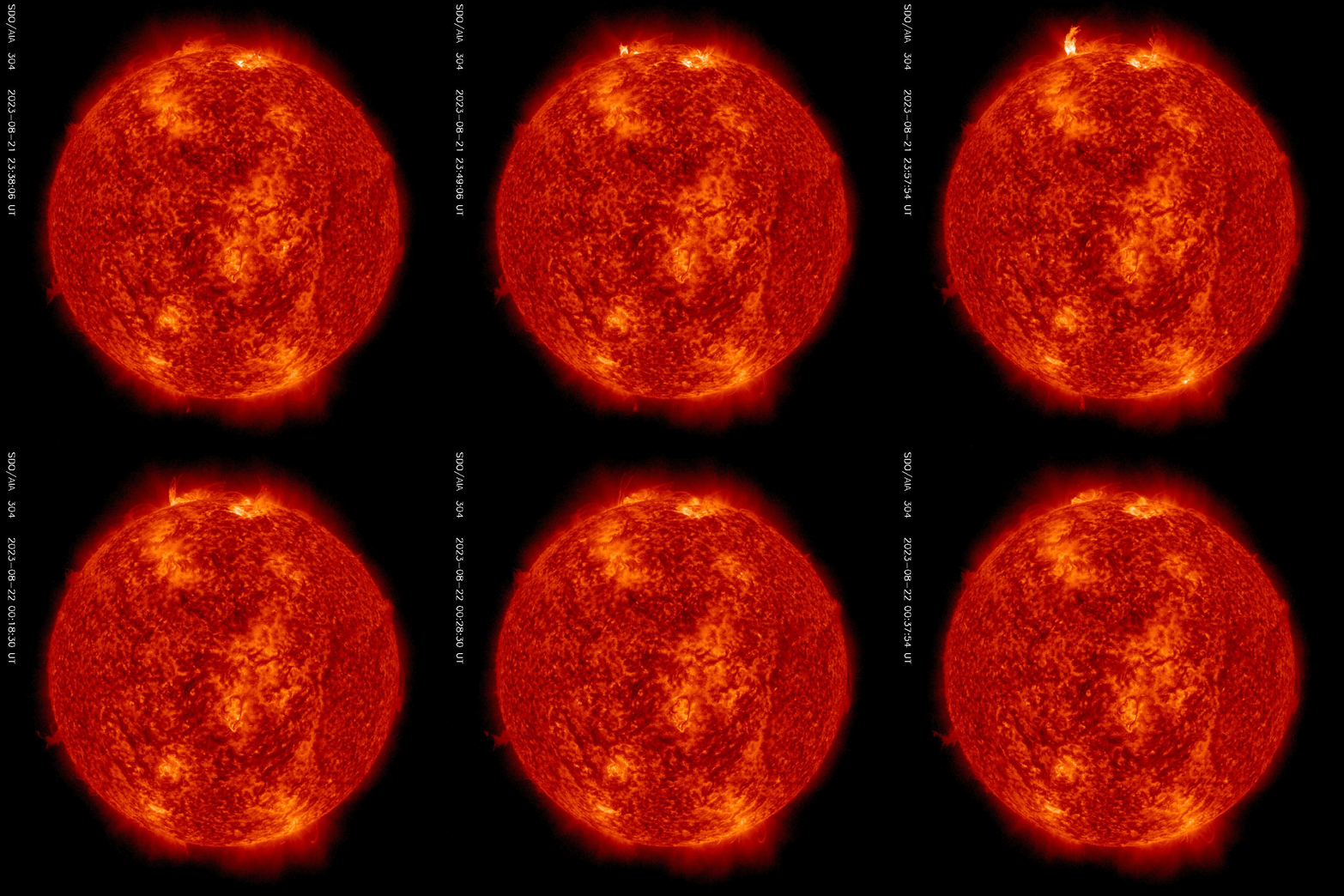
Recorded by NASA's Solar Dynamics Observatory, the movie shows two horn-like plumes of plasma leaping up from the new sunspot and, simultaneously,. sunspot AR3413. A bridge of magnetism linking the two active regions could coordinate their explosions as they turn toward Earth this week, doubling their impact on our planet. Stay tuned! Aurora alerts: SMS Text
Realtime Aurora Photo Gallery
Free: Spaceweather.com Newsletter
SOLAR ECLIPSE CRYSTAL PYRAMID: On Aug. 21, 2017, during the Great American Solar Eclipse, the students of Earth to Sky Calculus launched 11 space weather balloons from the path of totality. The armada soared into the stratosphere, touching the shadow of the Moon more than 100,000 feet above Earth's surface. This pyramid hitched a ride:
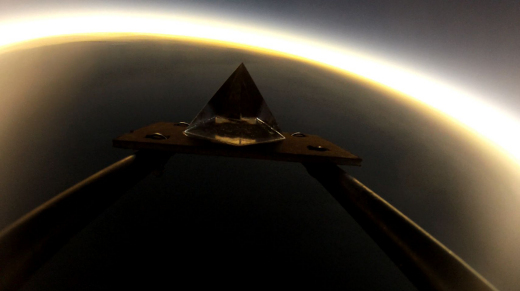
You can have it for $159.95. With the sun, Earth, and Moon perfectly aligned, the faces of the 5-sided crystal caught the reflection of the eclipsed sun. Watch the video! The pyramid comes with a gift card showing the crystal floating at the top of Earth's atmosphere and passing through the Moon's shadow. The interior of the card tells the story of the flight and confirms that this gift has been to the edge of space and back again.
Far Out Gifts: Earth to Sky Store
All sales support hands-on STEM education
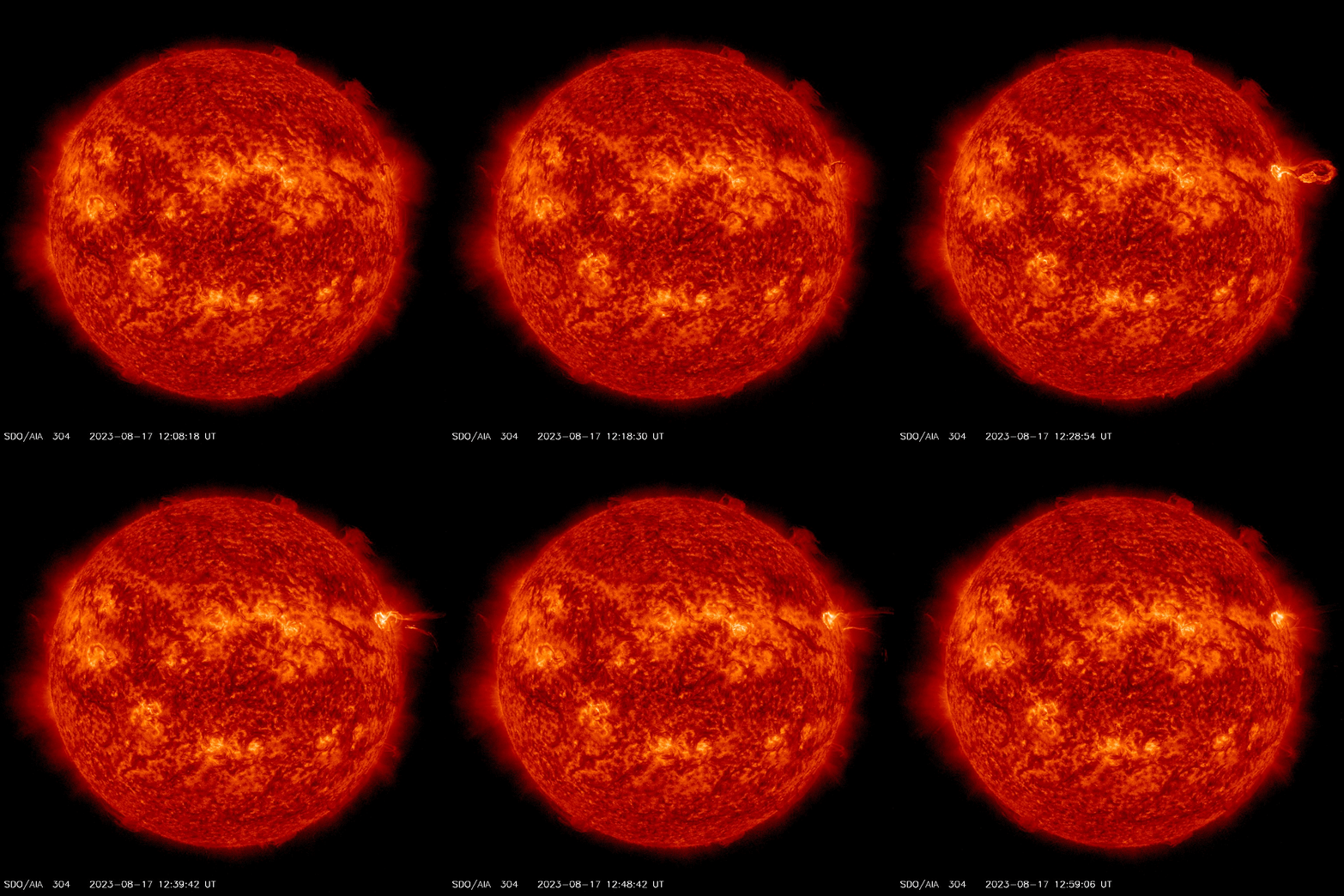
A MAGNIFICENT SPIRAL: Spiral shapes are at the heart of many solar explosions. We'll explain why below, but first take a look at this magnificent spiral photographed Aug. 17th by German astrophotographer Harald Paleske:
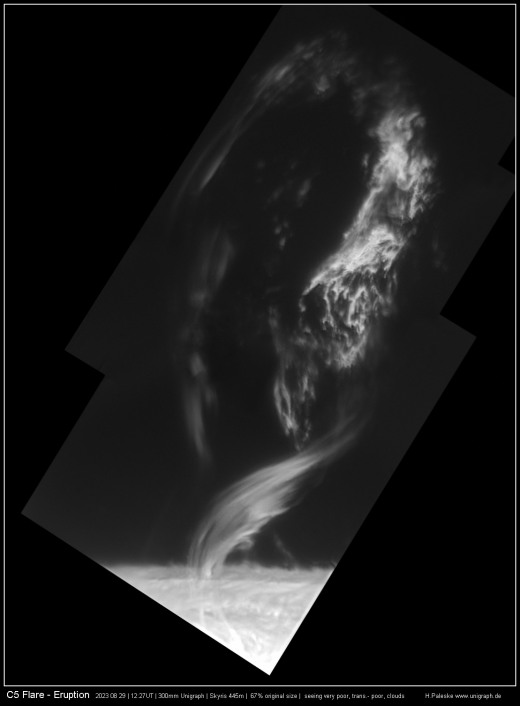
"I caught this C5-class solar flare at the edge of the sun using my new 300mm mirror Unigraph solar telescope," says Paleske. "I find the spiral structure beautiful."
Why spiral? Imagine you are holding a thick rubber band, one end of the loop in each hand. Start twisting--twist, twist, twist--until you can't twist the rubber band any more. It is taut and laden with energy. Now let go. Crack! The rubber band untwists with a painful explosive snap.
Physics teachers often liken magnetic fields to rubber bands, because they stretch and twist in the same way. When a sunspot's magnetic field becomes overtorqued (like that rubber band in the example) it can release its energy in the form of an explosively unfurling spiral--a.k.a., a "solar flare."
NASA's Solar Dynamics Observatory caught the same spiraling flare in motion (movie). Paleske's high-resolution photo, however, is the more beautiful of the two.
Realtime Space Weather Photo Gallery
Free: Spaceweather.com Newsletter