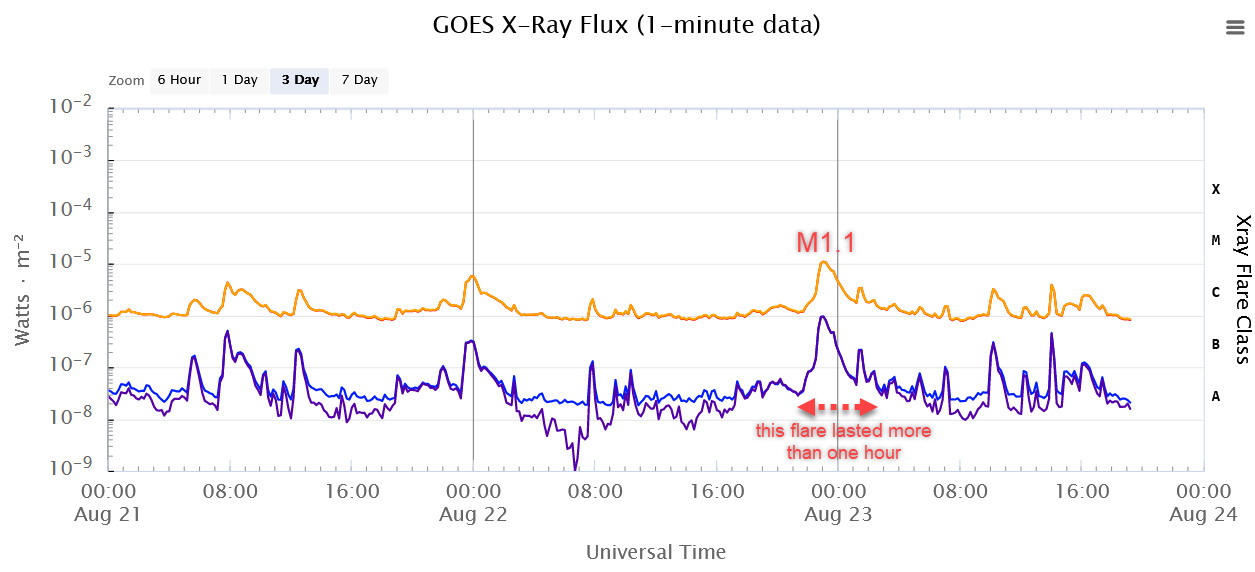
M-CLASS SOLAR FLARE (UPDATED): Last night's M1.1-class solar flare (image) was a dud. Although the explosion lasted long enough to lift a CME out of the sun's atmosphere, it apparently did not. SOHO coronagraph images show no sign of a significant coronal mass ejection. Solar flare alerts: SMS Text
DO SUNSPOTS MAKE CLOUDS ON NEPTUNE? A new paper in the research journal Icarus offers dramatic proof that solar activity can affect planetary weather. The big surprise: The planet is Neptune, 2.5 billion miles from the sun. Images taken by the Hubble Space Telescope over a period of 28 years show bright clouds forming in sync with the 11-year solar cycle:
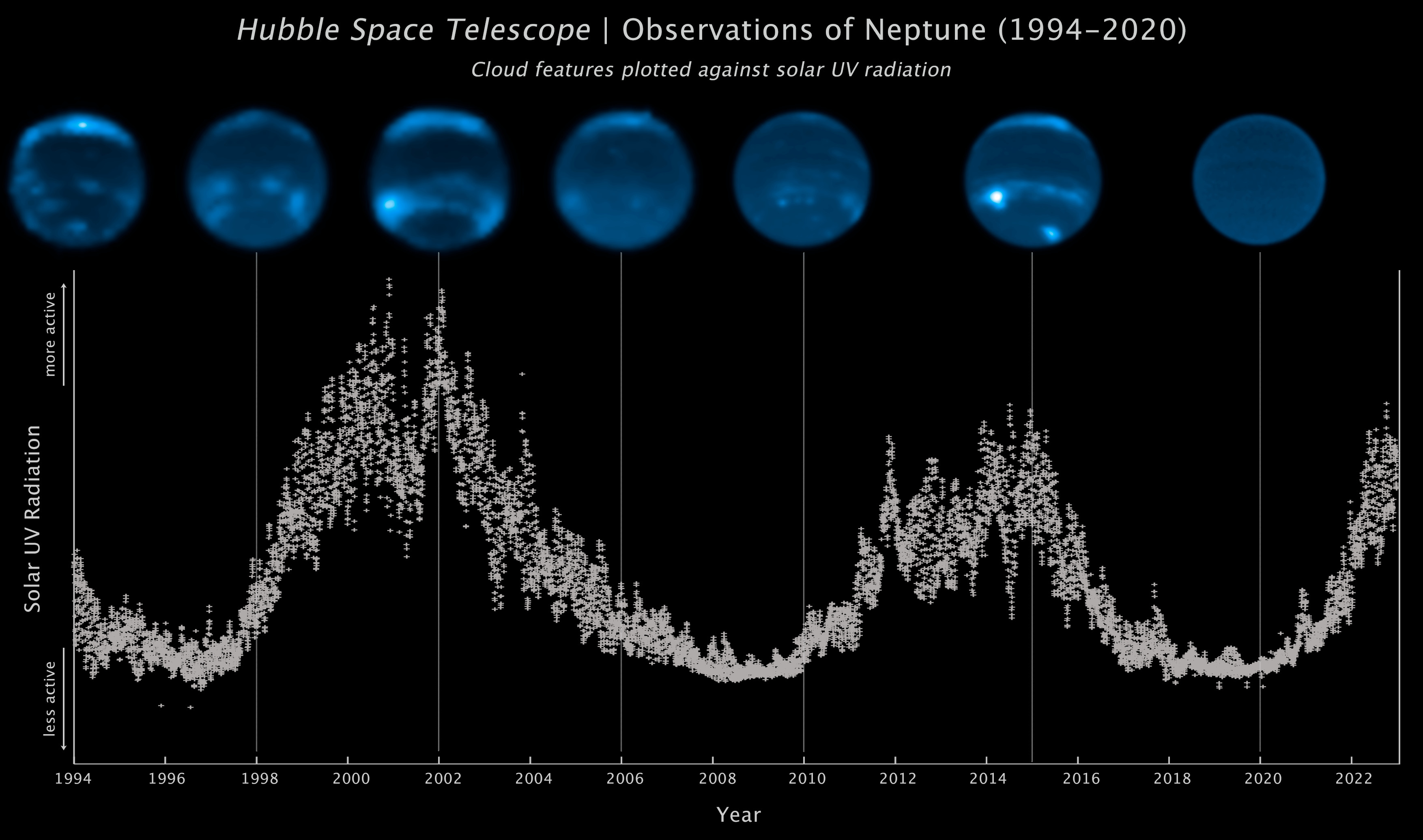
Above: Near-infrared images of clouds on Neptune compared to the 11-year solar cycle
The connection between Neptune and solar activity is surprising to planetary scientists because Neptune is our solar system's farthest major planet. It receives only 0.1% of the sunlight we get on Earth. Yet Neptune's cloudy weather seems to be driven by solar activity, and not the planet's four seasons, which each last approximately 40 years.
Other planets in our solar system don't behave this way. While clouds on Earth may be influenced by the solar cycle, the modulation is no more than a few percent; and even that small amount is controversial. Neptune's clouds, on the other hand, are bright, flamboyant and global. Their correlation with the solar cycle is obvious at a glance.
Chavez and her colleagues believe they have an explanation.
"Our findings support the theory that the sun's ultraviolet rays, when strong enough, may be triggering a photochemical reaction that ultimately leads to high-altitude clouds on Neptune," says Imke de Pater, emeritus professor of astronomy at UC Berkeley and a senior co-author of the study.
Their paper describes how UV rays from the sun (which are strongest when the sunspot number is high) penetrate Neptune's upper atmosphere and break apart molecules of methane gas. This sets off a chemical reaction yielding hydrocarbons (C𝑥H𝑦). If these hydrocarbons sink into the atmosphere, they could condense to form hazes and clouds.
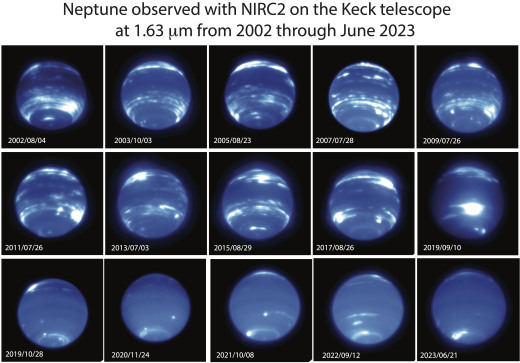
Above: 21 years of images from the Keck Observatory in Hawaii confirm Hubble's observations. [more]
Why doesn't this happen on every planet? "Neptune is unique," says de Pater. Unlike other planets in our solar system, Neptune has a lot of methane in its stratosphere. (How it gets there is a mystery, but that's another story.) Solar UV rays have little trouble reaching the gas and kick-starting cloud formation.
Realtime Space Weather Photo Gallery
Free: Spaceweather.com Newsletter
SOLAR ECLIPSE CRYSTAL PYRAMID: On Aug. 21, 2017, during the Great American Solar Eclipse, the students of Earth to Sky Calculus launched 11 space weather balloons from the path of totality. The armada soared into the stratosphere, touching the shadow of the Moon more than 100,000 feet above Earth's surface. This pyramid hitched a ride:
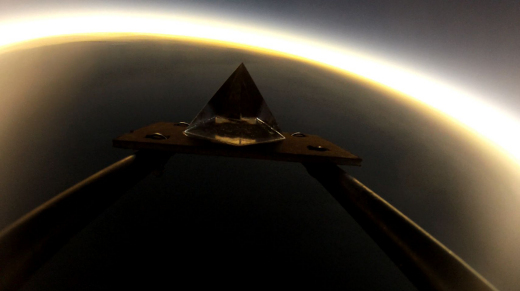
You can have it for $159.95. With the sun, Earth, and Moon perfectly aligned, the faces of the 5-sided crystal caught the reflection of the eclipsed sun. Watch the video! The pyramid comes with a gift card showing the crystal floating at the top of Earth's atmosphere and passing through the Moon's shadow. The interior of the card tells the story of the flight and confirms that this gift has been to the edge of space and back again.
Far Out Gifts: Earth to Sky Store
All sales support hands-on STEM education
Realtime Aurora Photo Gallery
Free: Spaceweather.com Newsletter