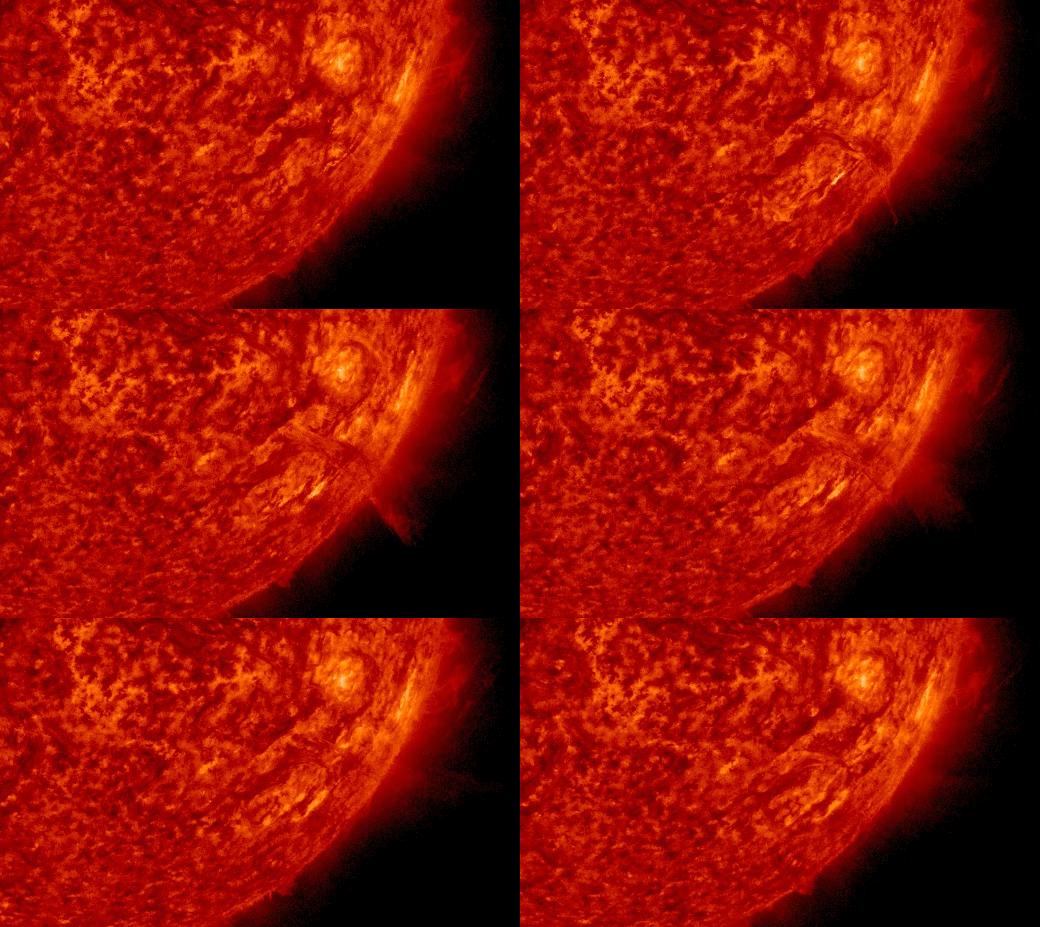
GEOMAGNETIC STORM WATCH (G1): A magnetic filament erupted near the sun's southwestern limb on Aug. 23rd (movie). The debris might graze Earth's magnetic field on Aug. 27th, according to NOAA models. A glancing blow could spark G1-class geomagnetic storms with auroras around the Arctic Circle. Aurora alerts: SMS Text

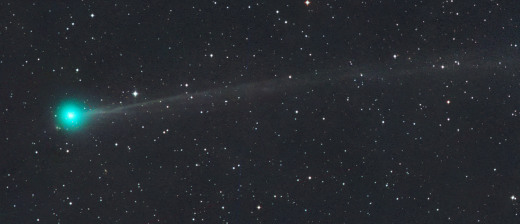
HYPERBOLIC COMET UPDATE: Comet Nishimura (C/2023 P1) is falling toward the sun for a close encounter on Sept. 13th. Currently, it is just outside the orbit of Venus, and accelerating toward Mercury's orbit. Austrian astronomer Michael Jaeger photographed the hyperbolic comet on Aug. 24th and found that it has grown a 1-degree-long tail:
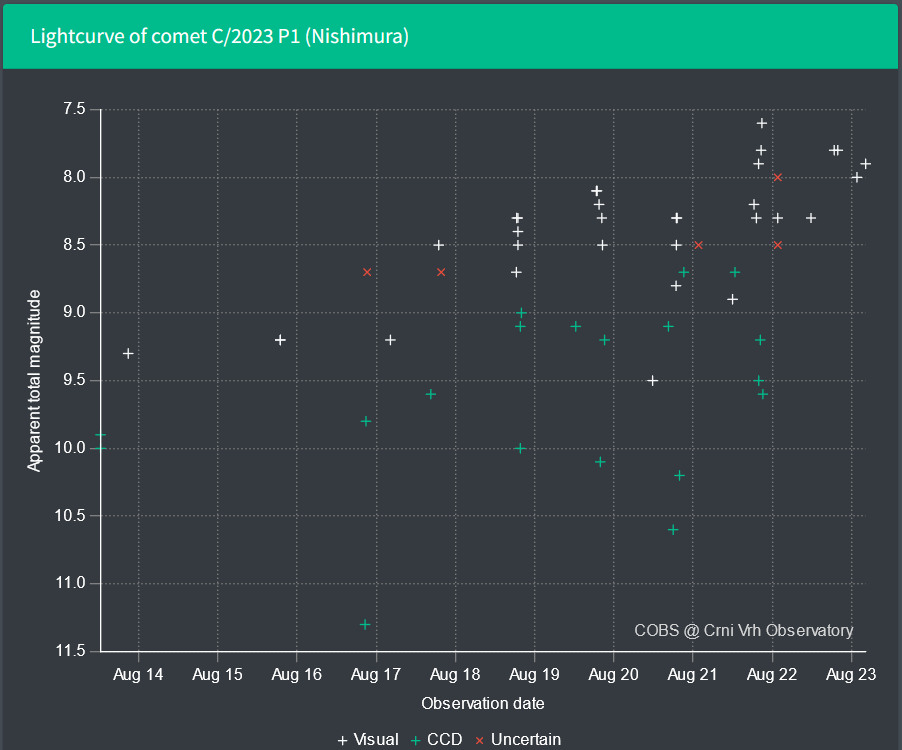
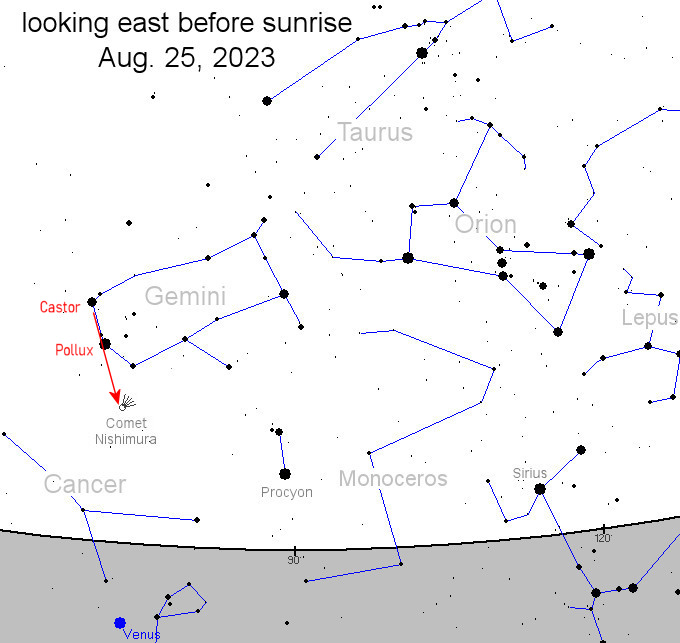
Since it was discovered in mid-August, Comet Nishimura has more than tripled in brightness--a sign that it is feeling the heat of the approaching sun. Its green head now shines like an 8th magnitude star. Friday morning, Aug. 25th, is a good time to observe it. Drawing a line through the brightest stars of Gemini (Castor and Pollux) leads directly to the comet in the morning predawn sky: finder chart.
Realtime Comet Photo Gallery
Free: Spaceweather.com Newsletter
DO SUNSPOTS MAKE CLOUDS ON NEPTUNE? A new paper in the research journal Icarus offers dramatic proof that solar activity can affect planetary weather. The big surprise: The planet is Neptune, 2.5 billion miles from the sun. Images taken by the Hubble Space Telescope over a period of 28 years show bright clouds forming in sync with the 11-year solar cycle:
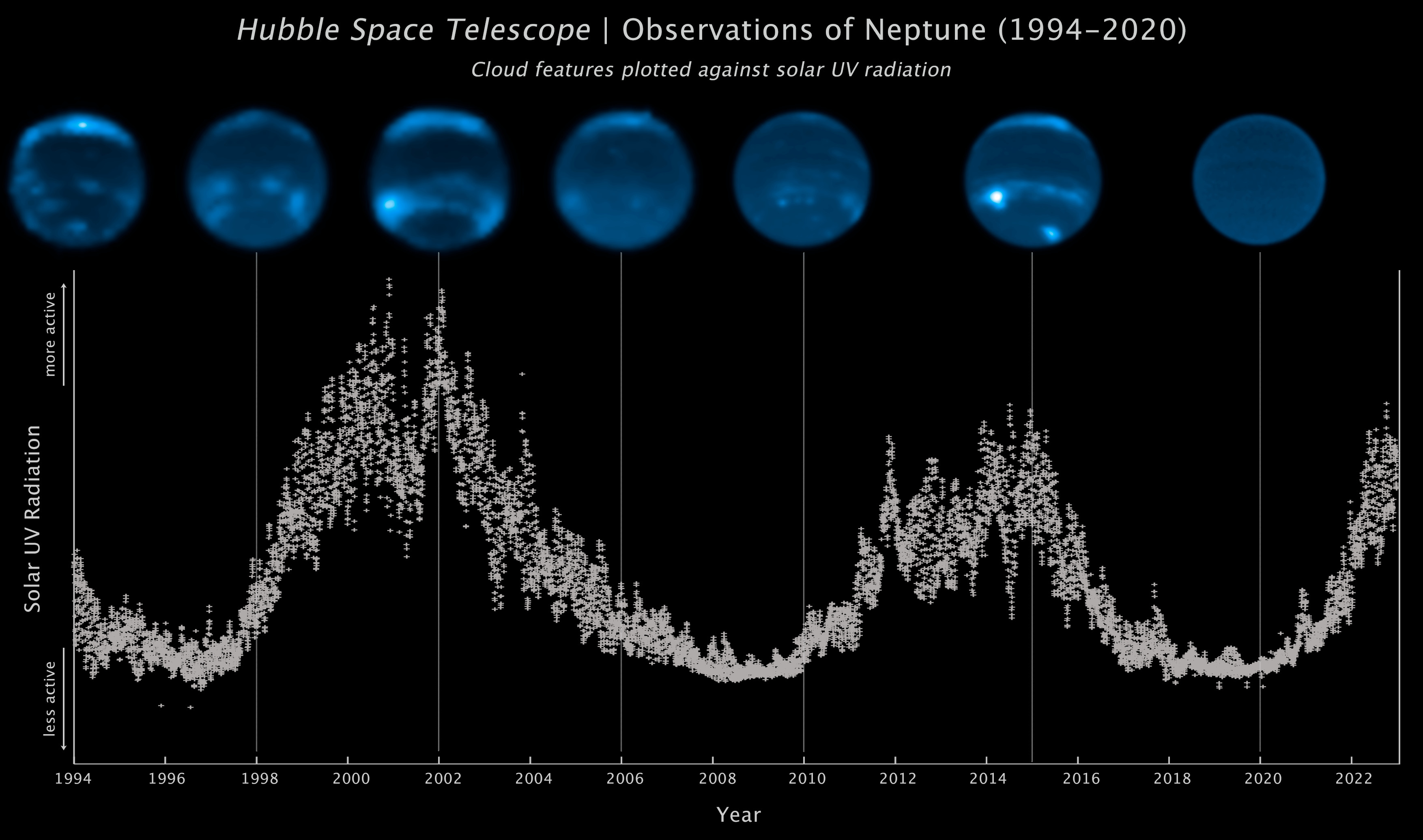
Above: Near-infrared images of clouds on Neptune compared to the 11-year solar cycle
The connection between Neptune and solar activity is surprising to planetary scientists because Neptune is our solar system's farthest major planet. It receives only 0.1% of the sunlight we get on Earth. Yet Neptune's cloudy weather seems to be driven by solar activity, and not the planet's four seasons, which each last approximately 40 years.
Other planets in our solar system don't behave this way. While clouds on Earth may be influenced by the solar cycle, the modulation is no more than a few percent; and even that small amount is controversial. Neptune's clouds, on the other hand, are bright, flamboyant and global. Their correlation with the solar cycle is obvious at a glance.
Chavez and her colleagues believe they have an explanation.
"Our findings support the theory that the sun's ultraviolet rays, when strong enough, may be triggering a photochemical reaction that ultimately leads to high-altitude clouds on Neptune," says Imke de Pater, emeritus professor of astronomy at UC Berkeley and a senior co-author of the study.
Their paper describes how UV rays from the sun (which are strongest when the sunspot number is high) penetrate Neptune's upper atmosphere and break apart molecules of methane gas. This sets off a chemical reaction yielding hydrocarbons (C𝑥H𝑦). If these hydrocarbons sink into the atmosphere, they could condense to form hazes and clouds.
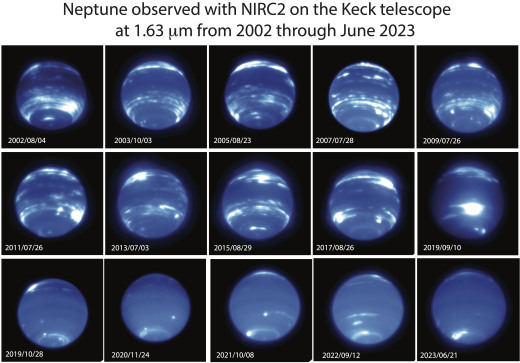
Above: 21 years of images from the Keck Observatory in Hawaii confirm Hubble's observations. [more]
Why doesn't this happen on every planet? "Neptune is unique," says de Pater. Unlike other planets in our solar system, Neptune has a lot of methane in its stratosphere. (How it gets there is a mystery, but that's another story.) Solar UV rays have little trouble reaching the gas and kick-starting cloud formation.
Realtime Space Weather Photo Gallery
Free: Spaceweather.com Newsletter
HUMOROUS "I LOVE YOU MORE" PENDANT: It's made of sterling silver and it will make you laugh: The "I Love You More" Space Pendant shows a cute money gazing at a golden banana inside a silver heart. The students of Earth to Sky Calculus thought it was hilarious, so on June 20th they flew it to the stratosphere:
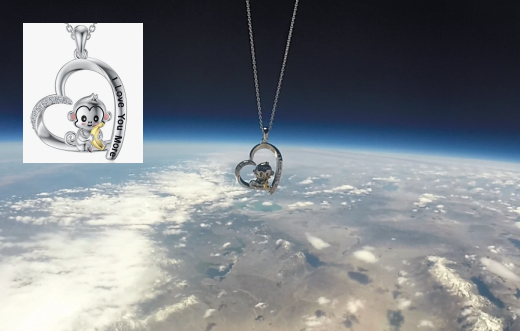
You can have it for $134.95. Engraved with the words, "I love you more," the pendant makes a great gift for romantic partners with a sense of humor. It comes with a greeting card showing the pendant in flight and telling the story of its journey to the stratosphere and back again.
Far Out Gifts: Earth to Sky Store
All sales support hands-on STEM education
Realtime Aurora Photo Gallery
Free: Spaceweather.com Newsletter