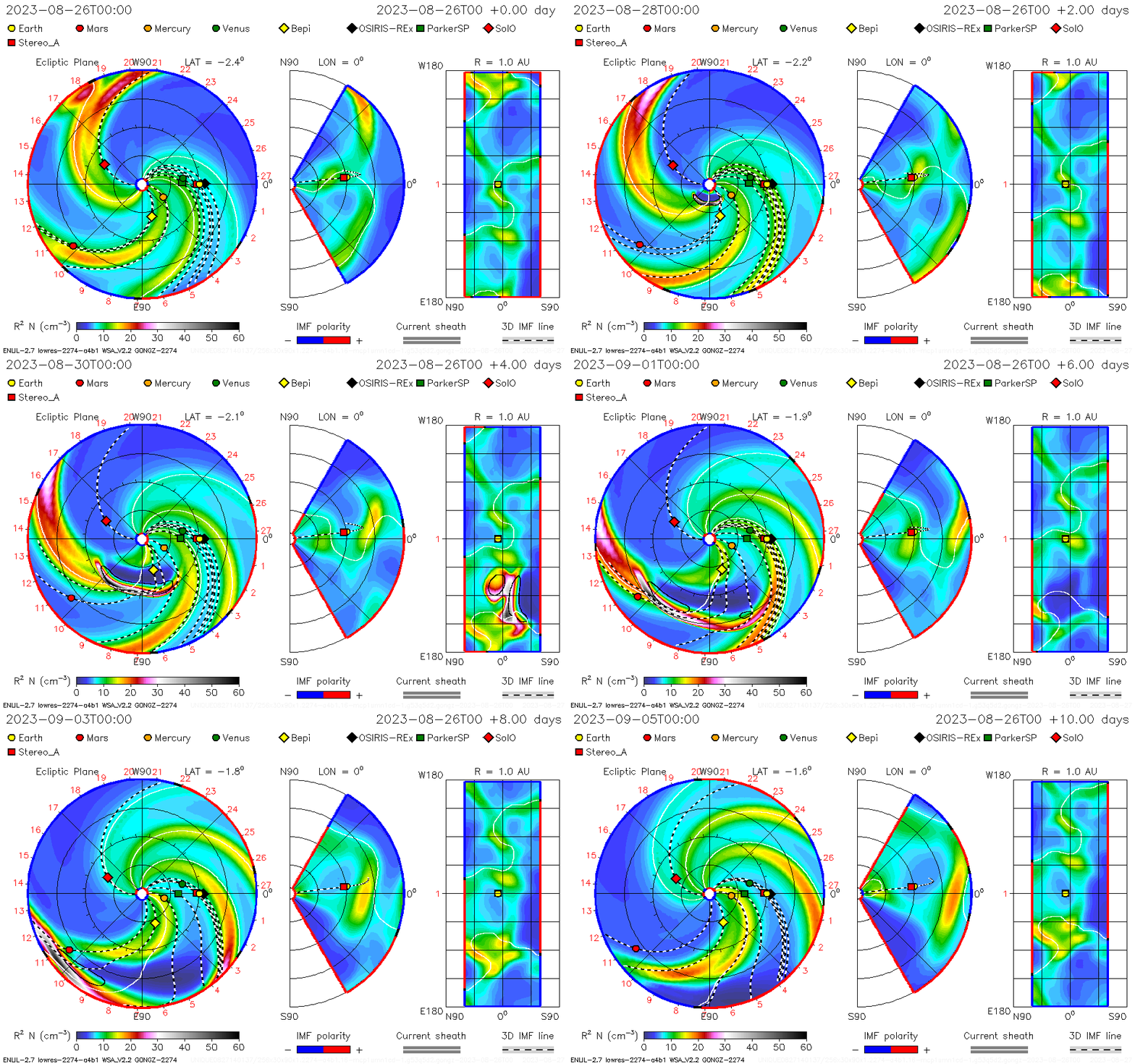
A CME IS HEADING FOR MARS: Over the weekend, an M1-class solar flare near the sun's eastern limb hurled a CME toward Mars. A NASA model suggests it will hit the Red Planet on Sept. 1st. The impact could spark ultraviolet auroras and erode a small amount of the Martian atmosphere. Solar flare alerts: SMS Text
THE SUPER BLUE MOON: This week, a quirky mixture of science, hyperbole and folklore will cause millions of people to go outside and stare at the sky. We're talking about the Super Blue Moon. This is what it will look like:
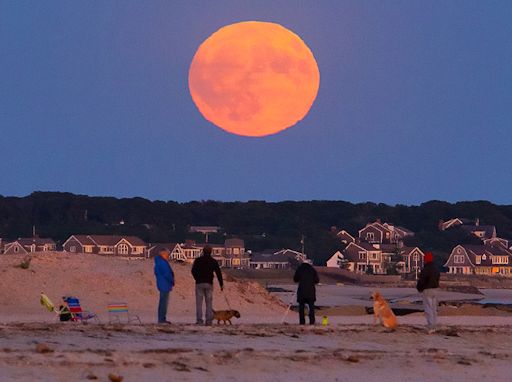
Above: A "supermoon" over Cape Cod on Oct. 15, 2016. Credit: Chris Cook.
The Super Blue Moon on Wednesday evening, Aug. 30th, will look a lot like an ordinary full Moon. However, there are three things that make it special.
First, the science: This week's full Moon is the biggest and brightest of 2023. Astronomers call it a "perigee moon." The Moon's orbit is an ellipse with one side ("perigee") about 50,000 km closer than the other ("apogee"). Full Moons that occur on the perigee side of the Moon's orbit are extra big and bright. This week's Moon will become full within 9 hours of perigee, making it the closest full Moon of the year (357,181 km away).
Next, the hyperbole: About 10 years ago, many science journalists and even some astronomers started calling perigee Moons "supermoons." A supermoon is 8% bigger and 15% brighter than an average full Moon. Would you call Clark Kent "super" if he were only 8% faster and 15% stronger than an average human? No, but let's roll with it! People love super things.
Finally, the folklore: You've probably heard the expression "Once in a blue Moon." It means "rare." Modern folklore provides a more precise definition. When there are two full Moons in a calendar month, the second one is "blue." Such blue moons come along every 2 to 3 years. August already had one full Moon on Aug. 2nd; now it is about to have another (blue) one on Aug. 30th.

By the way, the Moon won't literally turn blue. Most blue Moons are pale gray when they are high in the sky, or orange when they are rising and setting. If you actually see blue, it could mean that a volcano is erupting or a wildfire is nearby. Run!
In summary, this week's Super Blue Moon will be about 15% bigger and more gorgeous than an average moon. Go out after sunset on Aug. 30th, look east, and watch it rise into the darkening summer sky. If you take a picture, submit it here.
Realtime Space Weather Photo Gallery
Free: Spaceweather.com Newsletter
LASER-ETCHED SUPERMOON: On Aug. 22nd, the students of Earth to Sky Calculus launched a cosmic ray balloon to the stratosphere. This laser-etched Moon cube went along for the ride, ascending to an altitude of 101,140 feet:
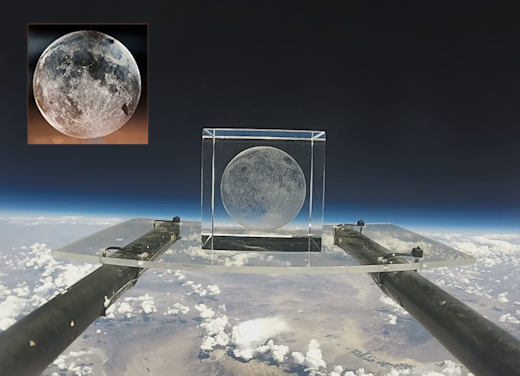
You can have it for $119.95. The students are selling these cubes as a fund-raiser for their cosmic ray ballooning program. It's an authentic representation of the Moon, with all of the craters, mountains and lava plains accurately portrayed.
The Moon-cube comes with a unique gift card showing the item floating at the top of Earth's atmosphere. The interior of the card tells the story of the flight and confirms that this gift has been to the edge of space and back again.
Far Out Gifts: Earth to Sky Store
All sales support hands-on STEM education
GIANT JELLYFISH SPRITE: On Aug. 14th, Stanislav Kaniansky of Latky, Slovakia, took one of the most detailed pictures ever of a sprite, an exotic form of upward-directed lightning. For a fraction of a second it towered over the landscape like a massive jellyfish:

"The thunderstorm was about 320 km away, giving me a good view of the atmosphere just above the cloudtops," says Kaniansky. "I captured the sprite using a Sony A7III digital camera with a 3.2 second exposure (ISO 8000)."
From bushy head to tentacled-toe, the sprite stretched about 50 km, ten times taller than a normal bolt of lightning. Balls of light only a few hundred meters in diameter dot the jellyfish's waist and tentacles.
Only a few decades ago, such a photo might be considered outlandish and possibly even fake. Now, however, we know that sprites are real and that they can assume a variety of fantastic shapes. See for yourself.

Realtime Sprite Photo Gallery
Free: Spaceweather.com Newsletter
Realtime Aurora Photo Gallery
Free: Spaceweather.com Newsletter