RARE BLUE SUPERMOON TONIGHT: When the sun goes down tonight, step outside and look east. That bright silvery orb rising into the twilight is a rare Blue Supermoon. It is 15% brighter than average full Moons and capable of raising unusually high perigean spring tides. Got a picture? Submit it here.
SPACE STATION TRANSITS THE SUN: One of these sunspots is not like the others. Yesterday in Athens, Greece, astronomer Anthony Ayiomamitis watched a winged shape flit across the face of the sun:
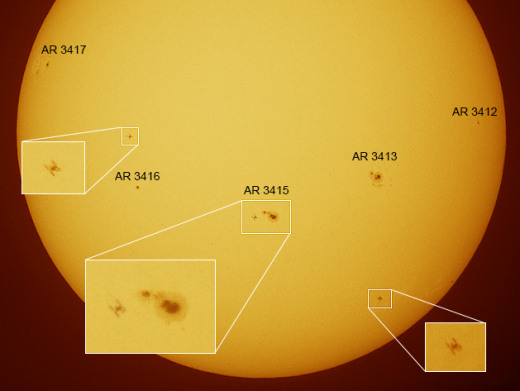
"It was China's Tiangong space station," says Ayiomamitis. "The 96,000 kg outpost (1/3rd the size of the ISS by volume) crossed the sun in only 0.69 seconds."
Tiangong is currently crewed by 3 Chinese astronauts. China hopes to keep at least that many astronauts on board for at least 10 years. Next year, Tiangong will be joined by a Hubble-class space telescope, which will share the space station's orbit and be able to dock with it for repairs and upgrades. Named Xuntian, which translates to "survey the heavens," the telescope will have a 2 m-diameter mirror, slightly smaller than that of Hubble, but with a field of view 300 times greater.
This means solar transits of Tiangong in 2024 might actually be double transits: One space station and one telescope. Stay tuned for that!
Realtime Space Weather Photo Gallery
Free: Spaceweather.com Newsletter
WHO NEEDS A SOLAR FLARE? The sun did not flare on Aug. 23rd, and there was no geomagnetic storm. Nevertheless, rural skies in Europe filled with a green aurora-like glow. Sylvain Chapeland sends this picture from a mountain in the south of France:
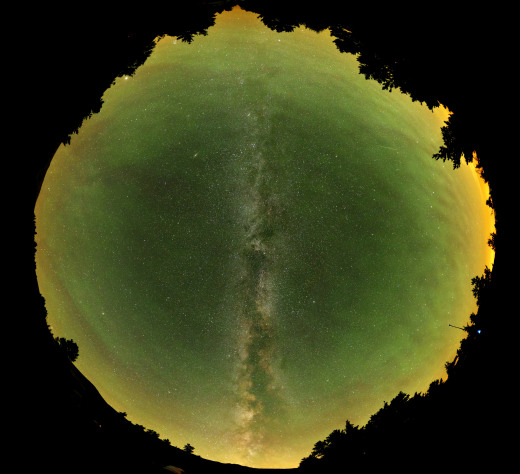
"I spent a week stargazing in the mountains and enjoyed excellent observing conditions," says Chapeland. "On the last night I noticed significant airglow. I never saw before such bright green airglow in all directions."
It might look like aurora, but it is not. Green airglow is produced by photochemistry in Earth's upper atmosphere. Approximately 95 km above Earth's surface, there is a layer of air where oxygen atoms (O) and oxygen molecules (O2) co-exist. When O bumps into O2, the collision creates a spark of green light--airglow.
Solar Max is boosting this process. Higher-than-normal UV radiation from the active sun is heating Earth's upper atmosphere, increasing the rate of O vs. O2 collisions. The resulting airglow may be observed on very dark nights from anywhere on Earth. It is often invisible to the naked eye, but an easy target for digital cameras with nighttime exposures. Got a picture? Submit it here.
Realtime Airglow Photo Gallery
Free: Spaceweather.com Newsletter
LASER-ETCHED SUPERMOON: On Aug. 22nd, the students of Earth to Sky Calculus launched a cosmic ray balloon to the stratosphere. This laser-etched Moon cube went along for the ride, ascending to an altitude of 101,140 feet:
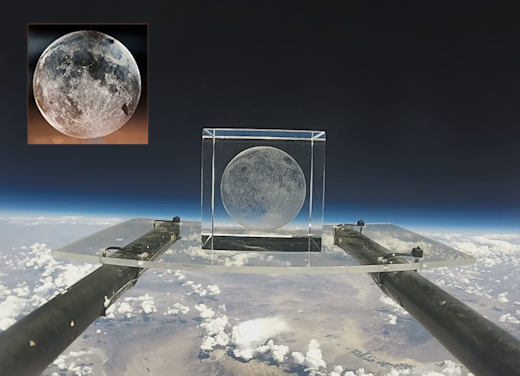
You can have it for $119.95. The students are selling these cubes as a fund-raiser for their cosmic ray ballooning program. It's an authentic representation of the Moon, with all of the craters, mountains and lava plains accurately portrayed.
The Moon-cube comes with a unique gift card showing the item floating at the top of Earth's atmosphere. The interior of the card tells the story of the flight and confirms that this gift has been to the edge of space and back again.
Far Out Gifts: Earth to Sky Store
All sales support hands-on STEM education
Realtime Aurora Photo Gallery
Free: Spaceweather.com Newsletter