FARSIDE SOLAR ACTIVITY: Two spectacular CMEs billowed away from the farside of the sun on Sept. 5th: movie. The source was farside sunspot AR3413, which has become hyperactive only days after turning away from Earth. The two CMEs appear to be heading in the direction of sundiving Comet Nishimura; see below! Solar flare alerts: SMS Text

THE SUN JUST RIPPED OFF A COMET'S TAIL: Comet Nishimura (C/2023 P1) is getting close to the sun--and it shows. On Sept. 2nd, a solar storm hit the comet at point blank range and ripped off its tail. Astrophotographer Michael Jaeger recorded the event from AZM Martinsberg, Austria:
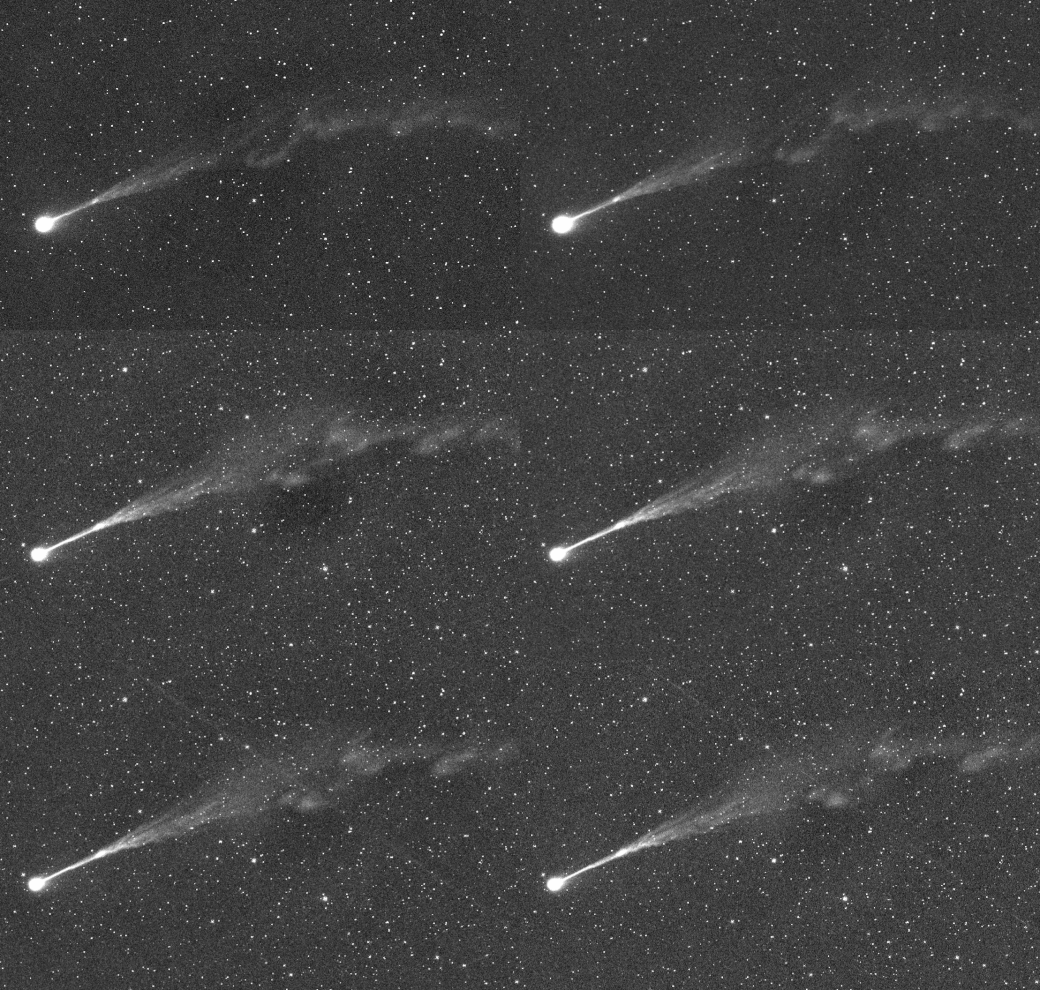
Researchers call this a "disconnection event." It's caused by a CME (or fast solar wind stream) hitting the comet. One of the earliest recorded examples of this phenomenon occured in April 2007 when NASA’s STEREO-A spacecraft watched a CME strike Comet Encke and rip its tail completely off: movie.

Comet Nishimura is plunging toward the sun for a 0.22 AU close encounter on Sept. 17th. Right now, it is about halfway between the orbits of Mercury and Venus (0.48 AU) where CMEs are denser and stronger than they are when they reach Earth at 1.0 AU.
The CME that hit Comet Nishimura probably came from active sunspot AR3413, which is almost directly facing the comet. This CME, in particular, had the right timing and direction to cause the disconnection event Jaeger observed:
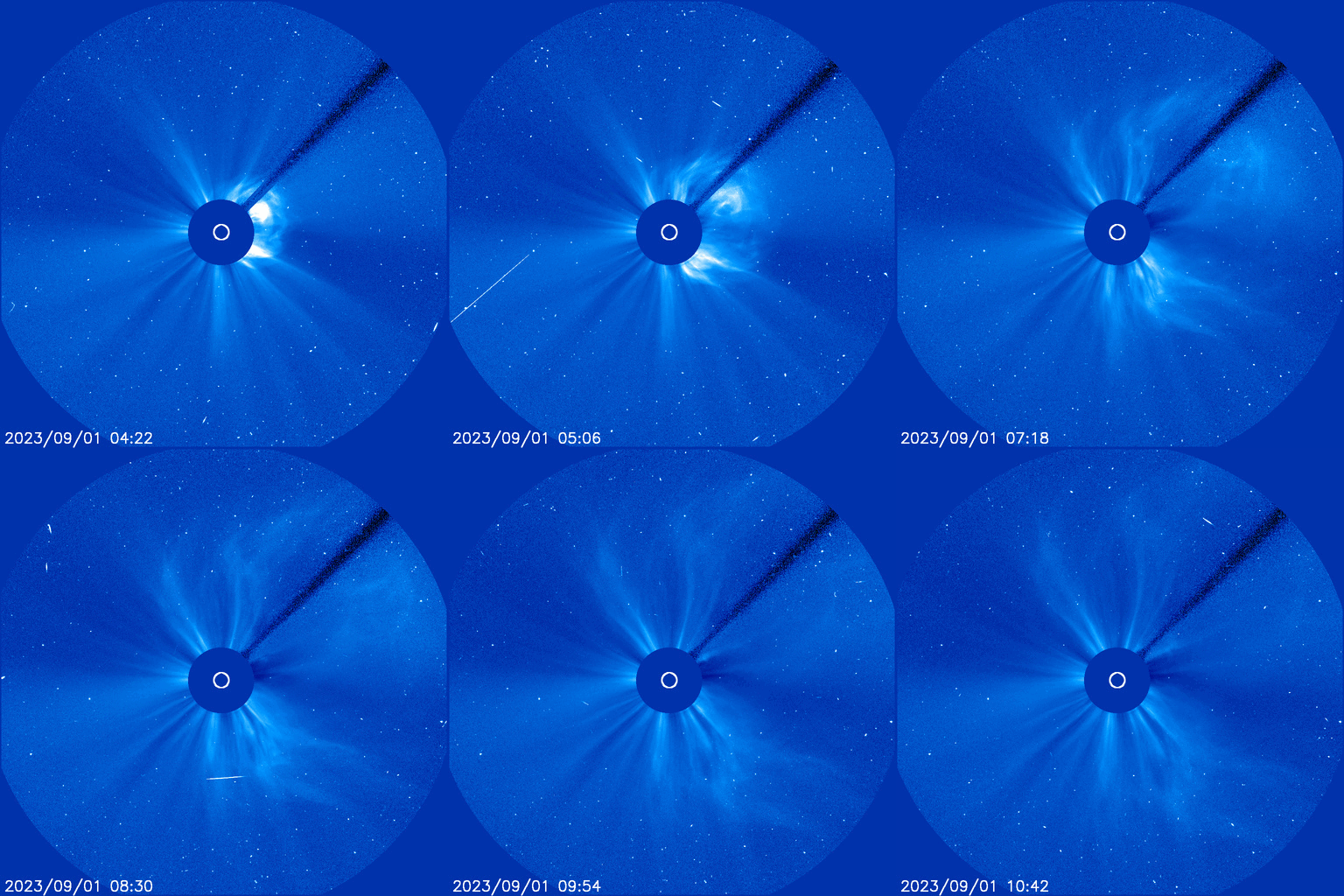
Nishimura's tail has since grown back--but it might not last for long. More CMEs are heading its way. SOHO recorded at least two moving in the right general direction on Sept. 5th. Experienced amateur astronomers who photograph Comet Nishimura in the early morning sky (observing tips, sky map) may be able to record their impact. Got a picture? Submit it here.
Realtime Comet Photo Gallery
Free: Spaceweather.com Newsletter
18K GOLD "ALWAYS AND FOREVER" PENDANT: Are you looking for an unforgettable gift? Consider the Always and Forever Space Pendent. On Aug. 29, 2023, the students of Earth to Sky Calculus launched it to the stratosphere onboard a cosmic ray research balloon:
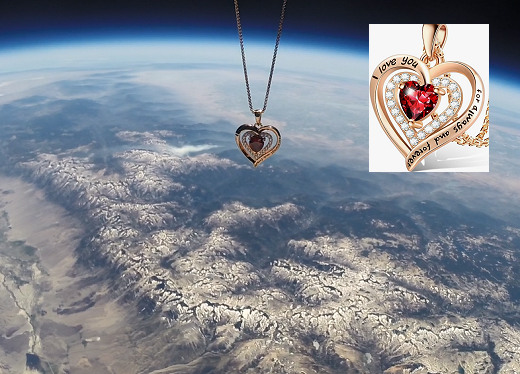
You can have it for $199.95. Engraved with the words "I love you always and forever", this 18K gold-plated sterling silver pendant has a heart-shaped ruby crystal in the middle surrounded by a ring of glittering 5A cubic zirconia nuggets. It is a visually striking premium pendant that makes a once-in-a-lifetime anniversary or birthday gift.
The students are selling space pendants to pay the helium bill for their cosmic ray ballooning program. Each one comes with a greeting card showing the jewelry in flight and telling the story of its trip to the stratosphere and back again.
Far Out Gifts: Earth to Sky Store
All sales support hands-on STEM education
THINGS YOU SEE WHILE HOG HUNTING: The night sky is changing. How? Daryn Morran sends this report from West Texas: "On Sept. 3rd, we were out hog hunting using night vision optics. I just happened to look up at the stars thru the night scope, and I saw something bizarre." He held his cell phone to the scope and photographed a UFO-like spectacle:

"I saw a line of 18 dots, pretty evenly spaced in a near perfect line, moving slowly thru the sky," says Morran. "The entire strand of lights then suddenly disappeared in the middle of the sky."
Morran witnessed a train of Starlink satellites en route to their final orbit approximatrely 500 km above Earth. Because they were still in low-Earth orbit at the time Morran saw them, the satellites could easily enter our planet's shadow. Indeed, that's what happened, and they "suddenly disappeared."
Only 5 years ago, sightings like this never happened. Then SpaceX started launching Starlink satellites, the first batch of 60 leaving Earth in May 2019. Now there are more than 4700. SpaceX has single-handedly tripled the number of active satellites orbiting our planet.
In fact, only 15 minutes after Morran caught this train of Starlinks in his hog rifle, SpaceX launched 21 more Starlinks from Cape Canaveral. It was SpaceX's 62nd orbital mission of 2023, setting a new record for most flights in a year.
The International Astronomical Union (IAU) is deeply concerned about the increasing number of satellites circling Earth. Bright satellite trains disrupt astronomy, interfere with nocturnal wildlife, and threaten the dark-sky heritage of all humanity. Learn more about this issue from the IAU's Center for Protection of the Dark and Quiet Sky.
Realtime Space Weather Photo Gallery
Free: Spaceweather.com Newsletter
Realtime Aurora Photo Gallery
Free: Spaceweather.com Newsletter