CME TO HIT SOLAR ORBITER: Europe's Solar Orbiter is about to get some good data. A farside halo CME is heading straight for the spacecraft. According to a NASA model, the CME will strike on Sept. 9th, giving Solar Orbiter's sensors an in situ view of the storm. The source of the blast was probably active sunspot AR3414, now transiting the farside of the sun. Solar flare alerts: SMS Text


BRIGHT COMET AT DAWN: Set your alarm for dawn. There is a bright comet in the morning sky. You probably can't see it with the naked eye, but even short exposures with digital cameras are picking up the starlike head and long tail of Comet Nishimura (C/2023 P1):

"This is a 4-second exposure (ISO 1600) from the Cabreja Volcano in Vega de San Mateo on Gran Canaria Island," says photographer Frank A. Rodriguez. "I used a Canon EOS R digital camera. What a nice comet!"
Comet Nishimura is plunging toward the sun for a close encounter inside the orbit of Mercury on Sept. 17th. Increasing heat is causing it to brighten rapidly. Latest estimates of the comet's brightness place it at magnitude +4.5. In a dark sky, this would be visible to the unaided eye, but the morning sky is not dark. Cameras are required to observe the comet; a few seconds of exposure time are enough for a very nice picture.

This morning in Germany, Michael Luy photographed the comet before breakfast:

"Visually it is a real challenge. I needed binoculars to see its shimmering green core," says Luy. "Hanging low in the eastern sky, Comet Nishimura is quickly outshone by the advancing dawn. This may not be a comet for the 'general public,' but it is a nice target for comet hunters and nature lovers."
Resources: observing tips, sky map, light curve, 3D orbit.
Realtime Comet Photo Gallery
Free: Spaceweather.com Newsletter
STERLING SILVER 'PLANET CAT' PENDANT: It's a far-out gift for the cat-lover in your life: The Planet Cat Pendant. The sterling silver jewelry touched space on April 29, 2023, when it hitched a ride onboard an Earth to Sky Calculus cosmic ray research balloon.
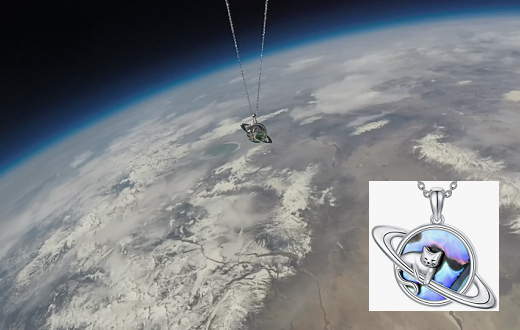
You can have it for $169.95. The students of Earth to Sky Calculus are selling space pendants to support their cosmic ray ballooning program. Each one comes with a greeting card showing the pendant in flight and telling the story of its journey to the stratosphere and back again.
The students are selling space pendants to pay the helium bill for their cosmic ray ballooning program. Each one comes with a greeting card showing the jewelry in flight and telling the story of its trip to the stratosphere and back again.
Far Out Gifts: Earth to Sky Store
All sales support hands-on STEM education
Realtime Space Weather Photo Gallery
Free: Spaceweather.com Newsletter
Realtime Aurora Photo Gallery
Free: Spaceweather.com Newsletter