A LARGE SUNSPOT IS FACING EARTH: Big sunspot AR3423 has doubled in size since Friday; the active region is now more than 100,000 km wide with four primary dark cores wider than Earth. The sunspot's magnetic poles are well separated, so it does not yet pose a threat for strong flares. If this changes, however, the sunspot is directly facing Earth, so any strong flares will be geoeffective. Solar flare alerts: SMS Text
BRIGHT COMET AT DAWN: Set your alarm for dawn. There is a bright comet in the morning sky. You probably can't see it with the naked eye, but even relatively short exposures with digital cameras are picking up the starlike head and long tail of Comet Nishimura (C/2023 P1):
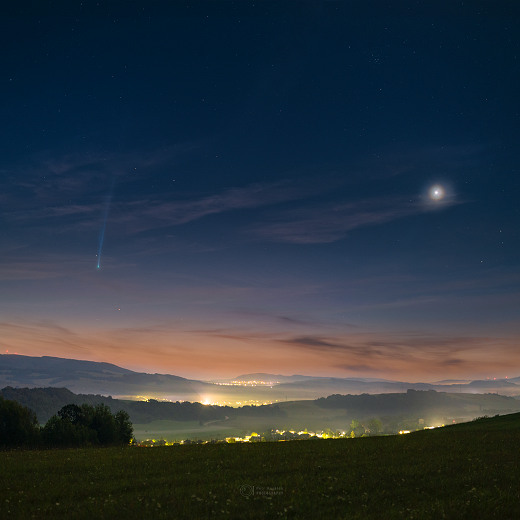
"This morning, I was successful in photographing Comet Nishimura from Zahradne, Slovakia, where the comet appeared against a slightly cloudy sky," says Petr Horalek. "Its tail is so bright that I could see it easily in my backyard telescope."
Latest estimates of the comet's brightness place it at magnitude +4.5. In a dark sky, this would be visible to the unaided eye, but the morning sky is not dark. Cameras are required to pluck the comet from the twilight of dawn. Many photographers are finding that less than a minute of exposure time is enough for a nice picture. Horalek's photo is a stack of 20 second shots (ISO 800).

The mornings ahead will be more difficult. Comet Nishimura is plunging toward the sun for a close encounter inside the orbit of Mercury on Sept. 17th. Increasing glare will challenge astrophotographers.
"I am truly happy I made it at least once to see this beauty!" says Horalek.
Resources: observing tips, sky map, light curve, 3D orbit.
Realtime Comet Photo Gallery
Free: Spaceweather.com Newsletter
STOLAR SYSTEM CRYSTAL BALL: Are you looking for a far-out gift? Consider the Solar System Crystal Ball. Watch the video as the orb travels to the stratosphere onboard an Earth to Sky Calculus cosmic ray balloon, stretching and inverting the incredible landscape of the Sierra Nevada mountains behind it:
You can have it for $229.95. The students are selling these crystal balls to pay for their cosmic ray ballooning program. The 800 gram sphere contains a model of the Solar System, including the sun, eight planets and their moons. It makes an incredible gift for anyone interested in space.
Each one comes with a unique gift card showing the item at the edge of space and telling the story of its flight. All proceeds support Earth to Sky Calculus and hands-on STEM research.
Far Out Gifts: Earth to Sky Store
All sales support hands-on STEM education
Realtime Space Weather Photo Gallery
Free: Spaceweather.com Newsletter
Realtime Aurora Photo Gallery
Free: Spaceweather.com Newsletter