SURPRISE GEOMAGNETIC STORM: An unexpected CME hit Earth's magnetic field on Sept. 12th (1237 UT), sparking a G2-class (Moderate) geomagnetic storm. The storm is subsiding now, but it is not finished. Global magnetometers are still registering off-and-on G1-class (Minor) activity. This means Arctic sky watchers should be alert for auroras after nightfall. Aurora alerts: SMS Text



During the storm, Viktor Szemán photographed these red atomic-oxygen auroras from Debraď, Slovakia:
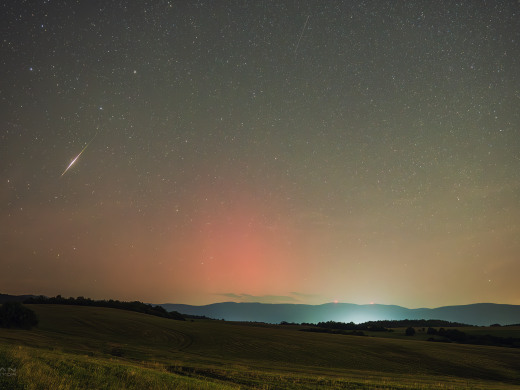
"I could not see the auroras with my naked eye, but it was visible with my camera," says Szemán. "During the 20 second exposure, a bright meteor zipped by--a lucky catch!"
There is an important lesson in Szemán's photo. Just because you can't see auroras doesn't mean they're not there. The 6300 Angstrom wavelength of red light from atomic oxygen is notoriously difficult for the human eye to detect. Cameras have no problem, though. So if a geomagnetic storm is underway, point your camera north and open the shutter (Szemán did this for 20s @ ISO 5000). You might be surprised by what it sees.
Realtime Aurora Photo Gallery
Free: Spaceweather.com Newsletter
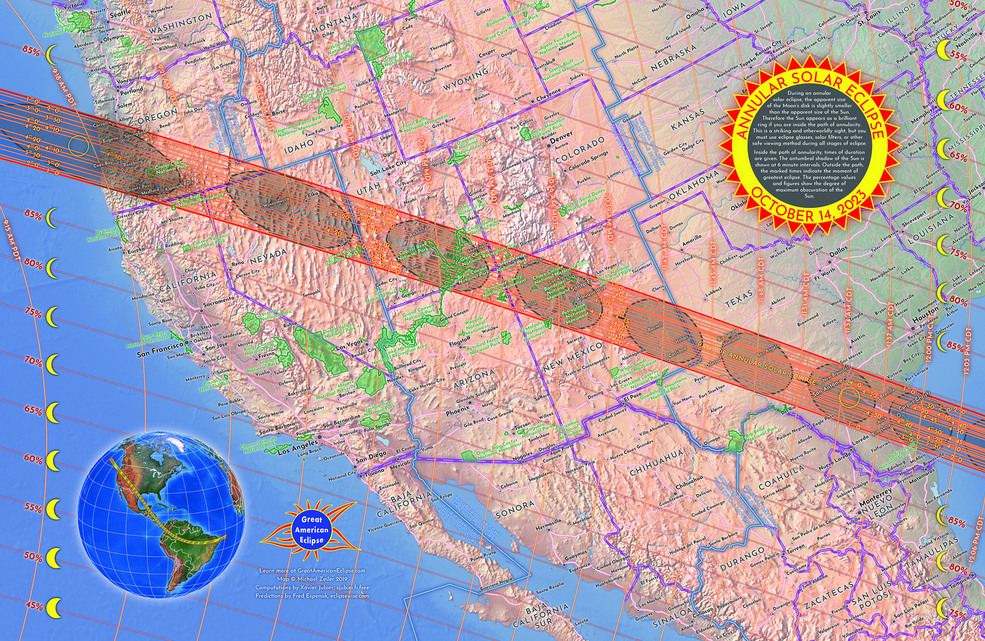
SOLAR ECLIPSE PENDANT: The students of Earth to Sky Calculus are about to try something never done before--to photograph the shadow of an annular solar eclipse from the stratosphere. On Oct. 14th, they'll launch a cosmic ray research balloon equipped with cameras to photograph the shadow zone of an eclipse over Nevada. You can support the flight by buying a Solar Eclipse Pendant:
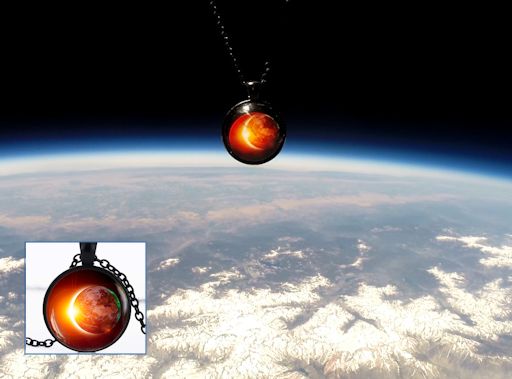
It's yours for $99.95. The students launched this pendant on July 17th. Floating at an altitude 105,000 feet above Earth’s surface, it made contact with space, experiencing temperatures as low as -63 C.
Buy the pendent now and for no additional charge we will fly it back to the stratosphere during the annular eclipse. Just make a note in the COMMENTS BOX of your shopping cart: "Fly my pendant again!"
Note: We have photographed the shadow of an eclipse before. Here's what the total eclipse of Aug. 21, 2017, looked like from the stratosphere over the Nebraska-Wyoming border:
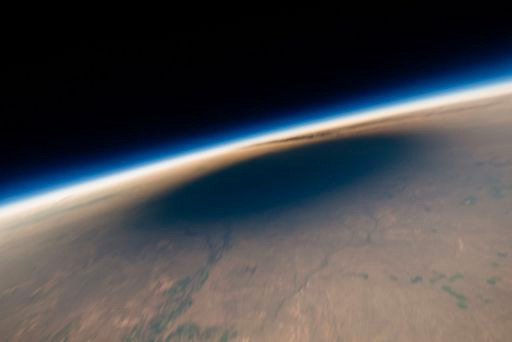
Total eclipses make deep black shadows, in this case blacking out more than 70 miles of terrain. What does the shadow of an *annular* eclipse look like? We hope to find out. It should be fuzzier around the edges, and not nearly as dark in the middle. An overview from the stratosphere could provide a unique picture.
Far Out Gifts: Earth to Sky Store
All sales support hands-on STEM education
Realtime Comet Photo Gallery
Free: Spaceweather.com Newsletter
Realtime Space Weather Photo Gallery
Free: Spaceweather.com Newsletter