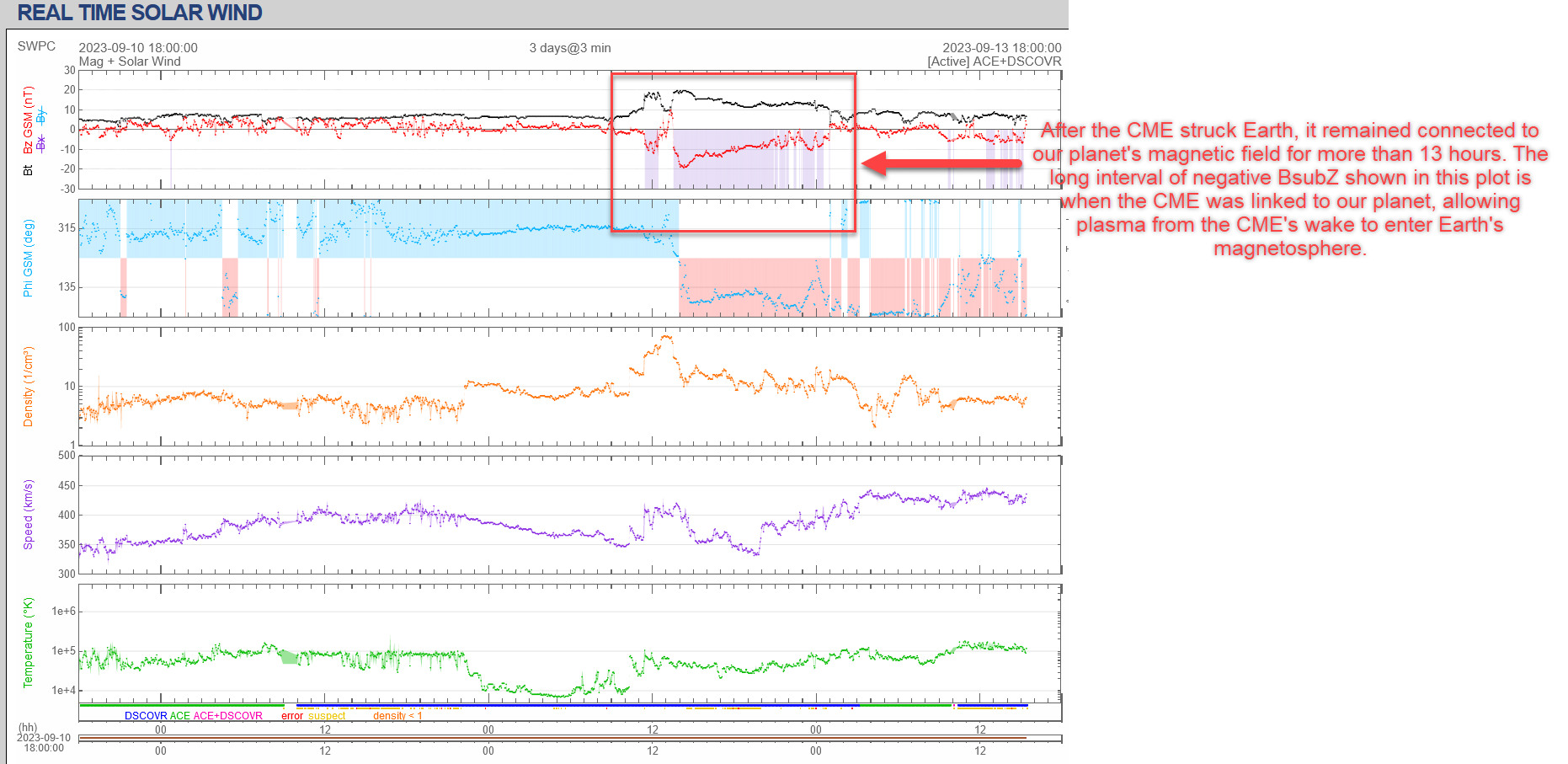
SURPRISE GEOMAGNETIC STORM: An unexpected CME hit Earth's magnetic field on Sept. 12th (1237 UT) and sparked a G2-class geomagnetic storm. Magnetically, the CME remained connected to our planet for more than 13 hours, allowing plasma from the CME's wake to enter Earth's magnetosphere. This fueled a display of auroras photographed as far south as Missouri (+40.2N) and Nebraska (+40.9N).


Matthew Merrell knew the storm was underway, and he waited anxiously for the sun to set over his home in central Minnesota. As darkness fell, he saw the auroras:

"It was a great start to the night with pillars visible as soon as the sky was dark enough," says Merrell. "By 10:00 pm it was just a gentle glow with very little motion."
Merrell witnessed only the subsiding tail-end of the storm, a G1-class event. At its G2 apex, the storm produced "BRIGHT" and "stunning" activity over Scotland, "massive rays" above Ireland, and an all-sky explosion of color over Iceland. Magnetometer needles in Britain swung wildly with more than 15 hours of dramatic undulations.
Forecasters did not see this coming. One surprised NOAA analyst called it a "stealthy CME." In retrospect, it was probably one of many relatively bright CMEs that left the sun on Sept. 8th, shown here in a 24 hour time-lapse from the Solar and Heliospheric Observatory (SOHO):
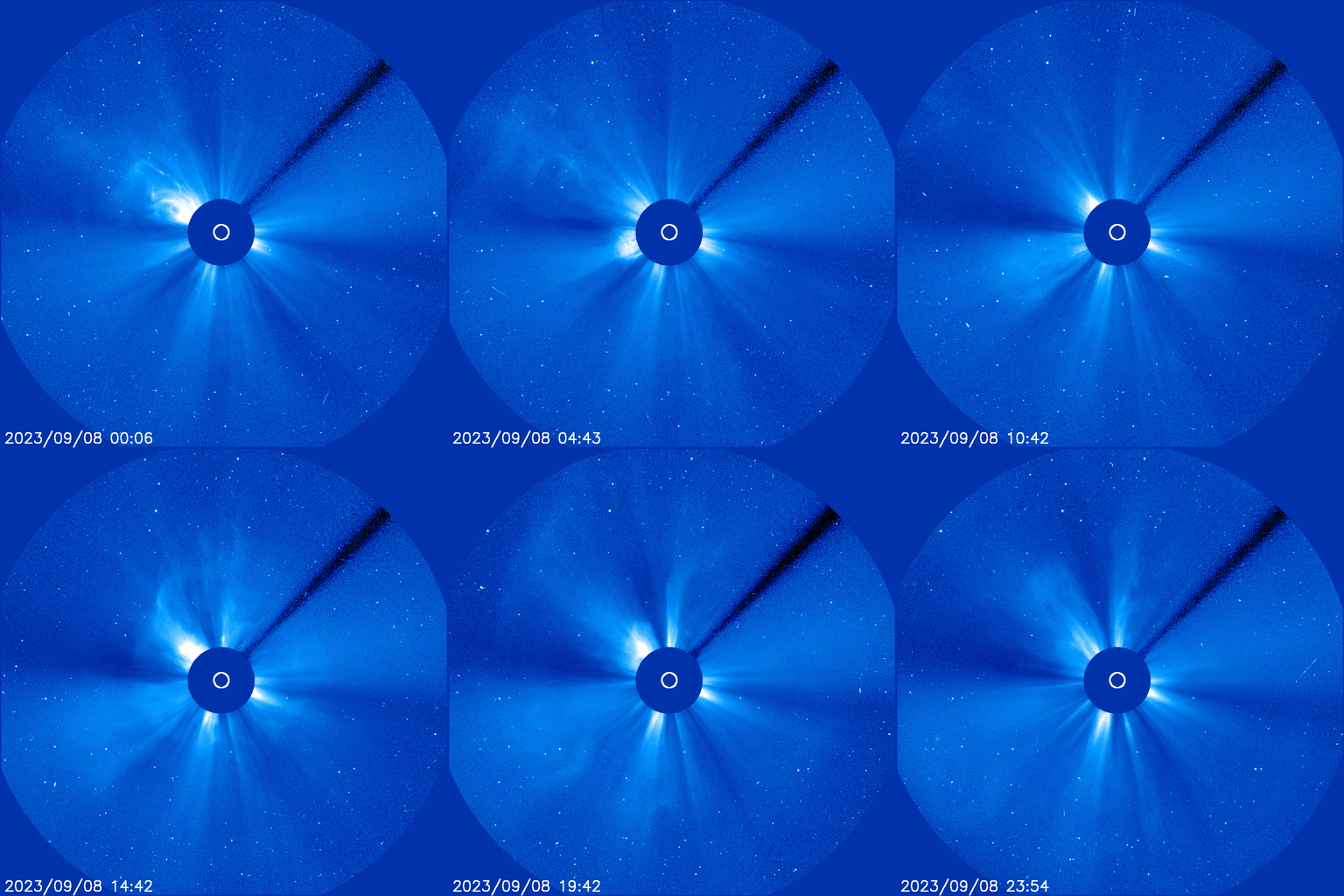
When the sun spits out so many storm clouds in such a short period of time, it can be hard to disentangle them and figure out which one(s) might be heading toward Earth. Notably the movie includes a distinct halo CME. At the time it was thought to be a farside event, but maybe it is the one that hit Earth yesterday.

Did you miss the storm? Subscribers to our Space Weather Alert Service received instant text messages when the CME arrived and, later, when the geomagnetic storm began. Give it a try! Aurora alerts: SMS Text
Realtime Aurora Photo Gallery
Free: Spaceweather.com Newsletter
SOLAR ECLIPSE PENDANT: The students of Earth to Sky Calculus are about to try something never done before--to photograph the shadow of an annular solar eclipse from the stratosphere. On Oct. 14th, they'll launch a cosmic ray research balloon equipped with cameras to photograph the shadow zone of an eclipse over Nevada. You can support the flight by buying a Solar Eclipse Pendant:
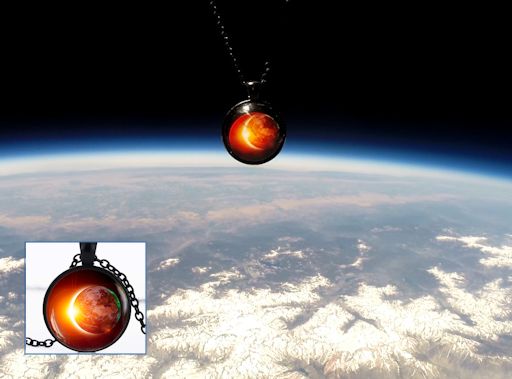
It's yours for $99.95. The students launched this pendant on July 17th. Floating at an altitude 105,000 feet above Earth’s surface, it made contact with space, experiencing temperatures as low as -63 C.
Buy the pendent now and for no additional charge we will fly it back to the stratosphere during the annular eclipse. Just make a note in the COMMENTS BOX of your shopping cart: "Fly my pendant again!"
Note: We have photographed the shadow of an eclipse before. Here's what the total eclipse of Aug. 21, 2017, looked like from the stratosphere over the Nebraska-Wyoming border:
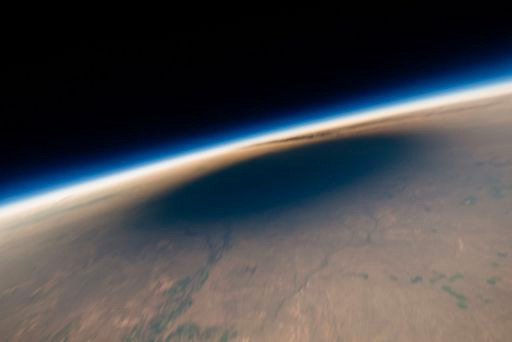
Total eclipses make deep black shadows, in this case blacking out more than 70 miles of terrain. What does the shadow of an *annular* eclipse look like? We hope to find out. It should be fuzzier around the edges, and not nearly as dark in the middle. An overview from the stratosphere could provide a unique picture.
Far Out Gifts: Earth to Sky Store
All sales support hands-on STEM education
Realtime Comet Photo Gallery
Free: Spaceweather.com Newsletter
Realtime Space Weather Photo Gallery
Free: Spaceweather.com Newsletter