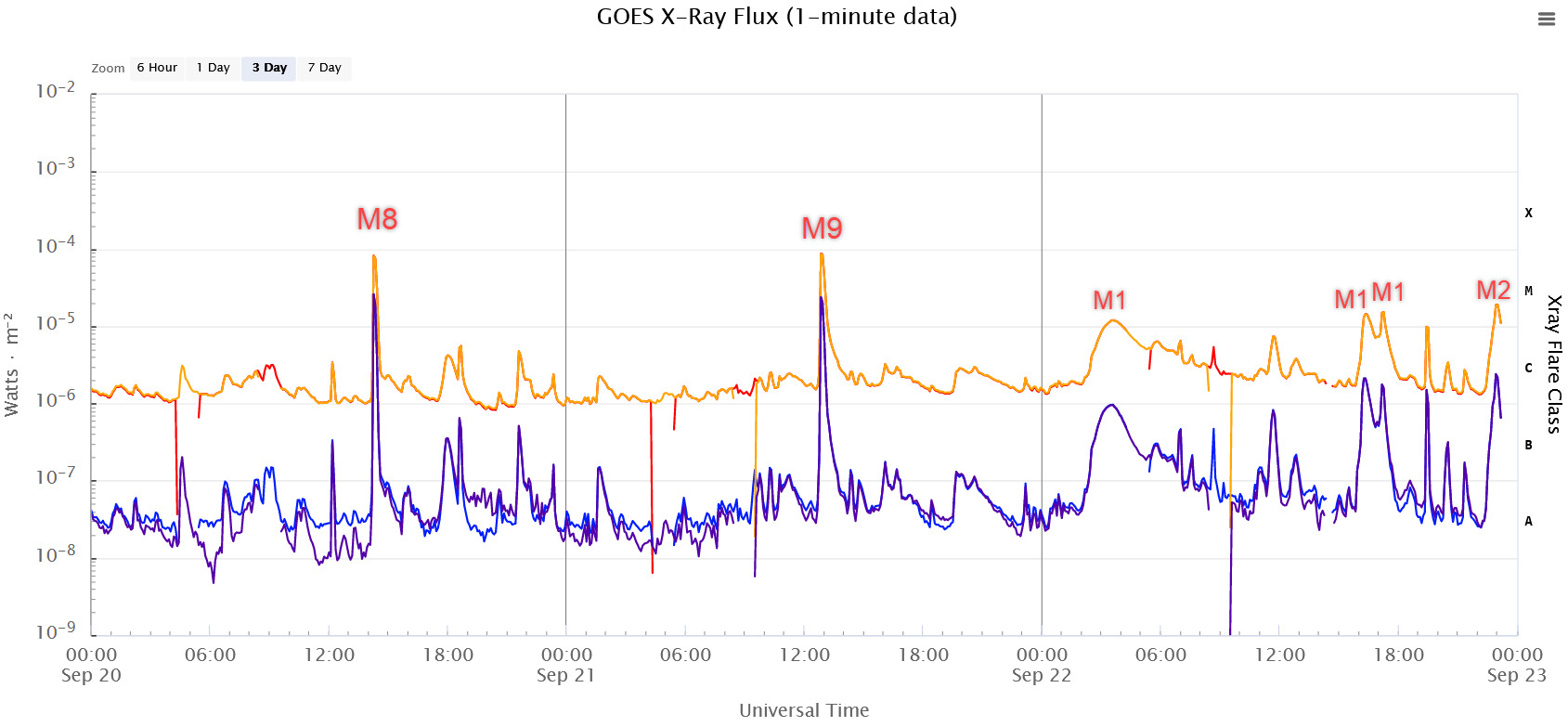
GEOMAGNETIC STORM WATCH (G1): Over the past few days, a series of M-class solar flares hurled multiple CMEs in the general direction of Earth. So many CMEs have left the sun since Sept. 20th, analysts are having trouble sorting them out and modeling their trajectories. Somewhere between two and four appear capable of grazing Earth's magnetic field between Sept. 23rd and Sept. 25th. Minor G1-class geomagnetic storms are possible on all those days. Aurora alerts: SMS Text

OSIRIS-REX RETURN CAPSULE--NAKED-EYE VISIBILITY? This weekend, NASA's OSIRIS-REx spacecraft will fly by Earth and drop off a sample of asteroid Bennu for researchers to the study. The return capsule will enter Earth’s atmosphere on Sunday morning, Sept. 24, at 7:42 a.m. PDT. Traveling about 27,650 mph, it will streak across Nevada before parachuting to Earth in the Utah desert:

Will the re-entry be visible to the human eye? Maybe. Seventeen years ago, meteor astronomer Dr. Peter Jenniskens of the SETI Institute led a NASA airborne mission to observe a similar re-entry of the Stardust capsule. He and his colleagues captured spectacular photos of the re-entry fireball. However, Stardust re-entered at night, OSIRIS-REx will do so in daylight, thus reducing its visibility.
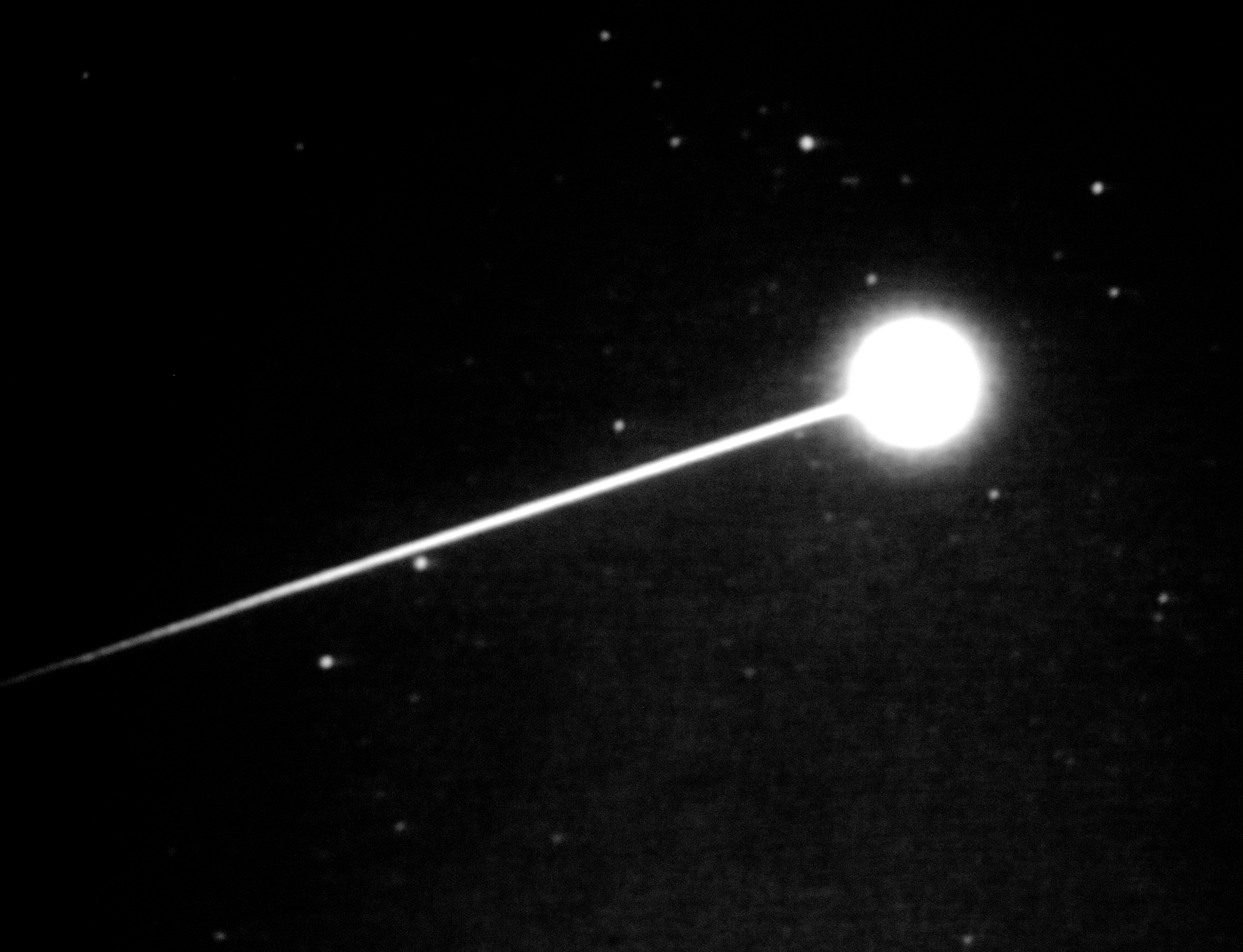
Jenniskens believes the OSIRIS-REx capsule *might* be visible to the naked-eye from a narrow corridor in eastern Nevada: "The OSIRIS-REx sample return capsule has similar mass and only slightly lower entry speed than the 2006 Stardust sample return capsule. Based on that, the OSIRIS-REx capsule will reach -5.1 magnitude for about 10 seconds around peak heating when viewed from the front at a distance of 100 km. Compare that to Venus at its brightest: -4.5 magnitude."
"Around peak heating, the capsule will pass over the town of Austin, Nevada," he continues. " Hence, visual observers in northeast Nevada who are located near Austin or further east as far as Elko or Ely, will see the capsule from the front or side and away from the rising Sun and should be able to see the entry by the naked eye, if the sky is clear."
Got a picture? Submit it here.
Realtime Space Weather Photo Gallery
Free: Spaceweather.com Newsletter
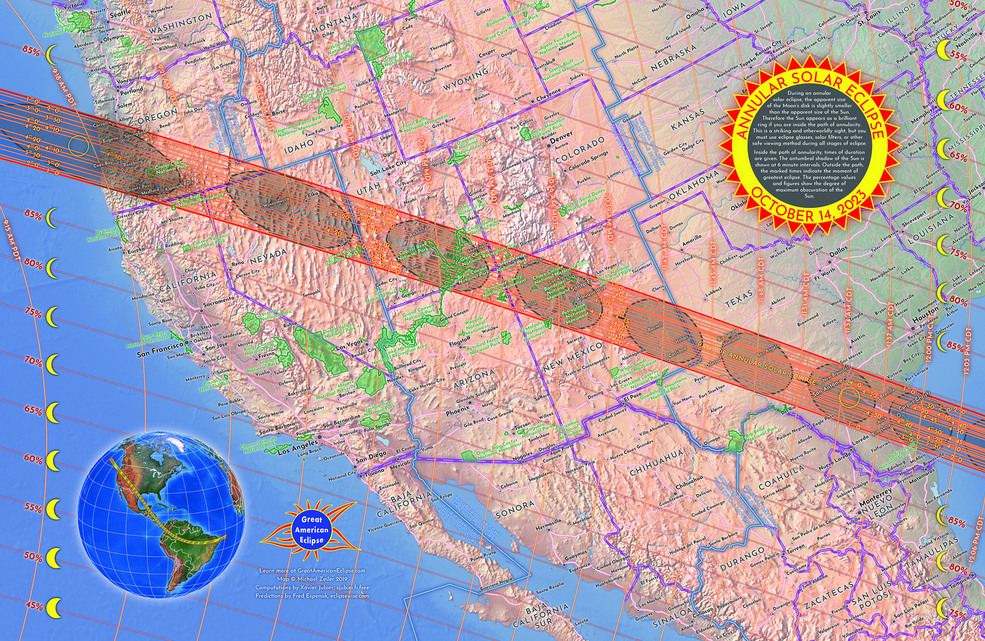
SOLAR ECLIPSE PENDANT: The students of Earth to Sky Calculus are about to try something never done before--to photograph the shadow of an annular solar eclipse from the stratosphere. On Oct. 14th, they'll launch a cosmic ray research balloon equipped with cameras to photograph the shadow zone of an eclipse over Nevada. You can support the flight by buying a Solar Eclipse Pendant:
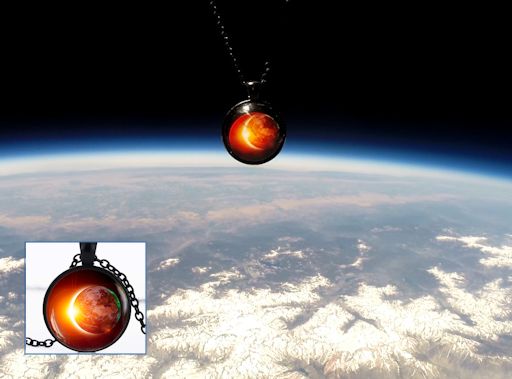
It's yours for $99.95. The students launched this pendant on July 17th. Floating at an altitude 105,000 feet above Earth’s surface, it made contact with space, experiencing temperatures as low as -63 C.
Buy the pendent now and for no additional charge we will fly it back to the stratosphere during the annular eclipse. Just make a note in the COMMENTS BOX of your shopping cart: "Fly my pendant again!"
Note: We have photographed the shadow of an eclipse before. Here's what the total eclipse of Aug. 21, 2017, looked like from the stratosphere over the Nebraska-Wyoming border:
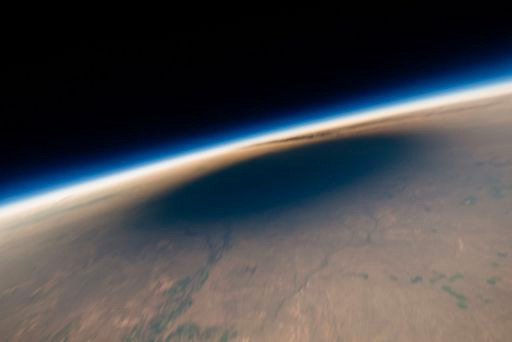
Total eclipses make deep black shadows, in this case blacking out more than 70 miles of terrain. What does the shadow of an *annular* eclipse look like? We hope to find out. It should be fuzzier around the edges, and not nearly as dark in the middle. An overview from the stratosphere could provide a unique picture.
Far Out Gifts: Earth to Sky Store
All sales support hands-on STEM education
Realtime Comet Photo Gallery
Free: Spaceweather.com Newsletter
Realtime Aurora Photo Gallery
Free: Spaceweather.com Newsletter