CHANCE OF FLARES TODAY: Don't be surprised if there's a solar flare today. Four of the ten sunspot groups now facing Earth have mixed-polarity magnetic fields with + and - signs in close proximity. It's a recipe for explosions. NOAA forecasters say there is a 40% chance of M-class flares and a 15% chance of X-flares on Sept. 27th. Aurora alerts: SMS Text
VAN GOGH WAVES IN THE MAGNETOSPHERE: When Vincent van Gogh painted "The Starry Night" in 1889, little did he know he was working at the forefront of 21st century astrophysics. A paper recently published in Nature Communications reveals that the same kind of waves pictured in the famous painting can cause geomagnetic storms on Earth.
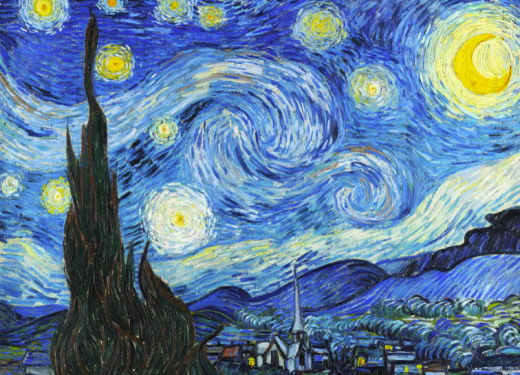
Above: Vincent van Gogh's 'Starry Night', which he painted in 1889: more
Physicists call them "Kelvin Helmholtz waves." They ripple into existence when streams of gas flow past each other at different velocities. Van Gogh saw them in high clouds outside the window of his asylum in Saint-Rémy, France. They also form in space where the solar wind flows around Earth's magnetic field.
"We have found Kelvin-Helmholtz waves rippling down the flanks of Earth's magnetosphere," says Shiva Kavosi of Embry–Riddle Aeronautical University, lead author of the Nature paper. "NASA spacecraft are surfing the waves, and directly measuring their properties."
This was first suspected in the 1950s by theoreticians who made mathematical models of solar wind hitting Earth's magnetic field. However, until recently it was just an idea; there was no proof the waves existed. When Kavosi's team looked at data collected by NASA's THEMIS and MMS spacecraft since 2007, they saw clear evidence of Kelvin Helmholtz instabilities.
"The waves are huge," says Kavosi. "They are 2 to 6 Earth radii in wavelength and as much as 4 Earth radii in amplitude."
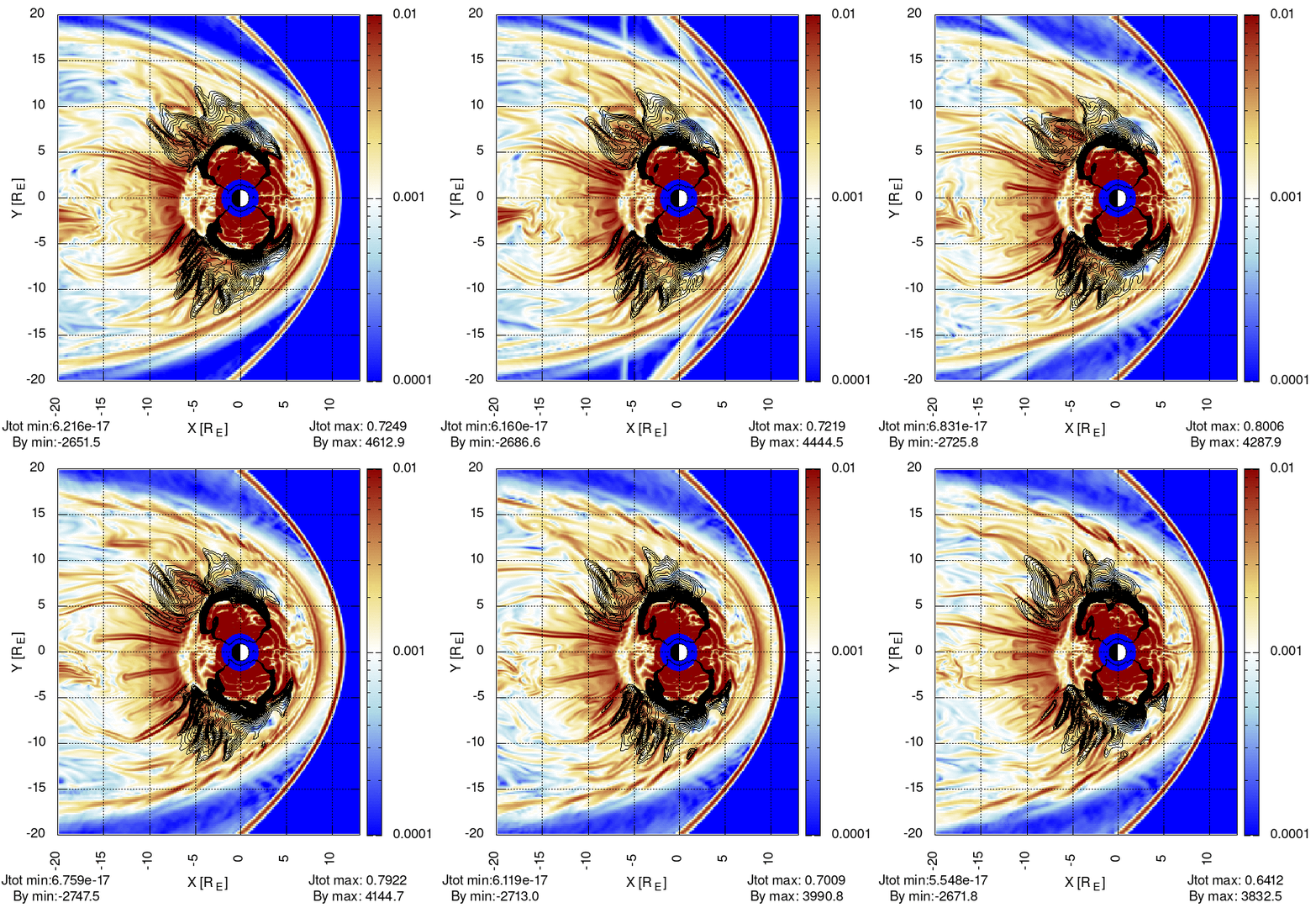
This computer model shows van Gogh waves moving down the flank of Earth's magnetosphere. Credit: Shiva Kasovi. [full-sized animation]
Imagine a wave taller than Earth curling over and breaking. That's exactly what happens. Kelvin-Helmholtz waves naturally break onto Earth's magnetic field, propelling energetic particles deep into the magnetosphere. This revs up Earth's radiation belts, triggering geomagnetic storms and auroras.
A key finding of Kavosi's paper is that the waves prefer equinoxes. They appear 3 times more frequently around the start of spring and fall than summer and winter. Researchers have long known that geomagnetic activity is highest around equinoxes. Kelvin-Helmholtz wave activity could be one reason why.
Our planet's seasonal dependence of geomagnetic activity has always been a bit of a puzzle. After all, the sun doesn't know when it's autumn on Earth. One idea holds that, around the time of the equinoxes, Earth's magnetic field links to the sun's because of the tilt of Earth's magnetic poles. This is called the Russell-McPherron effect after the researchers who first described it in 1973. Kavosi's research shows that Kelvin-Helmholtz waves might be important, too.
Northern autumn has just begun, which means Kelvin Helmholtz waves are now rippling around our planet, stirring up "Starry Night" auroras. Happy autumn!
Realtime Aurora Photo Gallery
Free: Spaceweather.com Newsletter
18K GOLD "ALWAYS AND FOREVER" PENDANT: Are you looking for an unforgettable gift? Consider the Always and Forever Space Pendent. On Aug. 29, 2023, the students of Earth to Sky Calculus launched it to the stratosphere onboard a cosmic ray research balloon:
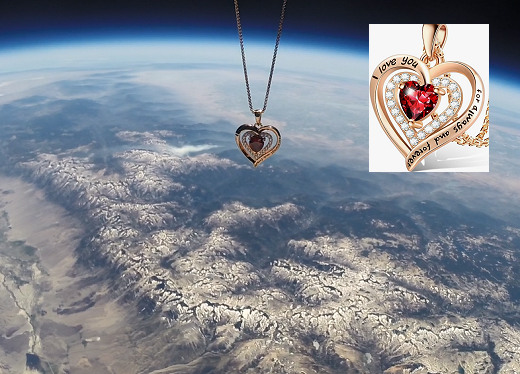
You can have it for $199.95. Engraved with the words "I love you always and forever", this 18K gold-plated sterling silver pendant has a heart-shaped ruby crystal in the middle surrounded by a ring of glittering 5A cubic zirconia nuggets. It is a visually striking premium pendant that makes a once-in-a-lifetime anniversary or birthday gift.
The students are selling space pendants to pay the helium bill for their cosmic ray ballooning program. Each one comes with a greeting card showing the jewelry in flight and telling the story of its trip to the stratosphere and back again.
Far Out Gifts: Earth to Sky Store
All sales support hands-on STEM education
COMET NISHIMURA VS. THE SUN: This month, Comet Nishimura (C/2023 P1) is passing by the sun inside the orbit of Mercury. The Heliospheric Imager on NASA's STEREO-A spacecraft has gotten some great footage of the close encounter:
"Comet Nishimura is looking spectacular!" says Karl Battams of the Naval Research Laboratory, who made the movie. "There are lots of beautiful interactions between the comet tail and the solar wind, along with a possible glancing blow from a CME."
The other bright object in the field of view is Mars. Although the comet and the planet seem to be close together (especially on Sept. 23rd), they are in fact very far apart. Mars is on the far side of the sun hundreds of millions of kilometers away.
The comet will remain in STEREO-A's field of view until Oct. 3rd, and Battams plans to make new movies every day. Stay tuned.
Realtime Space Weather Photo Gallery
Free: Spaceweather.com Newsletter
Realtime Comet Photo Gallery
Free: Spaceweather.com Newsletter
Realtime Aurora Photo Gallery
Free: Spaceweather.com Newsletter