POSSIBLE GLANCING-BLOW CME: NOAA forecasters say there is a slight chance that a CME might graze Earth today. It left the sun on Sept. 25th traveling near the edge of the Earth-strike zone. A glancing blow, if it occurs, would cause at most a minor G1-class geomagnetic storm. CME alerts: SMS Text

PERIGEE HARVEST MOON: Everyone has heard of the Harvest Moon. It's the full Moon closest to the northern autumnal equinox. Tonight's Harvest Moon is special, though. It's a "perigee" Harvest Moon, 5 percent bigger and 13 percent brighter than usual. Mohamad Sol photographed it rising behind a lighthouse on Estartit beach in Spain:
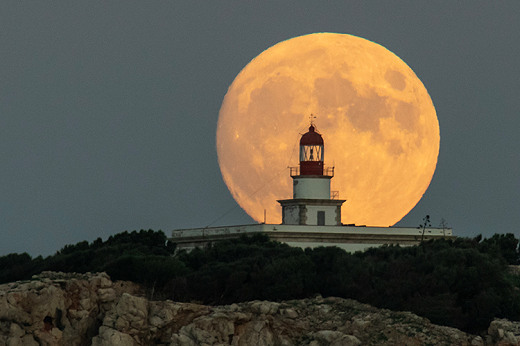
What is a "perigee moon?" The Moon's orbit is an ellipse with one side ("perigee") about 50,000 km closer than the other ("apogee"). Full Moons that occur on the perigee side of the Moon's orbit are extra big and bright. This week's Moon becomes full within 32 hours of perigee, making it unusually close (359,910 km away) and, thus, a "perigee Harvest Moon."
Before the days of electric lights, farmers relied on moonlight to harvest ripening autumn crops after sunset. The extra-bright Harvest Moon of 2023 would've helped them collect a bumper crop. Submit your photos here.
Realtime Space Weather Photo Gallery
Free: Spaceweather.com Newsletter
VAN GOGH WAVES IN THE MAGNETOSPHERE: When Vincent van Gogh painted "The Starry Night" in 1889, little did he know he was working at the forefront of 21st century astrophysics. A paper recently published in Nature Communications reveals that the same kind of waves pictured in the famous painting can cause geomagnetic storms on Earth.
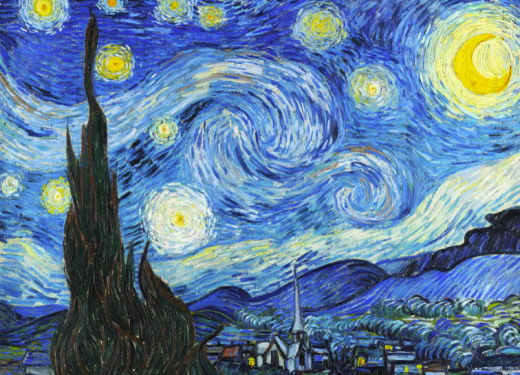
Above: Vincent van Gogh's 'Starry Night', which he painted in 1889: more
Physicists call them "Kelvin Helmholtz waves." They ripple into existence when streams of gas flow past each other at different velocities. Van Gogh saw them in high clouds outside the window of his asylum in Saint-Rémy, France. They also form in space where the solar wind flows around Earth's magnetic field.
"We have found Kelvin-Helmholtz waves rippling down the flanks of Earth's magnetosphere," says Shiva Kavosi of Embry–Riddle Aeronautical University, lead author of the Nature paper. "NASA spacecraft are surfing the waves, and directly measuring their properties."
This was first suspected in the 1950s by theoreticians who made mathematical models of solar wind hitting Earth's magnetic field. However, until recently it was just an idea; there was no proof the waves existed. When Kavosi's team looked at data collected by NASA's THEMIS and MMS spacecraft since 2007, they saw clear evidence of Kelvin Helmholtz instabilities.
"The waves are huge," says Kavosi. "They are 2 to 6 Earth radii in wavelength and as much as 4 Earth radii in amplitude."
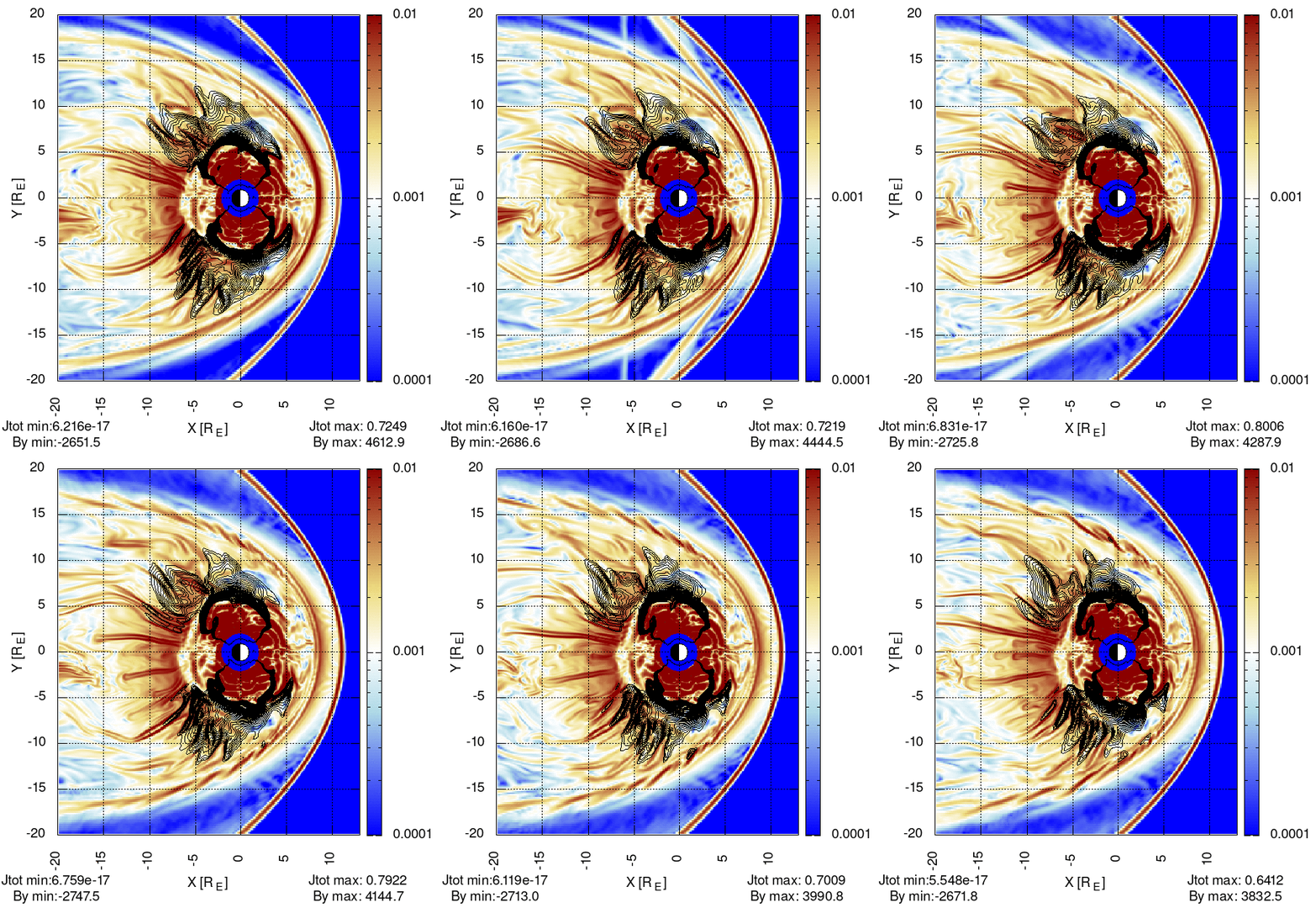
This computer model shows van Gogh waves moving down the flank of Earth's magnetosphere. Credit: Shiva Kasovi. [full-sized animation]
Imagine a wave taller than Earth curling over and breaking. That's exactly what happens. Kelvin-Helmholtz waves naturally break onto Earth's magnetic field, propelling energetic particles deep into the magnetosphere. This revs up Earth's radiation belts, triggering geomagnetic storms and auroras.
A key finding of Kavosi's paper is that the waves prefer equinoxes. They appear 3 times more frequently around the start of spring and fall than summer and winter. Researchers have long known that geomagnetic activity is highest around equinoxes. Kelvin-Helmholtz wave activity could be one reason why.
Our planet's seasonal dependence of geomagnetic activity has always been a bit of a puzzle. After all, the sun doesn't know when it's autumn on Earth. One idea holds that, around the time of the equinoxes, Earth's magnetic field links to the sun's because of the tilt of Earth's magnetic poles. This is called the Russell-McPherron effect after the researchers who first described it in 1973. Kavosi's research shows that Kelvin-Helmholtz waves might be important, too.
Northern autumn has just begun, which means Kelvin Helmholtz waves are rippling around our planet, stirring up "Starry Night" auroras. Happy autumn!
Realtime Aurora Photo Gallery
Free: Spaceweather.com Newsletter
SOLAR ECLIPSE TEST FLIGHT--SUCCESS! On Sept. 24th, the students of Earth to Sky Calculus launched a high-altitude balloon from eastern Nevada where, next month, there will be an annular solar eclipse. The balloon was released at sunrise so it would experience a range of lighting and temperature similar that of a deep eclipse. Everything worked--great flight (max. altitude 118767 feet), great landing, great photography. When we launch again on Oct. 14th, we should be able to photograph the Moon's shadow racing across the remote Nevada landscape.
To help pay for the flight, this pendant went along for the ride:
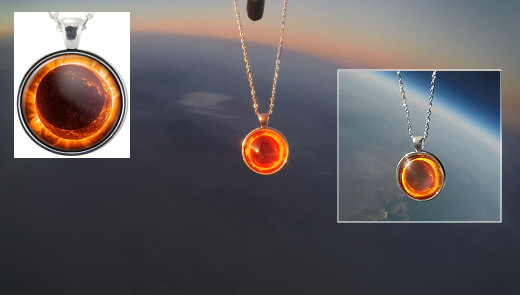
You can have it for $129.95. The handmade pendant shows an annular eclipse in progress, with the new Moon turning the sun into a ring of fire. Buy the pendent now and for no additional charge we will fly it back to the stratosphere during the annular eclipse. Just make a note in the COMMENTS BOX of your shopping cart: "Fly my pendant again!"
Note: We have photographed the shadow of an eclipse before. Here's what the total eclipse of Aug. 21, 2017, looked like from the stratosphere over the Nebraska-Wyoming border:
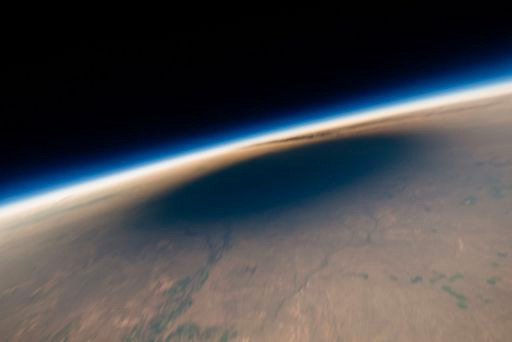
Total eclipses make deep black shadows, in this case blacking out more than 70 miles of terrain. What does the shadow of an *annular* eclipse look like? We hope to find out. It should be fuzzier around the edges, and not nearly as dark in the middle. An overview from the stratosphere could provide a unique picture.
Far Out Gifts: Earth to Sky Store
All sales support hands-on STEM education
Realtime Comet Photo Gallery
Free: Spaceweather.com Newsletter
Realtime Space Weather Photo Gallery
Free: Spaceweather.com Newsletter