NO GEOMAGNETIC STORMS THIS WEEKEND: Last weekend, a CME hit Earth's magnetic field, sparking two days of geomagnetic storms and an outburst of rare red auroras. This weekend will be completely different. No CMEs are heading for Earth, and our planet's magnetic field should remain calm and quiet. CME alerts: SMS Text
HOWEVER, THERE COULD BE SOME SOLAR FLARES: Solar flares are going off like popcorn in the magnetic canopy of new sunspot AR3451. The strongest so far is this staccato M2.5-class explosion recorded by NASA's Solar Dynamics Observatory during the early hours of Oct. 1st:
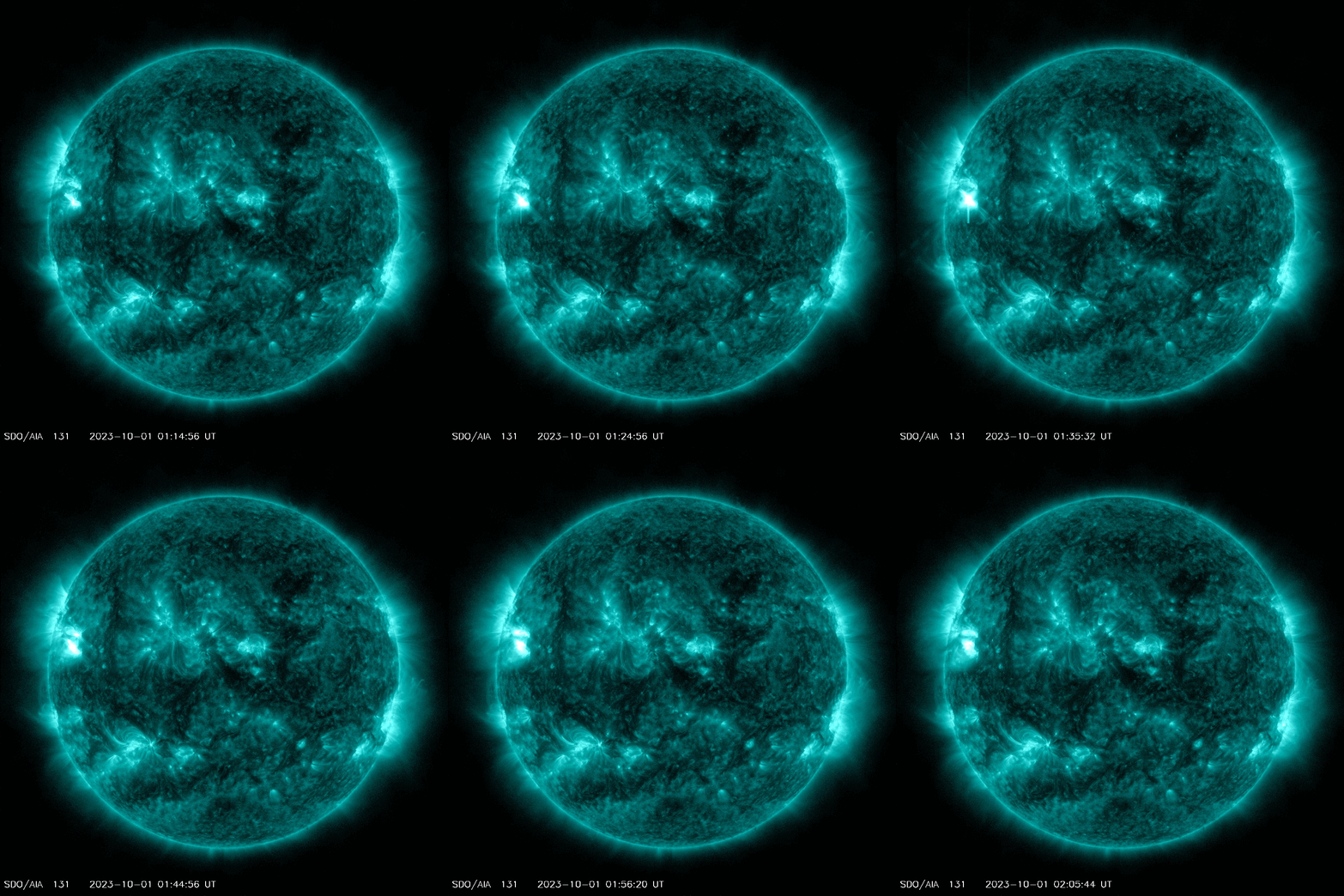
The sunspot didn't even exist 24 hours ago. Since then it has grown more than a dozen dark cores, two of them wider than Earth. Magnetic maps of the sunspot are not fully definitive because it is facing away from Earth. However, the sunspot appears to have a mixed-polarity 'delta-class' magnetic configuration that harbors energy for -- you guessed it -- strong flares. Solar flare alerts: SMS Text
Realtime Space Weather Photo Gallery
Free: Spaceweather.com Newsletter
SPACE STATION TRANSIT: The International Space Station (ISS) has been circling Earth and occasionally transiting the sun for almost 25 years. "It never gets old," says Greek astronomer Anthony Ayiomamitis, who caught the ISS leapfrogging sunspots on Oct. 1st:

The ISS was almost directly over Athens when Ayiomamitis recorded the split-second (0.74s) transit. This means it was nearby and big. "The ISS subtended an angle of 50 arcseconds thanks to its range of only 551 km," he says.
Realtime Space Weather Photo Gallery
Free: Spaceweather.com Newsletter
SOLAR ECLIPSE TEST FLIGHT--SUCCESS! On Sept. 24th, the students of Earth to Sky Calculus launched a high-altitude balloon from eastern Nevada where, next month, there will be an annular solar eclipse. The balloon was released at sunrise so it would experience a range of lighting and temperature similar that of a deep eclipse. Everything worked--great flight (max. altitude 118767 feet), great landing, great photography. When we launch again on Oct. 14th, we should be able to photograph the Moon's shadow racing across the remote Nevada landscape.
To help pay for the flight, this pendant went along for the ride:
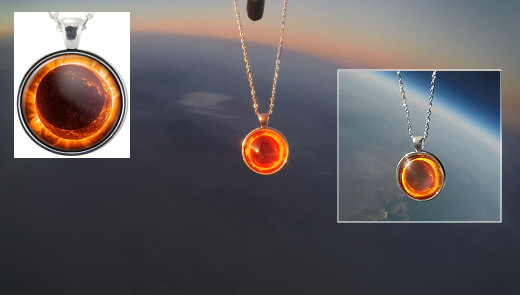
You can have it for $129.95. The handmade pendant shows an annular eclipse in progress, with the new Moon turning the sun into a ring of fire. Buy the pendent now and for no additional charge we will fly it back to the stratosphere during the annular eclipse. Just make a note in the COMMENTS BOX of your shopping cart: "Fly my pendant again!"
Note: We have photographed the shadow of an eclipse before. Here's what the total eclipse of Aug. 21, 2017, looked like from the stratosphere over the Nebraska-Wyoming border:
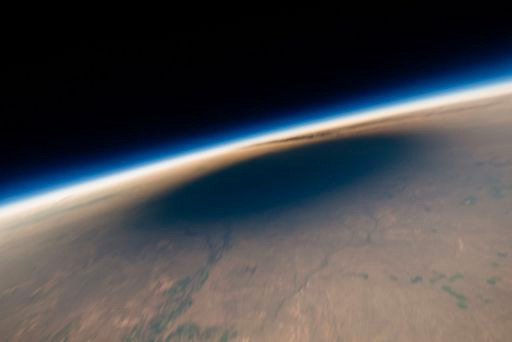
Total eclipses make deep black shadows, in this case blacking out more than 70 miles of terrain. What does the shadow of an *annular* eclipse look like? We hope to find out. It should be fuzzier around the edges, and not nearly as dark in the middle. An overview from the stratosphere could provide a unique picture.
Far Out Gifts: Earth to Sky Store
All sales support hands-on STEM education
Realtime Comet Photo Gallery
Free: Spaceweather.com Newsletter
Realtime Aurora Photo Gallery
Free: Spaceweather.com Newsletter