CHANCE OF FLARES TODAY: NOAA forecasters say there is a 45% chance of M-class solar flares today. The most likely source is sunspot complex AR3451-52, which emerged over the weekend with an unstable 'delta-class' magnetic field. Solar flare alerts: SMS Text
THE NORTHERN HEMISPHERE OF THE SUN IS IN CHARGE: For the second month in a row, sunspot counts in the sun's northern hemisphere are more than double the south. The assymetry is obvious in this summary of September's sunspots compiled by astronomer Senol Sanli using data from NASA's Solar Dynamics Observatory:
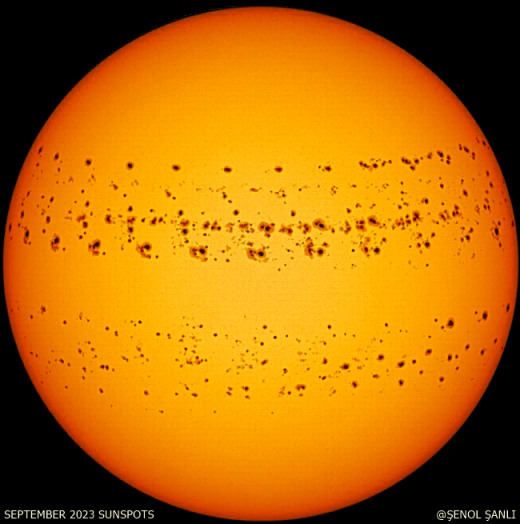
According to the Royal Observatory of Belgium's Solar Influences Data Analysis Center, in September the monthly sunspot number for the sun's northern hemisphere was 90, the southern hemisphere was only 44; that's a ratio of 2-to-1 in favor of the north. August was about the same. Looking back over an entire year, the north is leading the south by an average of 50%.
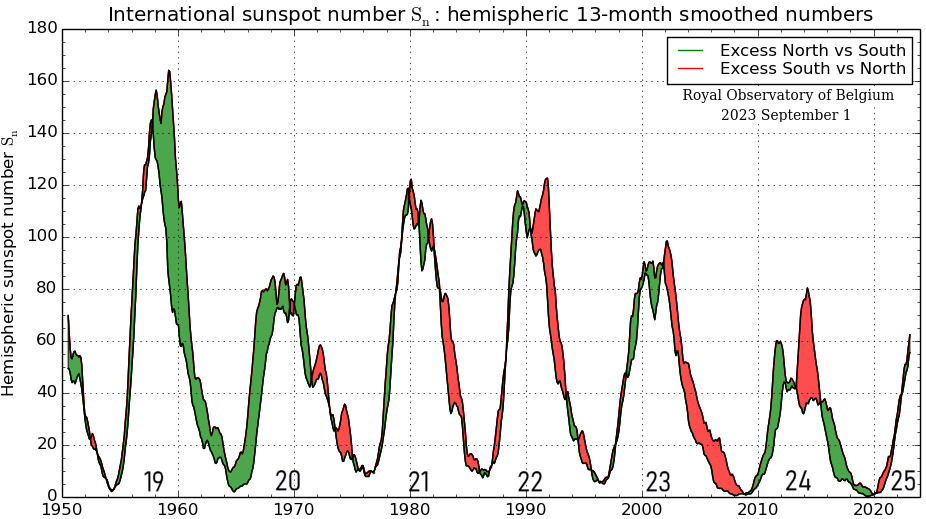
What's going on? In fact, it's not unusual for the sun's northern and southern hemispheres to be out of synch. As long ago as the 19th century, solar cycle pioneers Spoerer (1889) and Maunder (1890) noted that there were often long periods of time when most sunspots were found preferentially in one hemisphere and not the other. This plot from the Royal Observatory of Belgium shows assymetries throughout the last 6 solar cycles:
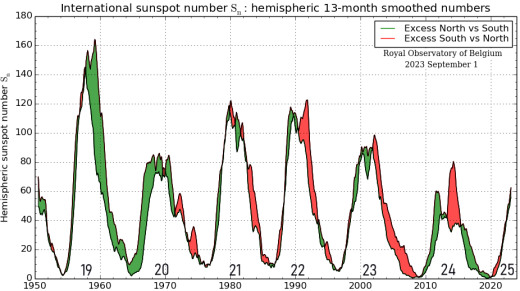
Until recently, Solar Cycle 25 was pretty evenly matched, north vs. south. Sunspot counts from August and September, however, suggest that the northern hemisphere may be seizing control--at least temporarily. This has happened during the upslope of all four previous solar cycles (21-24).
One possible explanation for this phenomenon may be that the two hemispheres of the sun have their own solar cycles, one out of phase with the other by about a year. Indeed, Solar Max is often double peaked. You can see it in the hemispheric sunspot plot. In the three most recent cycles (22-24), north peaked before south, creating two surges of solar activity separated by a "Gnevyshev gap." Solar Cycle 25 might continue this trend.
A complete discussion of sunspot asymmetries is included in David Hathaway's excellent review article "The Solar Cycle."
Realtime Space Weather Photo Gallery
Free: Spaceweather.com Newsletter
SOLAR ECLIPSE TEST FLIGHT--SUCCESS! On Sept. 24th, the students of Earth to Sky Calculus launched a high-altitude balloon from eastern Nevada where, next month, there will be an annular solar eclipse. The balloon was released at sunrise so it would experience a range of lighting and temperature similar that of a deep eclipse. Everything worked--great flight (max. altitude 118767 feet), great landing, great photography. When we launch again on Oct. 14th, we should be able to photograph the Moon's shadow racing across the remote Nevada landscape.
To help pay for the flight, this pendant went along for the ride:
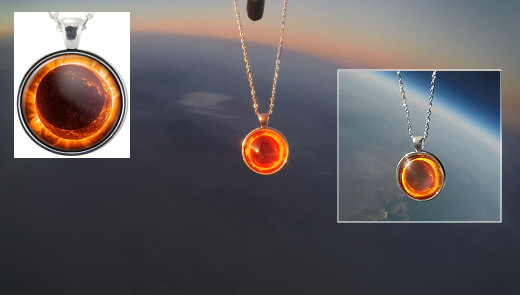
You can have it for $129.95. The handmade pendant shows an annular eclipse in progress, with the new Moon turning the sun into a ring of fire. Buy the pendent now and for no additional charge we will fly it back to the stratosphere during the annular eclipse. Just make a note in the COMMENTS BOX of your shopping cart: "Fly my pendant again!"
Note: We have photographed the shadow of an eclipse before. Here's what the total eclipse of Aug. 21, 2017, looked like from the stratosphere over the Nebraska-Wyoming border:
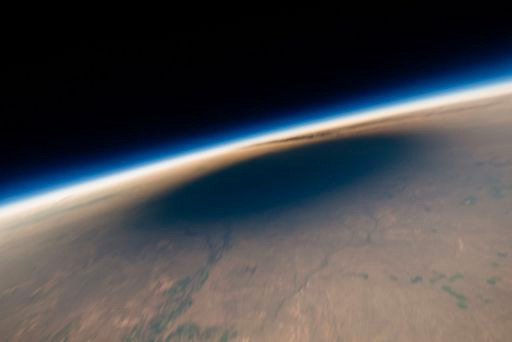
Total eclipses make deep black shadows, in this case blacking out more than 70 miles of terrain. What does the shadow of an *annular* eclipse look like? We hope to find out. It should be fuzzier around the edges, and not nearly as dark in the middle. An overview from the stratosphere could provide a unique picture.
Far Out Gifts: Earth to Sky Store
All sales support hands-on STEM education
Realtime Comet Photo Gallery
Free: Spaceweather.com Newsletter
Realtime Aurora Photo Gallery
Free: Spaceweather.com Newsletter