HUGE NEW SATELLITE OUTSHINES ALMOST EVERY STAR: A paper published this week in the research journal Nature examines the alarming brightness of Bluewalker 3 -- a communications satellite the size of a raquetball court. At times it outshines 99% of the stars in the sky. One such satellite is no problem, but it may soon be followed by hundreds more. Full story.
THREE CME IMPACTS IN SEPTEMBER: The sun has been buffeting Earth with CMEs. In September there were three significant strikes, each one sparking a geomagnetic storm with mid-latitude auroras. Another side-effect might surprise you. Each CME reduced cosmic radiation around our planet:
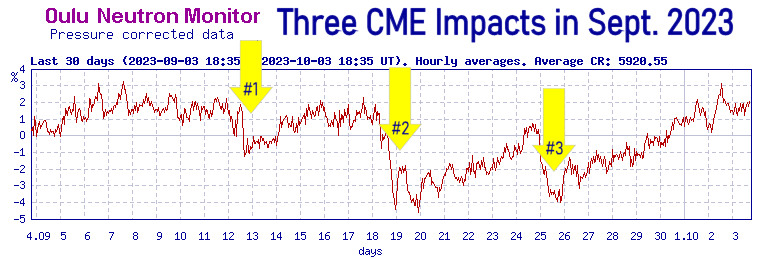
This is called a "Forbush decreases," named after American physicist Scott Forbush who studied cosmic rays in the early 20th century. It happens when a coronal mass ejection (CME) sweeps past Earth and pushes galactic cosmic rays away from our planet. Radiation from deep space hitting Earth’s upper atmosphere is briefly wiped out.
Normally, when cosmic rays hit the top of Earth's atmosphere, they produce a cascade of secondary particles that percolate down toward the ground. Using neutron counters, researchers in Oulu, Finland, have been monitoring these particles from space for almost 60 years. In the plot, above, we see how the three CMEs caused abrupt reductions in neutrons reaching the sensors in Finland.
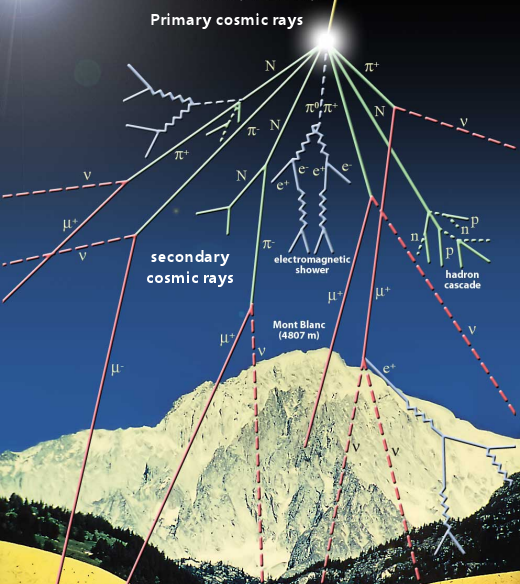
The example of Sept. 2023 explains, in part, why the intensity of galactic cosmic rays drops around Solar Max. The sun keeps sweeping them away from our planet, ironically making space safer for astronauts and satellites.
Realtime Space Weather Photo Gallery
Free: Spaceweather.com Newsletter
THE NORTHERN HEMISPHERE OF THE SUN IS IN CHARGE: For the second month in a row, sunspot counts in the sun's northern hemisphere are more than double the south. The assymetry is obvious in this summary of September's sunspots compiled by astronomer Senol Sanli using data from NASA's Solar Dynamics Observatory:
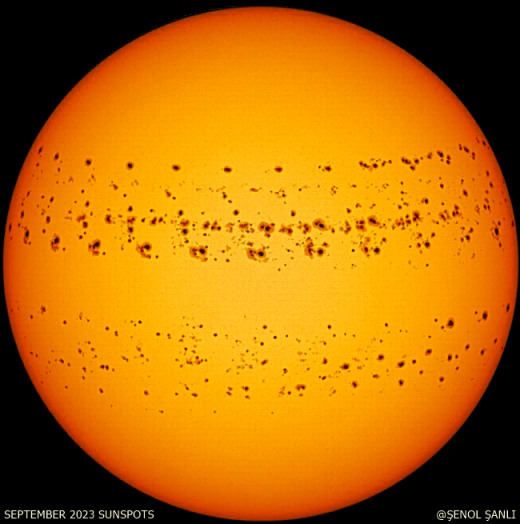
According to the Royal Observatory of Belgium's Solar Influences Data Analysis Center, in September the monthly sunspot number for the sun's northern hemisphere was 90, the southern hemisphere was only 44; that's a ratio of 2-to-1 in favor of the north. August was about the same. Looking back over an entire year, the north is leading the south by an average of 50%.
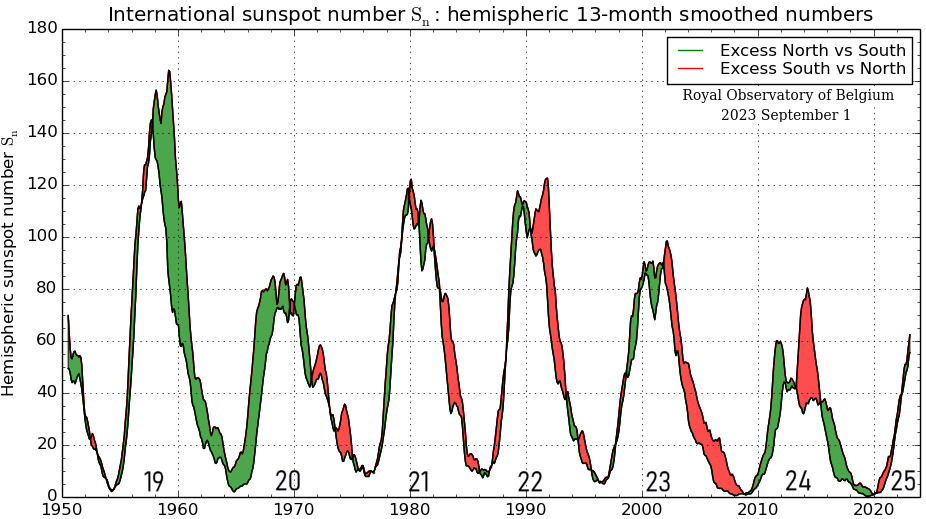
What's going on? In fact, it's not unusual for the sun's northern and southern hemispheres to be out of synch. As long ago as the 19th century, solar cycle pioneers Spoerer (1889) and Maunder (1890) noted that there were often long periods of time when most sunspots were found preferentially in one hemisphere and not the other. This plot from the Royal Observatory of Belgium shows assymetries throughout the last 6 solar cycles:
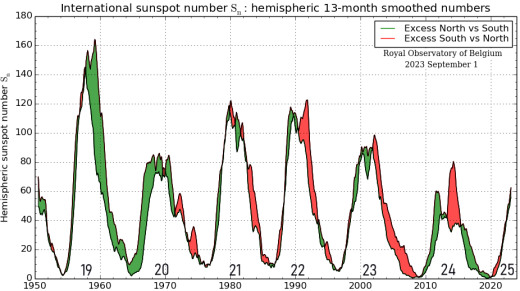
Until recently, Solar Cycle 25 was pretty evenly matched, north vs. south. Sunspot counts from August and September, however, suggest that the northern hemisphere may be seizing control--at least temporarily. This has happened during the upslope of all four previous solar cycles (21-24).
One possible explanation for this phenomenon may be that the two hemispheres of the sun have their own solar cycles, one out of phase with the other by about a year. Indeed, Solar Max is often double peaked. You can see it in the hemispheric sunspot plot. In the three most recent cycles (22-24), north peaked before south, creating two surges of solar activity separated by a "Gnevyshev gap." Solar Cycle 25 might continue this trend.
A complete discussion of sunspot asymmetries is included in David Hathaway's excellent review article "The Solar Cycle."
Realtime Space Weather Photo Gallery
Free: Spaceweather.com Newsletter
IRIDESCENT BLACK PEARL PENDANT: It came from Tahiti--and now it's been to the edge of space. On Aug. 29, 2023, this genuine Black Tahitian South Sea Cultured Pearl flew to the stratosphere onboard an Earth to Sky Calculus cosmic ray balloon, soaring 119,010 feet above the Sierra Nevada mountains of central California:
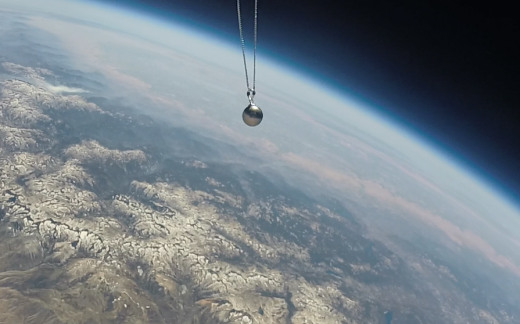
You can have it for $199.95. The 9 mm pearl has a lovely iridescent sheen that hints at a South Sea rainbow when held in sunlight. Its surface is so smooth, it reflected a tiny image of the Sierra from an altitude of 119,101 feet!
The students of Earth to Sky are selling space pendants to support their cosmic ray ballooning program. Each one comes with a greeting card showing the pendant in flight and telling the story of its trip to the stratosphere and back again.
Far Out Gifts: Earth to Sky Store
All sales support hands-on STEM education
Realtime Comet Photo Gallery
Free: Spaceweather.com Newsletter
Realtime Aurora Photo Gallery
Free: Spaceweather.com Newsletter