HUGE NEW SATELLITE OUTSHINES ALMOST EVERY STAR: A paper published this week in the research journal Nature examines the alarming brightness of Bluewalker 3 -- a communications satellite the size of a raquetball court. At times it outshines 99% of the stars in the sky. One such satellite is no problem, but it may soon be followed by hundreds more. Full story.
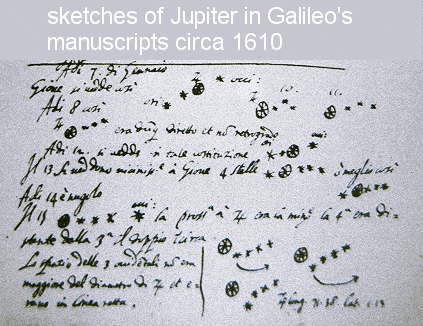
WHAT WOULD GALILEO SAY? Before you read any further, click here. That's what Galileo saw in 1610 when he turned his primitive telescope toward Jupiter. The satellites were tiny specks of light with no discernable features. What a difference 400 years makes. On Oct. 3, 2023, Philip Smith looked through a modern backyard telescope and saw a full-fledged world:
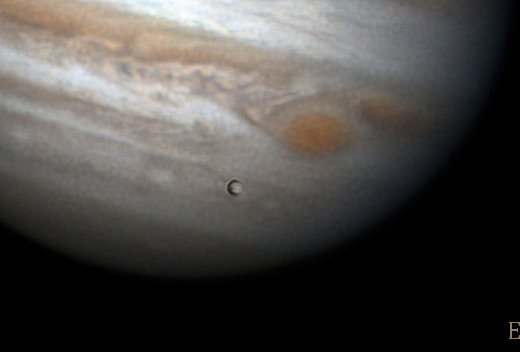
"I caught Europa transiting the cloudtops of Jupiter from my observatory in Manorville, New York," says Smith. "The moon's disk was surprisingly well resolved in my 14 inch telescope."
Far from being a featureless point of light, Europa is now considered one of the most complex and fascinating worlds in the solar system. Cracks, ridges, and chaotic terrain on the moon's icy crust may offer access to one of the largest oceans in the solar system--and a possible abode for aquatic life. NASA's Europa Clipper spacecraft, due to launch one year from now in October 2024, will conduct a detailed reconnaissance of the moon's surface to help plan future missions including a lander and perhaps even a submarine.
Realtime Space Weather Photo Gallery
Free: Spaceweather.com Newsletter
THREE CME IMPACTS IN SEPTEMBER: The sun has been buffeting Earth with CMEs. In September there were three significant strikes, each one sparking a geomagnetic storm with mid-latitude auroras. Another side-effect might surprise you. Each CME reduced cosmic radiation around our planet:
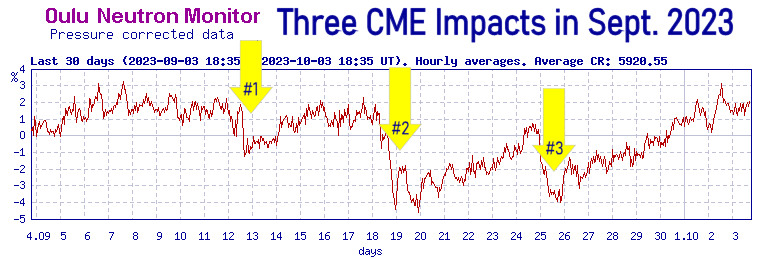
This is called a "Forbush decreases," named after American physicist Scott Forbush who studied cosmic rays in the early 20th century. It happens when a coronal mass ejection (CME) sweeps past Earth and pushes galactic cosmic rays away from our planet. Radiation from deep space hitting Earth’s upper atmosphere is briefly wiped out.
Normally, when cosmic rays hit the top of Earth's atmosphere, they produce a cascade of secondary particles that percolate down toward the ground. Using neutron counters, researchers in Oulu, Finland, have been monitoring these particles from space for almost 60 years. In the plot, above, we see how the three CMEs caused abrupt reductions in neutrons reaching the sensors in Finland.
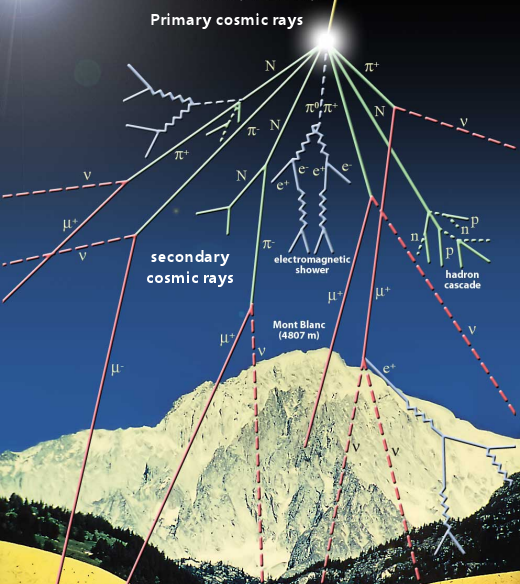
The example of Sept. 2023 explains, in part, why the intensity of galactic cosmic rays drops around Solar Max. The sun keeps sweeping them away from our planet, ironically making space safer for astronauts and satellites.
Realtime Space Weather Photo Gallery
Free: Spaceweather.com Newsletter
IRIDESCENT BLACK PEARL PENDANT: It came from Tahiti--and now it's been to the edge of space. On Aug. 29, 2023, this genuine Black Tahitian South Sea Cultured Pearl flew to the stratosphere onboard an Earth to Sky Calculus cosmic ray balloon, soaring 119,010 feet above the Sierra Nevada mountains of central California:
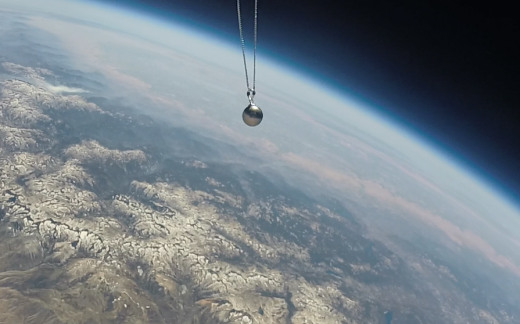
You can have it for $199.95. The 9 mm pearl has a lovely iridescent sheen that hints at a South Sea rainbow when held in sunlight. Its surface is so smooth, it reflected a tiny image of the Sierra from an altitude of 119,101 feet!
The students of Earth to Sky are selling space pendants to support their cosmic ray ballooning program. Each one comes with a greeting card showing the pendant in flight and telling the story of its trip to the stratosphere and back again.
Far Out Gifts: Earth to Sky Store
All sales support hands-on STEM education
Realtime Comet Photo Gallery
Free: Spaceweather.com Newsletter
Realtime Aurora Photo Gallery
Free: Spaceweather.com Newsletter