POSSIBLE GLANCING BLOW CME: NOAA forecasters say that a CME might graze Earth's magnetic field on Oct. 7th. It left the sun on Oct. 3rd, propelled by an explosion near the sun's northeastern limb. The glancing blow, if it occurs, could spark a minor G1-class geomagnetic storm. Aurora alerts: SMS Text

WHERE YOUR COSMIC RAY DATA COME FROM: Spaceweather.com and the students of Earth to Sky Calculus launch cosmic ray balloons more than once a month to monitor space radiation in Earth's atmosphere. Sometimes things go wrong. Last October (we're talking about 2022) one of our balloons flew off course and landed on a steep rocky slope overlooking Echo Lake, a mile-wide pool of melted snow in the Sierra Nevada at an altitude of 12,000 ft:

Echo Lake, still covered in snow in Aug. 2023. Note the human figure in the binocular view. That's a member of the payload recovery team.
A year later it's still there. The payload was quickly buried in snow by the Great Winter of 2023. At one point, we estimate, it was under as much as 30 feet of snow. Recovery teams led by Dr. Tony Phillips have visited Echo Lake four times (Oct. & Nov. 2022, August & Sept. 2023) each time getting a little closer to the payload but never recovering it.
Will the 5th time be the charm? Today the team is trying again. Improved route-finding (based on repeated visits) will allow us to reach the payload earlier in the day with more hours of sunlight to dig. At the landing site, the snow pack is down to only a few feet--even less in some places--so the search is not as daunting as it was before.
If the payload is recovered, we will be able to finally stitch together a complete record of radiation data for the past year. Wish us luck, and stay tuned for updates!
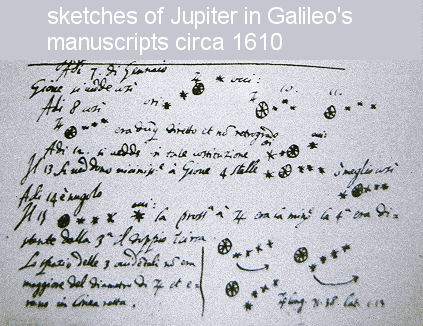
WHAT WOULD GALILEO SAY? Before you read any further, click here. That's what Galileo saw in 1610 when he turned his primitive telescope toward Jupiter. The satellites were tiny specks of light with no discernable features. What a difference 400 years makes. On Oct. 3, 2023, Philip Smith looked through a modern backyard telescope and saw a full-fledged world:
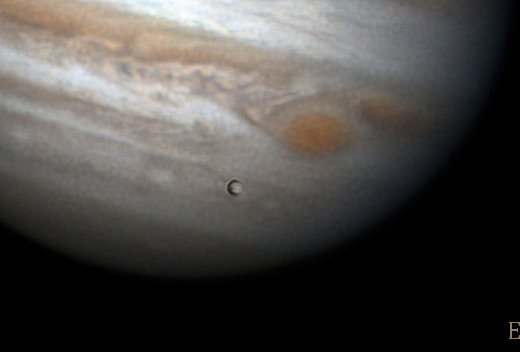
"I caught Europa transiting the cloudtops of Jupiter from my observatory in Manorville, New York," says Smith. "The moon's disk was surprisingly well resolved in my 14 inch telescope."
Far from being a featureless point of light, Europa is now considered one of the most complex and fascinating worlds in the solar system. Cracks, ridges, and chaotic terrain on the moon's icy crust may offer access to one of the largest oceans in the solar system--and a possible abode for aquatic life. NASA's Europa Clipper spacecraft slated for launch in October 2024 will conduct a detailed reconnaissance of Europa's surface to help plan future missions including a lander and perhaps even a submarine.
What would Galileo say to that?
more images: from Michael Karrer of Austria
Realtime Space Weather Photo Gallery
Free: Spaceweather.com Newsletter
IRIDESCENT BLACK PEARL PENDANT: It came from Tahiti--and now it's been to the edge of space. On Aug. 29, 2023, this genuine Black Tahitian South Sea Cultured Pearl flew to the stratosphere onboard an Earth to Sky Calculus cosmic ray balloon, soaring 119,010 feet above the Sierra Nevada mountains of central California:
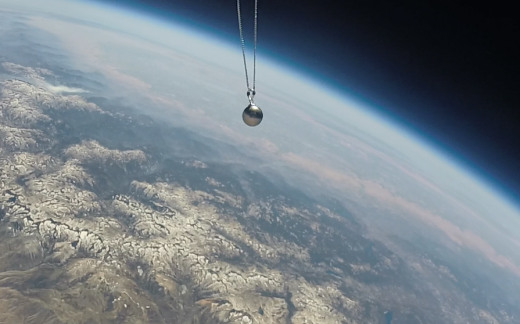
You can have it for $199.95. The 9 mm pearl has a lovely iridescent sheen that hints at a South Sea rainbow when held in sunlight. Its surface is so smooth, it reflected a tiny image of the Sierra from an altitude of 119,101 feet!
The students of Earth to Sky are selling space pendants to support their cosmic ray ballooning program. Each one comes with a greeting card showing the pendant in flight and telling the story of its trip to the stratosphere and back again.
Far Out Gifts: Earth to Sky Store
All sales support hands-on STEM education
Realtime Comet Photo Gallery
Free: Spaceweather.com Newsletter
Realtime Aurora Photo Gallery
Free: Spaceweather.com Newsletter