GEOMAGNETIC STORM WATCH (G1): NOAA forecasters say there is still a chance of a glancing CME impact today, Oct. 7th. If the CME arrives, it could spark minor G1-class geomagnetic storms. Solar flare alerts: SMS Text

THE SUN'S MAGNETIC POLES ARE DISAPPEARING: The sun is about to lose something important: Its magnetic poles.
Recent measurements by NASA's Solar Dynamic Observatory reveal a rapid weakening of magnetic fields in the polar regions of the sun. North and south magnetic poles are on the verge of disappearing. This will lead to a complete reversal of the sun's global magnetic field perhaps before the end of the year.
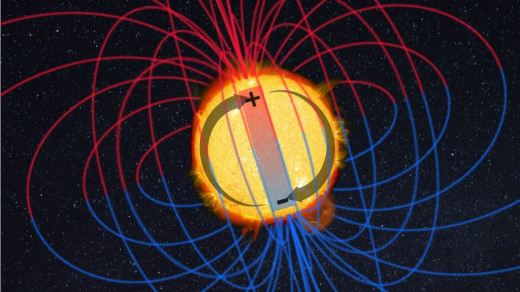
An artist's concept of the sun's dipolar magnetic field. Credit: NSF/AURA/NSO.
If this were happening on Earth, there were be widespread alarm. Past reversals of our planet's magnetic field have been linked to calamities ranging from sudden climate change to the extinction of Neanderthals. On the sun, it's not so bad.
"In fact, it's routine," says Todd Hoeksema, a solar physicist at Stanford University. "This happens every 11 years (more or less) when we're on the verge of Solar Maximum."
Vanishing poles and magnetic reversals have been observed around the peak of every single solar cycle since astronomers learned to measure magnetic fields on the sun. Hoeksema is the director of Stanford's Wilcox Solar Observatory (WSO), that is observing its fifth reversal since 1980.
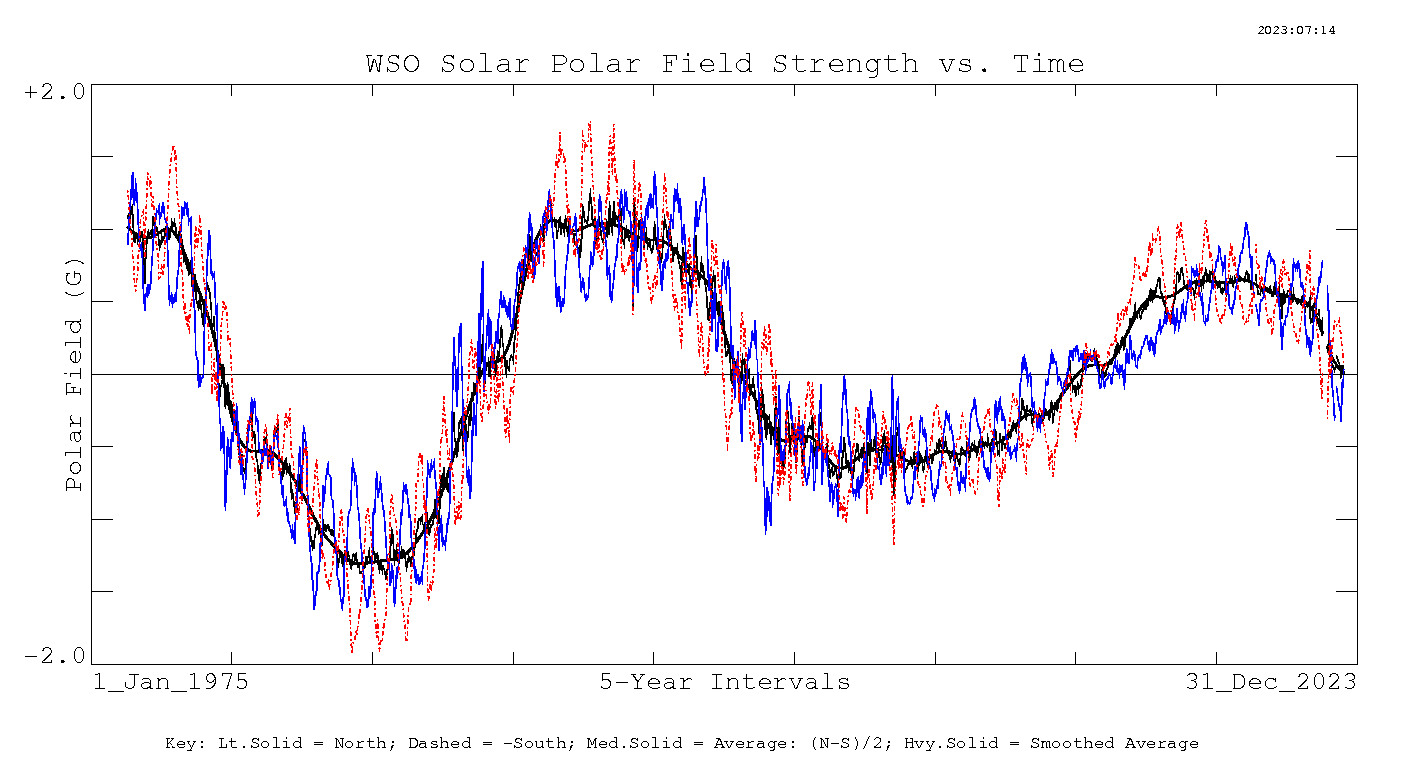
The last five polar field reversals observed at the Wilcox Solar Observatory (inset)
"One thing we have learned from these decades of data is that no two polar field reversals are alike," he says.
Sometimes the transition is swift, taking only a few months for the poles to vanish and reappear on opposite ends of the sun. Sometimes it takes years, leaving the sun without magnetic poles for an extended period of time.
"Even more strange," says Hoeksema, "sometimes one pole switches before the other, leaving both poles with the same polarity for a while."
Indeed, such a scenario could be playing out now. The sun's south magnetic pole has almost completely vanished, but the north magnetic pole is still hanging on, albeit barely.
How does all this effect us on Earth? One way we feel solar field reversals is via the heliospheric current sheet:
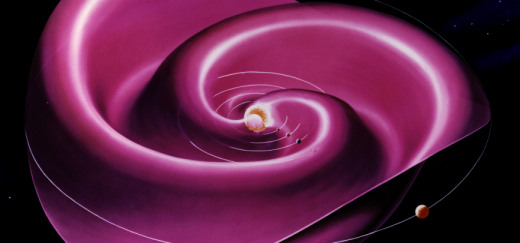
An artist's concept of the heliospheric current sheet.
The sun is surrounded by a wavy ring of electricity that the solar wind pulls and stretches all the way out to the edge of the Solar System. This structure is a part of the sun's magnetosphere. During field reversals, the current sheet becomes extra wavy and highly tilted. As the sun spins, we dip in and out of the steepening undulations. Passages from one side to another can cause geomagnetic storms and auroras.
Most of all, the vanishing of the poles means we're on the verge of Solar Maximum. Solar Cycle 25 is shaping up to be stronger than forecasters expected, and its peak could be relatively intense. Stay tuned for updates!
Realtime Space Weather Photo Gallery
Free: Spaceweather.com Newsletter
IRIDESCENT BLACK PEARL PENDANT: It came from Tahiti--and now it's been to the edge of space. On Aug. 29, 2023, this genuine Black Tahitian South Sea Cultured Pearl flew to the stratosphere onboard an Earth to Sky Calculus cosmic ray balloon, soaring 119,010 feet above the Sierra Nevada mountains of central California:
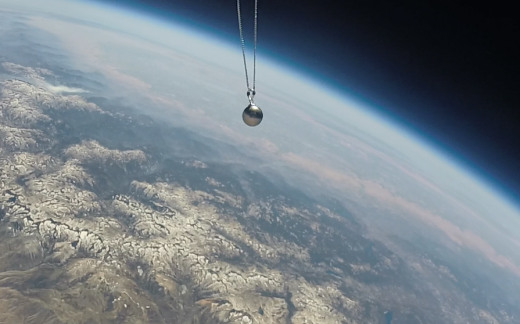
You can have it for $199.95. The 9 mm pearl has a lovely iridescent sheen that hints at a South Sea rainbow when held in sunlight. Its surface is so smooth, it reflected a tiny image of the Sierra from an altitude of 119,101 feet!
The students of Earth to Sky are selling space pendants to support their cosmic ray ballooning program. Each one comes with a greeting card showing the pendant in flight and telling the story of its trip to the stratosphere and back again.
Far Out Gifts: Earth to Sky Store
All sales support hands-on STEM education
Realtime Comet Photo Gallery
Free: Spaceweather.com Newsletter
Realtime Aurora Photo Gallery
Free: Spaceweather.com Newsletter