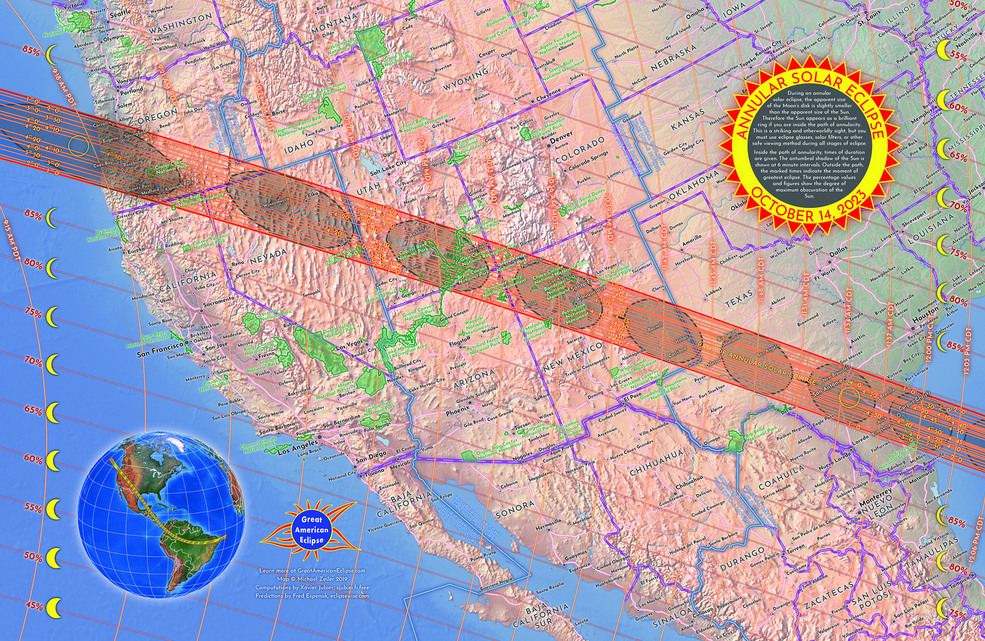
RING OF FIRE SOLAR ECLIPSE: This weekend, Saturday, Oct. 14th, the Moon will pass in front of the sun, producing a "ring of fire" annular eclipse. The narrow path of annularity stretches across both North and South America--with a partial eclipse visible from almost every point on both continents. Eclipse maps and glasses are available from GreatAmericanEclipse.com.
THE MILLENNIUM FALCON FLIES AGAIN: Last July, astronomers were surprised when Comet 12P/Pons-Brooks exploded, and the debris formed the shape of the Millennium Falcon. New surprise: It just happened again. On Oct. 5th, the comet exploded with a 100-fold increase in brightness. Once again the debris is shaped like the 'the fastest hunk of junk in the galaxy':
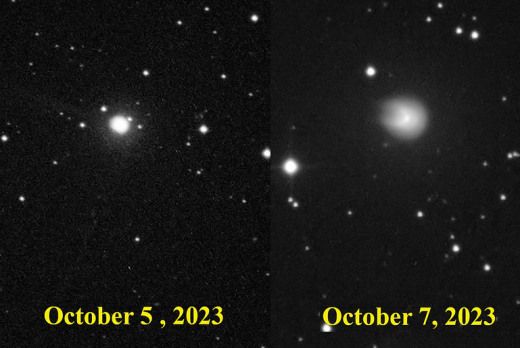
"It appears that Comet 12P is developing the same type of interesting coma as occurred with the last outburst in July," says photographer . Eliot Herman, who has been monitoring the comet from the Utah Desert Observatory.
Richard Miles of the British Astronomical Association thinks 12P may be one of 10 to 20 known comets with active ice volcanoes. "The two 'horns' may be caused by a peculiarly-shaped cryovolcanic vent with some sort of blockage causing material to be expelled with a weird flow pattern," he speculates.
This is *not* just a funny-shaped comet tail, he stresses. Miles used a JPL ephemeris to compare the direction of the horns with the expected direction of the comet's dust and ion tails. It was a complete mismatch.
"The difference between the July horns and its October ones is about 55-60° projected on the sky," says Miles. "The mismatch between either of these directions and the ion tail direction and dust tail direction was almost the most it could be!"
Amateur astronomer Lars Zielke of Tvis, Denmark, has been tracking the outburst every night. This animation shows the change in only 24 hours (Oct. 7-8):
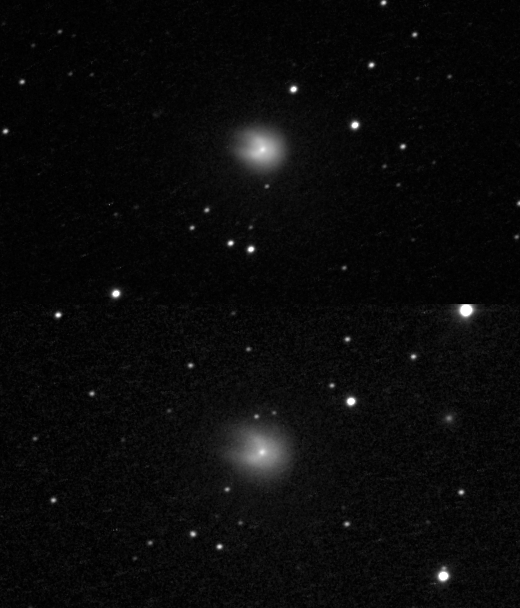
"What a difference in size!" says Zielke. "I think there is a hint of a globular dust cloud expanding around the comet's core, and it is easy to see the expansion of the 'horns' of the Falcon."
Comet 12P could attract widespread interest next year--especially if it continues to explode. The comet is falling toward the sun for a close encounter in April 2024 when it is expected to become a naked-eye object at 4th or 5th magnitude. Talk about perfect timing. 12P will reach maximum brightness only a few days before the total solar eclipse on April 8, 2024. Sky watchers in the path of totality could look up and see an outburst for themselves.
Amateur astronomers are encouraged to monitor developments. After its latest outburst, the comet is shining as brightly as an 11th magnitude star, putting it within range of mid-sized backyard telescopes. Look for 12P in the constellation Hercules just across the border from the bright star Vega. [sky map]
Realtime Comet Photo Gallery
Free: Spaceweather.com Newsletter
HANDMADE SOLAR ECLIPSE PENDANT: The students of Earth to Sky Calculus are about to try something never done before--to photograph the shadow of an annular solar eclipse from the stratosphere. On Oct. 14th, they'll launch a cosmic ray research balloon equipped with cameras to photograph the shadow zone of an eclipse over Nevada. You can support the flight by buying a handmade Annular Solar Eclipse Pendant:
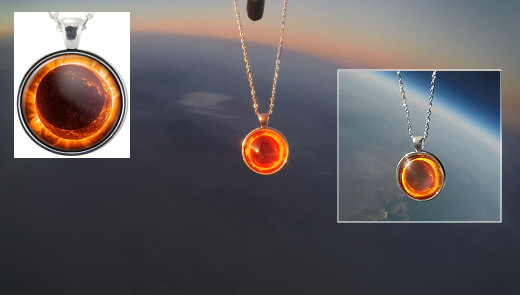
It's yours for $129.95. The students launched this pendant from the eclipse zone in a Nevada test flight on Sept. 24, 2023. Floating at an altitude 118,767 feet above Earth’s surface, it made contact with space, experiencing temperatures as low as --59 C.
Buy the pendent now and for no additional charge we will fly it back to the stratosphere during the annular eclipse. Just make a note in the COMMENTS BOX of your shopping cart: "Fly my pendant again!"
Note: We have photographed the shadow of an eclipse before. Here's what the total eclipse of Aug. 21, 2017, looked like from the stratosphere over the Nebraska-Wyoming border:
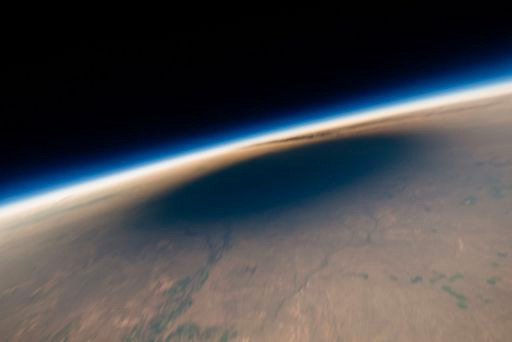
Total eclipses make deep black shadows, in this case blacking out more than 70 miles of terrain. What does the shadow of an *annular* eclipse look like? We hope to find out. It should be fuzzier around the edges, and not nearly as dark in the middle. An overview from the stratosphere could provide a unique picture.
Far Out Gifts: Earth to Sky Store
All sales support hands-on STEM education
Realtime Aurora Photo Gallery
Free: Spaceweather.com Newsletter
Realtime Space Weather Photo Gallery
Free: Spaceweather.com Newsletter