THE FORECAST CALLS FOR QUIET: With no CMEs heading for Earth and no solar flares in the offing, the forecast calls for quiet. Solar and geomagnetic activity should remain low for the rest of the weekend. Solar flare alerts: SMS Text
RING OF FIRE SOLAR ECLIPSE: Sky watchers across the Americas witnessed a rare annular solar eclipse on Oct. 14th. The moon glided dead center across the solar disk, turning our star into a beautiful "ring of fire." Photos are pouring in from the eclipse zone. Check out our realtime gallery for the latest.
In Nevada's Valley of the Moon (yes, that's a real place), Dr. Tony Phillips video-recorded the ring of fire through a bank of filter-perfect clouds:
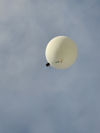
At the same time, two Earth to Sky Calculus helium balloons were en route to the stratophere on a mission to photograph the Moon's shadow from above. We might not know the results for a few days while the payloads are being recovered from remote wilderness areas. Stay tuned!
Meanwhile, if you have a picture of the eclipse, submit it here. Your image will be automatically added to our realtime photo gallery.
Realtime Solar Eclipse Photo Gallery
Free: Spaceweather.com Newsletter
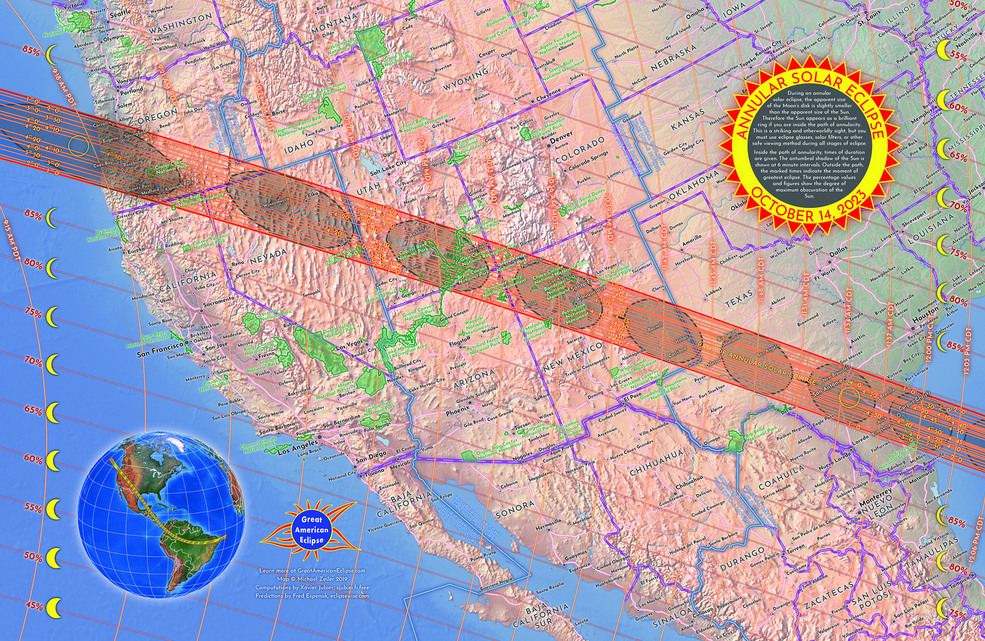
HANDMADE SOLAR ECLIPSE PENDANT: The students of Earth to Sky Calculus are about to try something never done before--to photograph the shadow of an annular solar eclipse from the stratosphere. On Oct. 14th, they'll launch a cosmic ray research balloon equipped with cameras to photograph the shadow zone of an eclipse over Nevada. You can support the flight by buying a handmade Annular Solar Eclipse Pendant:
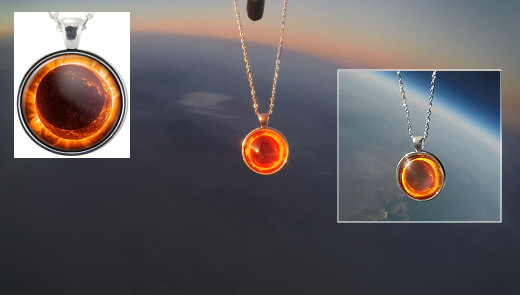
It's yours for $129.95. The students launched this pendant from the eclipse zone in a Nevada test flight on Sept. 24, 2023. Floating at an altitude 118,767 feet above Earth’s surface, it made contact with space, experiencing temperatures as low as --59 C.
Buy the pendent now and for no additional charge we will fly it back to the stratosphere during the annular eclipse. Just make a note in the COMMENTS BOX of your shopping cart: "Fly my pendant again!"
Note: We have photographed the shadow of an eclipse before. Here's what the total eclipse of Aug. 21, 2017, looked like from the stratosphere over the Nebraska-Wyoming border:
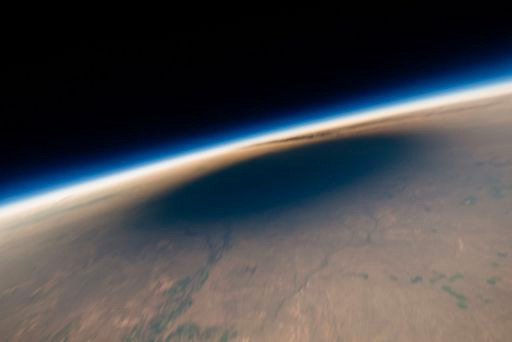
Total eclipses make deep black shadows, in this case blacking out more than 70 miles of terrain. What does the shadow of an *annular* eclipse look like? We hope to find out. It should be fuzzier around the edges, and not nearly as dark in the middle. An overview from the stratosphere could provide a unique picture.
Far Out Gifts: Earth to Sky Store
All sales support hands-on STEM education
Realtime Space Weather Photo Gallery
Free: Spaceweather.com Newsletter
Realtime Aurora Photo Gallery
Free: Spaceweather.com Newsletter
Realtime Comet Photo Gallery
Free: Spaceweather.com Newsletter