A LULL IN SUNSPOT ACTIVITY: In the past two weeks, sunspot counts have sharply dropped, leaving the solar disk without any complex or very active sunspots. Does this mean Solar Cycle 25 is ending prematurely? No. "Sunspot lulls" are normal statistical fluctuations observed during even very strong solar cycles. Solar Cycle 25 will soon bounce back as it heads for a maximum in 2024-25. Solar flare alerts: SMS Text
THE MYSTERY OF ORANGE AURORAS: A recent display of auroras over Canada has experts scratching their heads. The mystery? They were orange: Auroras can be many colors. Orange is not one of them. Nevertheless, on Oct. 19th, Harlan Thomas saw these
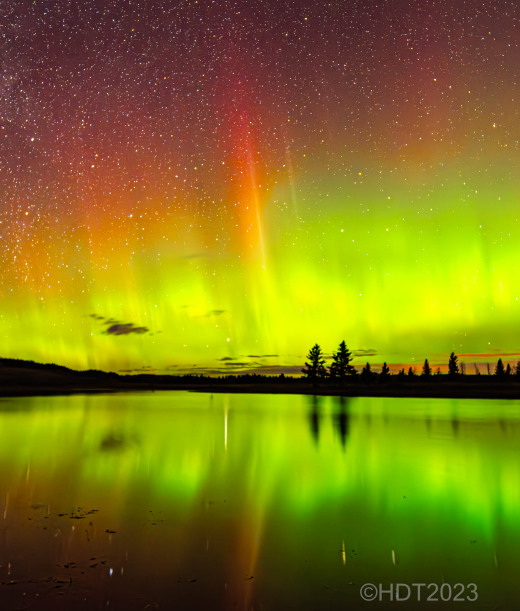
"This was a first for me," says Harlan Thomas, who photographed the display over Sibbald Pond west of Calgary, Alberta, on Oct. 19th. "The orange was sublime, just incredible. The pillars in the center stayed there glowing for more than 20 minutes."
Auroras get their colors from atoms and molecules in Earth's atmosphere. During geomagnetic storms, energetic particles rain down from space, striking the air and causing it to glow. Red, green, purple and even pink are common signs of excited oxygen and nitrogen.
The problem is, there's nothing in the air capable of making bright orange. Theoretically, nitrogen and oxygen (N2, N2+, and O2+) can produce emissions at orange wavelengths. However, these emissions are very weak compared to other colors produced by the same molecules. Any orange should be overwhelmed.
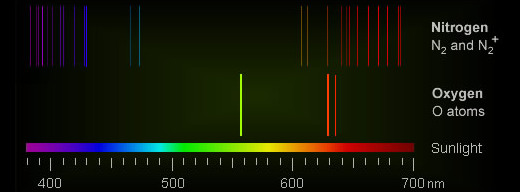
Aurora colors produced by atoms and molecules in Earth's atmosphere. [more]
The answer may be hiding in plain sight. Take another look at Thomas's photo. Bright red auroras on top appear to overlap the green auroras lower down. Red and green mixing together may have produced the yellow-orange glow Thomas witnessed.
Aurora physicist Kjellmar Oksavik of the University of Bergen in Norway, believes that's the correct explanation.
"The red auroras are formed by low-energy electrons colliding with atomic oxygen at high altitudes (200-400 km). Here, oxygen atoms are excited into a quantum state called O(1D), where they can emit a red photon at 630.0 nanometers."
"Higher-energy electrons penetrated deeper into the atmosphere, colliding with atomic oxygen at lower altitudes (100-150 km)," he continues. "Here, oxygen atoms are excited into a state called O(1S), where they emit a green photon at 557.7 nanometers."
"In between, there can be a mixing of the two processes, which fools the camera and eye to believe that it is orange. In reality, it is both red and green at the same time," he says.
"Another beauty of this picture," he points out, "is that it reveals the alignment of Earth’s magnetic field. The bright pillar in the center is a textbook example of a very tall auroral ray. These are aligned along the magnetic field and caused by a broad spectrum of electrons raining down from Earth’s magnetosphere. Slower electrons collide high up (red), while the more energetic electrons travel further down into a much denser atmosphere (green)." Such a continuum of red to green should naturally produce yellows and oranges in the transition zone--no mystery molecule required.
Have you photographed an orange aurora? Submit your pictures here.
Realtime Aurora Photo Gallery
Free: Spaceweather.com Newsletter
IO TRANSITS THE GREAT RED SPOT: Planets and moons are aligning. On Nov. 3rd, Jupiter will be at opposition, placing the sun, Earth and Jupiter in an almost straight line. Weeks around opposition are a great time to watch Jupiter's moons and their shadows cross the giant planet's cloudtops. Philip Smith just made this video from his backyard observatory in Manorville, NY:

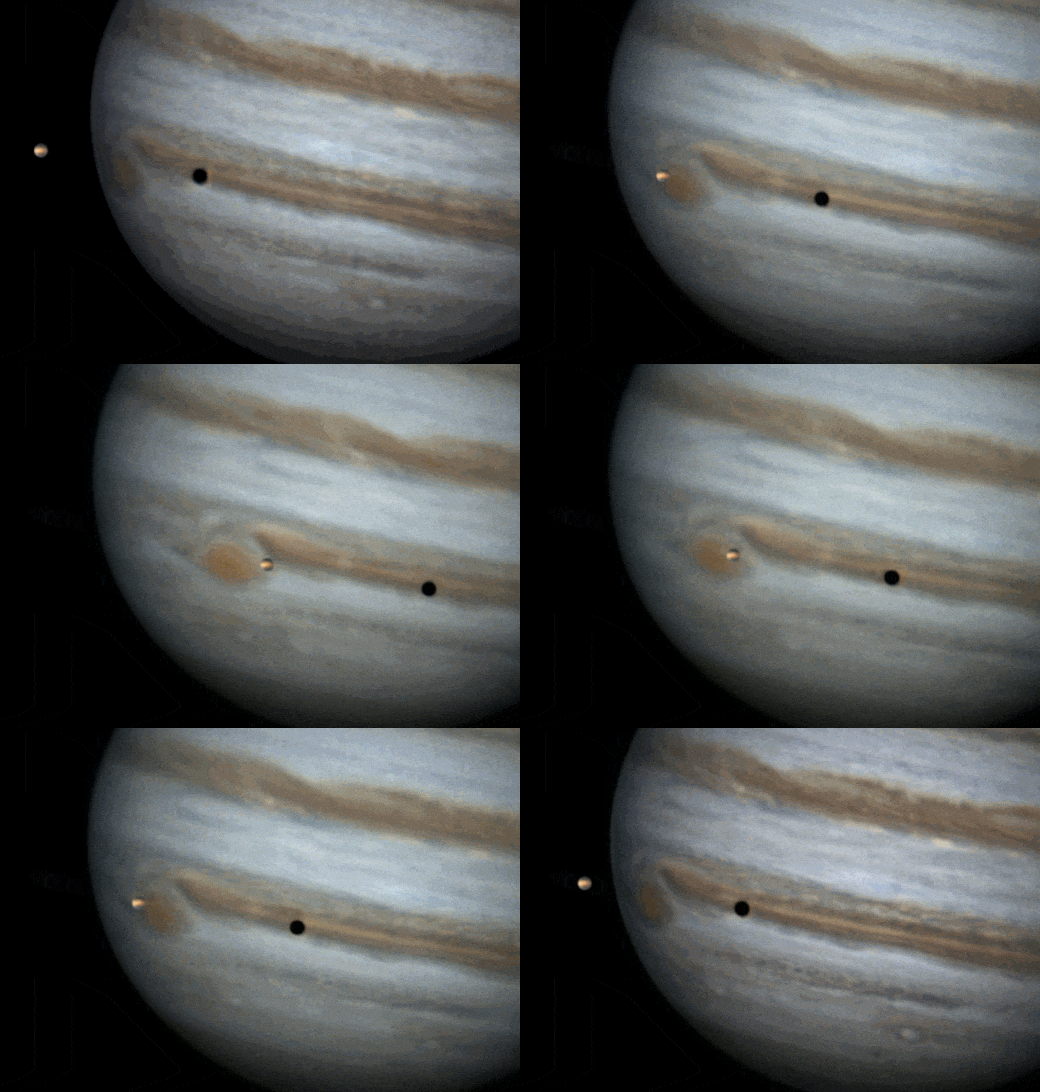
"Jupiter's moon Io transited the Great Red Spot--and its shadow was visible, too!" says Smith."I recorded the event on Oct. 4th using a 14-inch telescope."
Opposition geometry is perfect for transits and shadow-casting. BBC's Sky at Night Magazine lists more dates of interest in the nights ahead. Look for Jupiter rising in the east after sunset not far from the Pleiades star cluster. Even small telescopes can see the show.
Realtime Space Weather Photo Gallery
Free: Spaceweather.com Newsletter
HANDMADE ANNULAR SOLAR ECLIPSE PENDANT: This pendant has touched the shadow of the Moon. The students of Earth to Sky Calculus launched it to the stratosphere on Oct. 14, 2023, during the annular solar eclipse. The handmade pendant was 78,500 feet high when the Moon's shadow arrived and wrapped it in a cool twilight-like darkness:
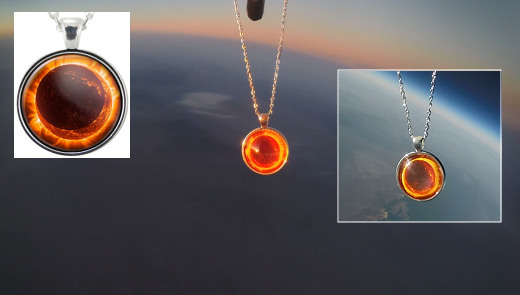
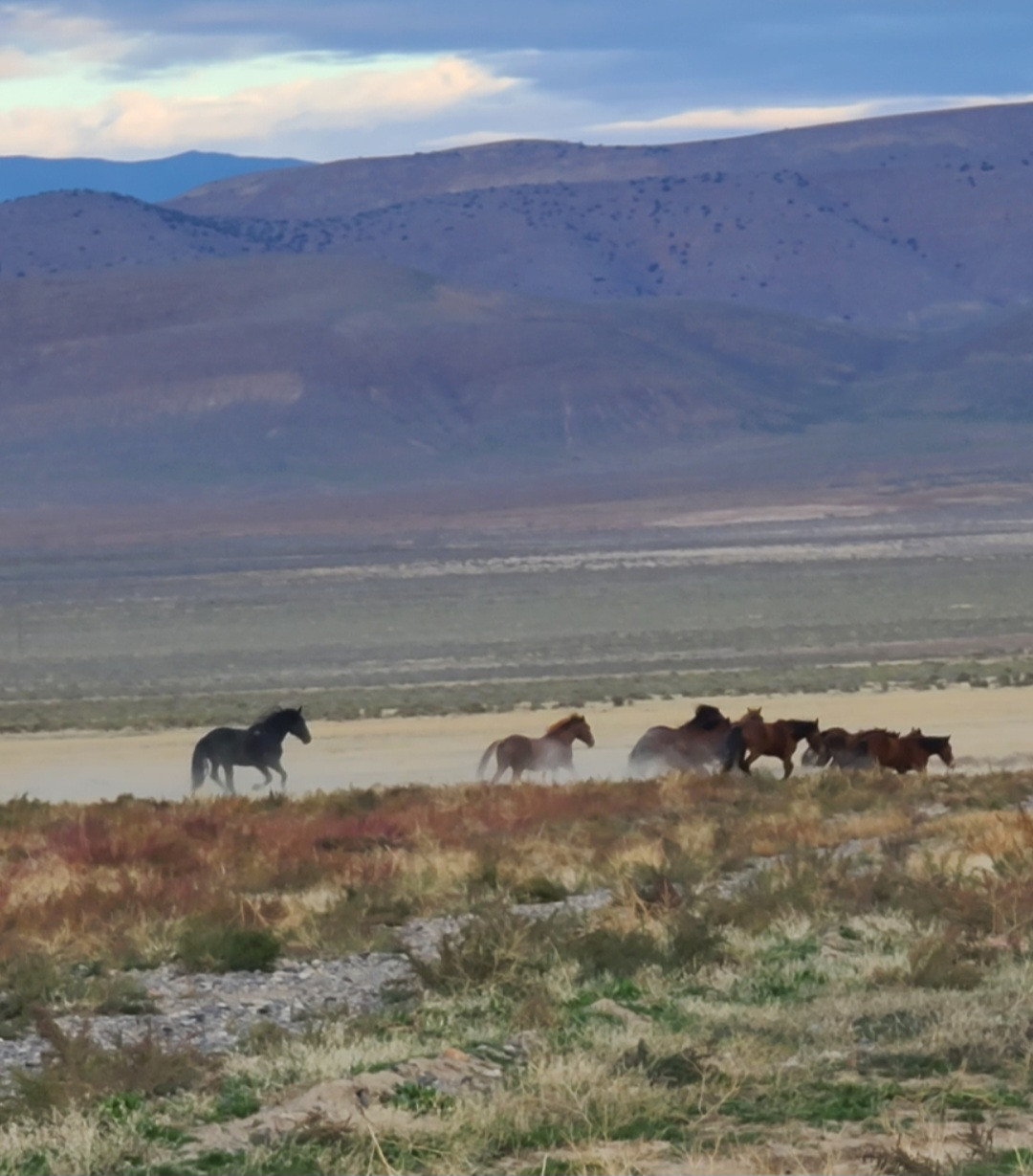
You can have it for $129.95. The pendant left Earth from Nevada's Valley of the Moon, a remote area filled with the scent of sage and herds of wild horses. Indeed, no fewer than three mustang families approached the launch team during the eclipse to see what was going on. It was a magical experience.

The students are selling space pendants to pay the helium bill for their cosmic ray ballooning program. Each one comes with a greeting card showing the jewelry in flight and telling the story of its trip to the stratosphere and back again.
Far Out Gifts: Earth to Sky Store
All sales support hands-on STEM education
Realtime Space Weather Photo Gallery
Free: Spaceweather.com Newsletter
Realtime Comet Photo Gallery
Free: Spaceweather.com Newsletter