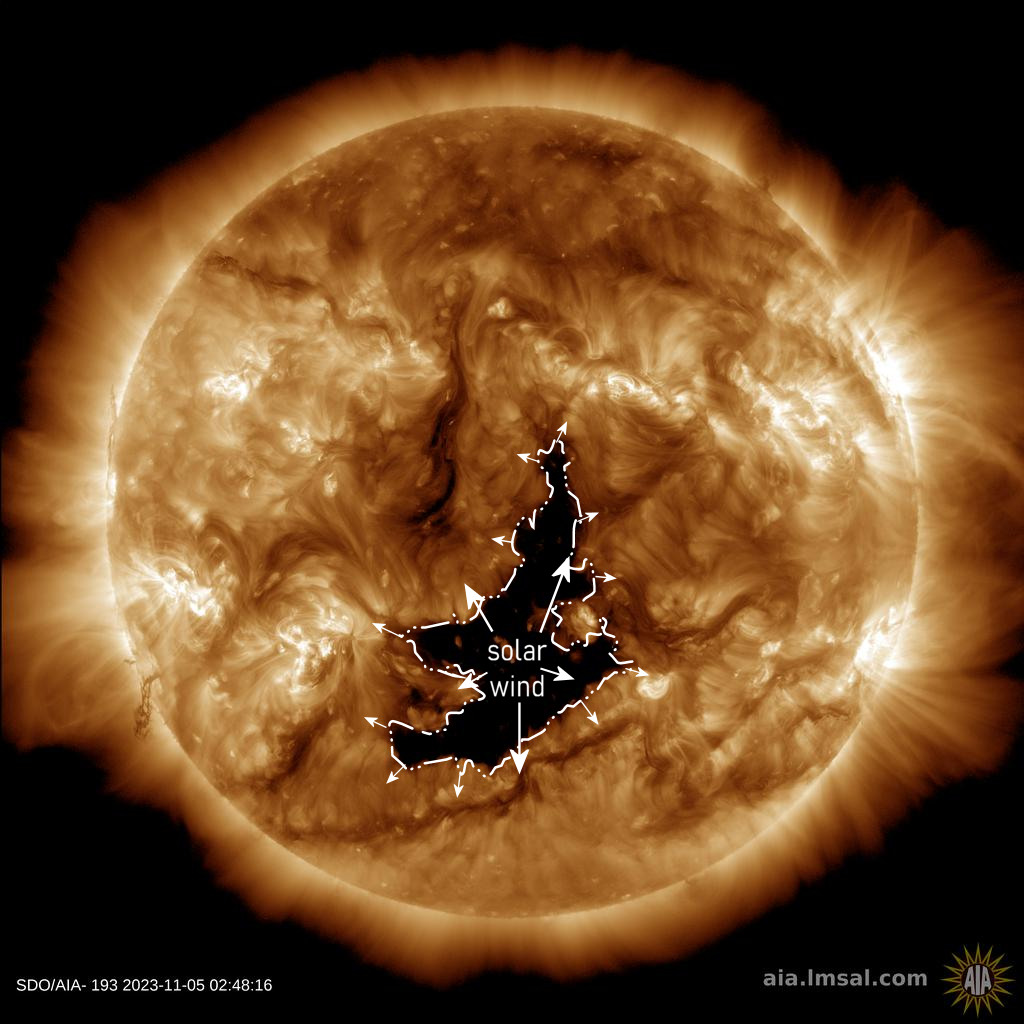
GEOMAGNETIC STORM WATCH (G1): Minor G1-class geomagnetic storms are possible on Nov. 8th and 9th when Earth enters a stream of fast-moving solar wind. The gaseous material is flowing from a southern hole in the sun's atmosphere. High-latitude sky watchers should be alert for auroras. Aurora alerts: SMS Text

EARTH'S RING CURRENT JUST SPRANG A LEAK: During this past weekend's strong G3-class geomagnetic storm, low-latitude auroras spread as far south as Texas and Arizona. Upon further review, most of those lights were not auroras at all. Everything red in this montage is an "SAR arc":

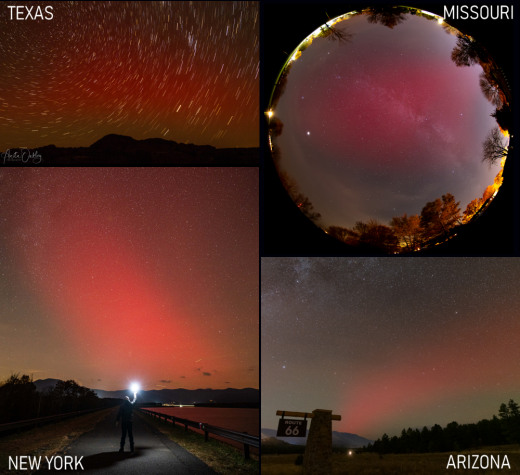
Credits: Texas (Anita Oakley); Missouri (Dan Bush); New York (James Perez-Rogers); Arizona (Jeremy Perez)
"This was a new phenomenon to me," says Jeremy Perez, who took the Arizona picture. "I had never heard of SARs before, but I kept shooting anyway."
SAR arcs were discovered in 1956 at the beginning of the Space Age. Researchers didn't know what they were and unwittingly gave them a misleading name: "Stable Auroral Red arcs" or SAR arcs. In fact, SAR arcs are neither stable nor auroras.
Auroras appear when charged particles rain down from space, hitting the atmosphere and causing it to glow. SAR arcs form differently. They are a sign of heat energy leaking into the upper atmosphere from Earth's ring current system–a donut-shaped circuit carrying millions of amps around our planet.
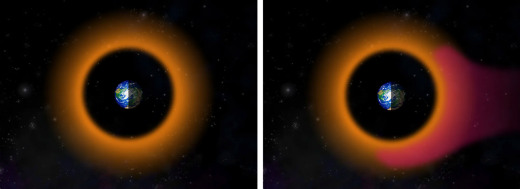
An artist's concept of Earth's ring current, quiet (left) and active (right) [more]
"On Nov. 5th, the ring current was pumped up by hours of strong geomagnetic storming, with energy dissipating into these SAR arcs," says Jeff Baumgardner of Boston University's Center for Space Physics. "It was a global event. Our cameras registered SAR arc activity from Italy to New Zealand."
Recent research has linked SAR arcs to another phenomenon that is not an aurora: STEVE. The mauve ribbon in the sky was not originally thought to have anything to do with Earth's ring current. Yet in 2015, observers in New Zealand caught a bright red SAR arc transforming itself into STEVE like a caterpillar into a butterfly.
On Nov. 5th, Mark Savage may have witnessed the same metamorphosis over Northumberland, UK:
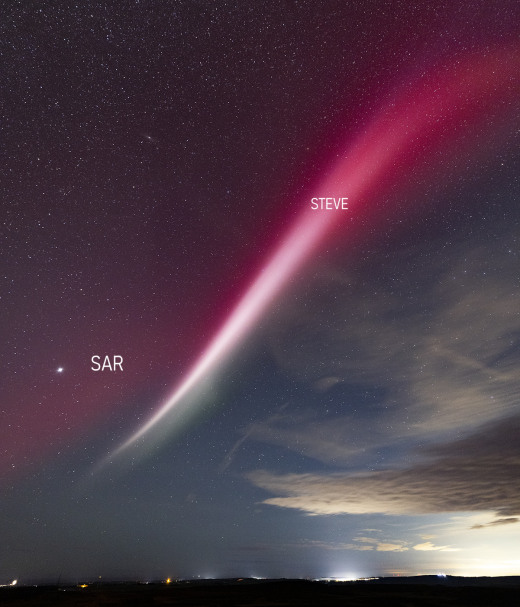
"The connection is still elusive," says Carlos Martinis, a leading researcher in the field at Boston University. "Sometimes SAR arcs evolve into STEVE--but not always. This is a very active field of research, involving citizen scientists and researchers."
Did you see an SAR arc on Nov. 5th? Submit your pictures here.
more SAR images: from Greg Redfern of Shenandoah National Park, Virginia; from Dean Cosgrove near Stockville, Nebraska; from Chris Cook of Borrego Springs, California; from Todd Bush of Banner Elk, North Carolina; from Ronnie Sherrill of Troutman, North Carolina; from George Preoteasa of Milford, PA; from David Blanchard of Wupatki National Monument, Arizona; from Hunter Outten of Laurel, Delaware; from Caryl Bohn of West Oak, Nebraska; from Ken Sklute of Phoenix, Arizona; from Bernhard Deufel of Horgen, Switzerland; from Klaus Steinberg of Troisdorf, Germany; from Bernhard Deufel of Horgen, Switzerland
Realtime Aurora Photo Gallery
Free: Spaceweather.com Newsletter
VOYAGER GOLDEN RECORD CHRISTMAS ORNAMENT: This is a must-have Christmas ornament for space fans: The Voyager Golden Record. On Oct. 31, 2023, the students of Earth to Sky Calculus launched it to the stratosphere onboard a cosmic ray research balloon:
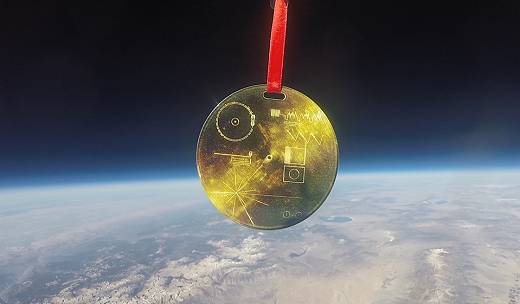
You can have it for $99.95. The 3-inch aluminum disk is imprinted with instructions intended for extraterrestrials, telling them how to play the phonographs now sailing through interstellar space onboard NASA's Voyager probes. Having touched the edge of space, it's the closest thing on Earth to an actual Golden Record.
The students are selling these unique ornaments to support their cosmic ray ballooning program. Each one comes with a greeting card showing the ornament in flight and extra materials decoding the markings on the disk.
Far Out Gifts: Earth to Sky Store
All sales support hands-on STEM education
Realtime Space Weather Photo Gallery
Free: Spaceweather.com Newsletter
Realtime Comet Photo Gallery
Free: Spaceweather.com Newsletter