ASTEROID TO OCCULT BETELGEUSE: Next month, main-belt asteroid 319 Leona will pass directly in front of Betelgeuse, allowing astronomers to make a crude map of the star's surface. The occultation will be visible on Dec. 12th within a narrow corridor stretching from central Asia and southern Europe to Florida and Mexico. Data from the occultation may help theorists better predict when the famously unstable star will finally explode. Full story and observing tips.
MAJOR CRYOVOLCANIC OUTBURST: Comet 12P/Pons-Brooks just experienced its biggest outburst yet. On Nov. 14th the cryovolcanic comet abruptly brightened more than 100-fold all the way to magnitude +9.3. Retired biology professor and now-amateur astronomer Eliot Herman has been monitoring the comet almost every night, and he caught the latest eruption hours after it began (lower right):
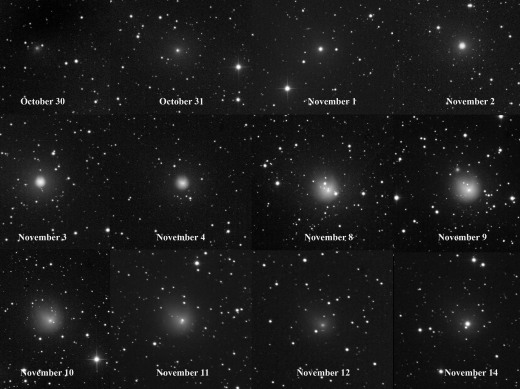
"There have now been four major outbursts by this comet in 2023: July 20th, Oct. 5th, Nov. 1st, and now Nov. 14th--a trend that looks to be more frequent activity," says Herman.
Astronomers have long known that Comet 12P/Pons-Brooks is unstable. Discovered in 1812 by Pons, and discovered again in 1883 by Brooks, it visits the inner solar system every 71 years. Since the 19th century at least seven significant outbursts have been observed. 2023 is on pace to match that number in one year alone.
This comet has been widely reported in the news as the 'devil comet' due to a pair of devil-like horns that appeared during three prior outbursts. This time might be different. "There is no sign of any dark lane in the coma," reports Nick James, Director of the Comet Section of the British Astronomical Association, who took this picture on Nov. 15th:
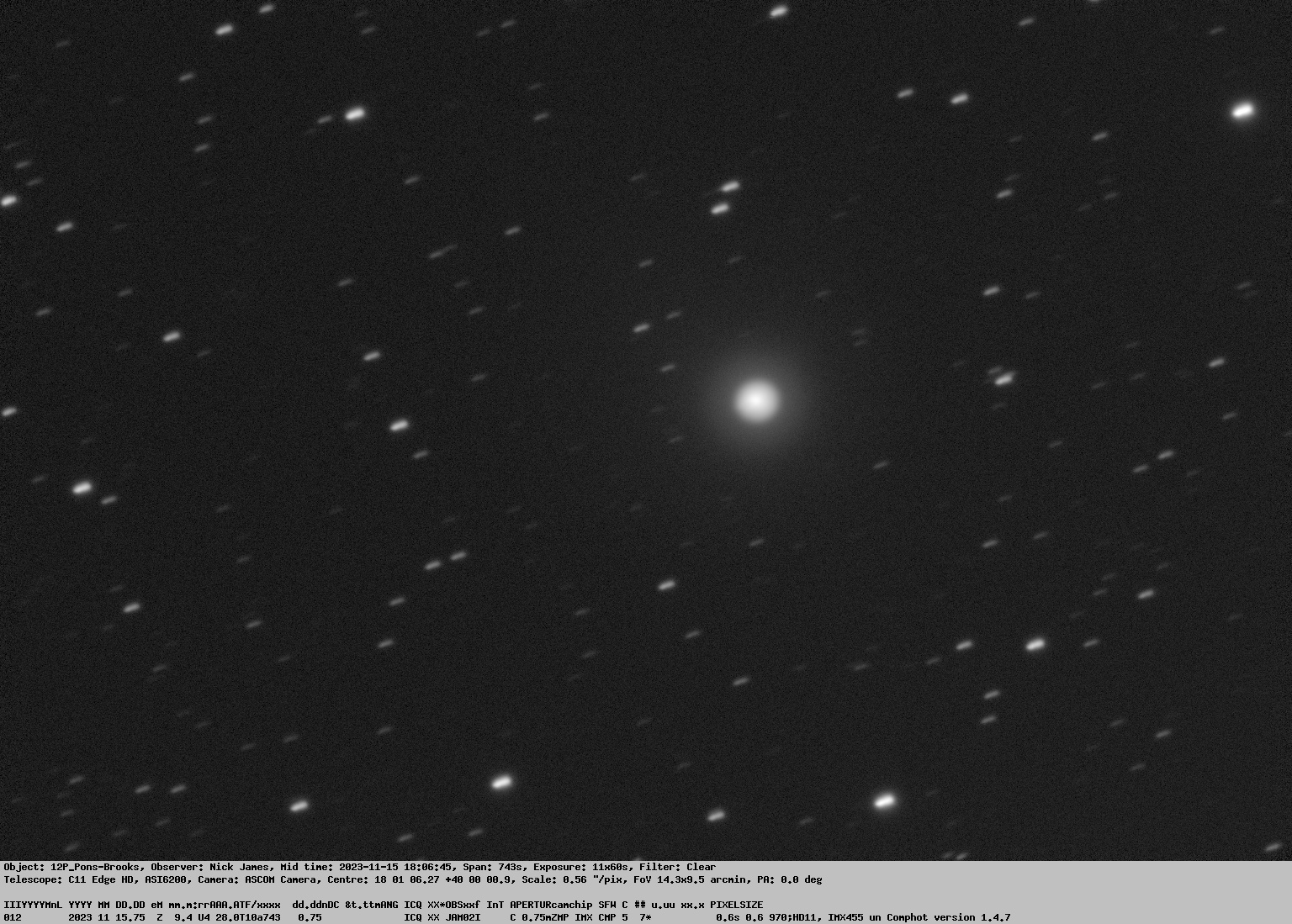
"The [comet's atmosphere] seems perfectly circular this time," he says.
Richard Miles of the British Astronomical Association thinks 12P may be one of 10 to 20 known comets with active ice volcanoes. The “magma” is a cold mixture of liquid hydrocarbons and dissolved gasses, all trapped beneath a surface which has the consistency of wax. These bottled-up volatiles can explode when sunlight opens a fissure.
Amateur astronomers are encouraged to monitor developments. Comet 12P is currently in the constellation Hercules not far from the bright star Vega. Will the devil's horns reappear? Submit your photos here.
Realtime Space Weather Photo Gallery
Free: Spaceweather.com Newsletter
OUT-OF-THIS-WORLD STOCKING STUFFER: This Christmas stocking stuffer has touched space. Make it Soap! Scented like Earl Grey tea, this bar of soap flew 117,749 feet above the snow-capped Sierra Nevada Mountains of central California onboard an Earth to Sky Calculus cosmic ray balloon:
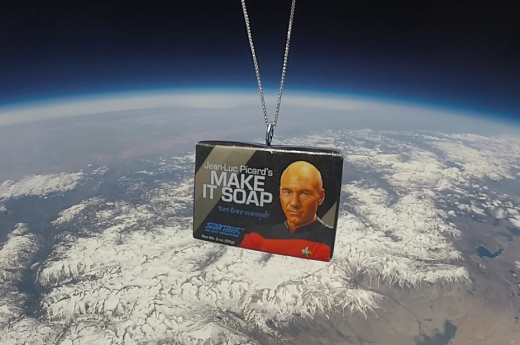
You can have it for $49.95. The students of Earth to Sky are selling space soap to support their cosmic ray ballooning program. Each bar comes with a greeting card showing the soap in flight and telling the story of its journey to the stratosphere and back again. Spock soap is available, too!
Far Out Gifts: Earth to Sky Store
All sales support hands-on STEM education
Realtime Aurora Photo Gallery
Free: Spaceweather.com Newsletter
Realtime Comet Photo Gallery
Free: Spaceweather.com Newsletter