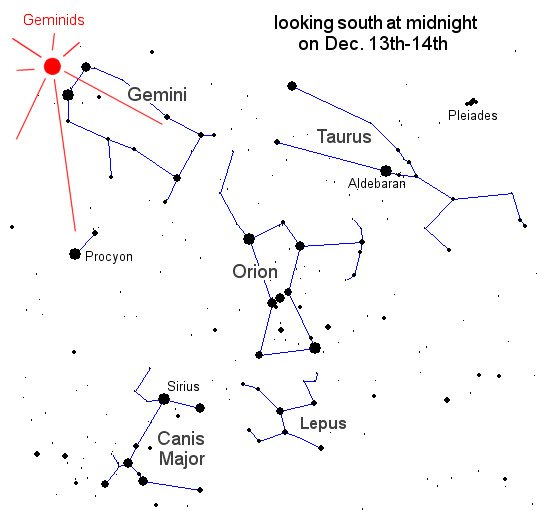
THE GEMINID METEOR SHOWER: Earth is entering a stream of debris from "rock comet" 3200 Phaethon, source of the annual Geminid meteor shower. Last night, Dec. 11-12, NASA cameras recorded 23 Geminid fireballs over the USA. Many more are coming. Forecasters expect the shower to peak on Dec. 13-14 with as many as 100 meteors/hour visible from dark sky sites. More: Observing tips; sky map.
THE BETELGEUSE OCCULTATION--WHAT HAPPENED? As reports trickle in from Europe and the Middle East, a consensus is emerging: The occultation of Betelgeuse by asteroid Leona may have been less dramatic than expected. "Observing with the naked eye, the drop in brightness was barely visible," reports Fabrizio Melandri from Terranova Da Sibari, Italy. Using his camera, he made a 1 minute star trail exposure to illustrate the change:
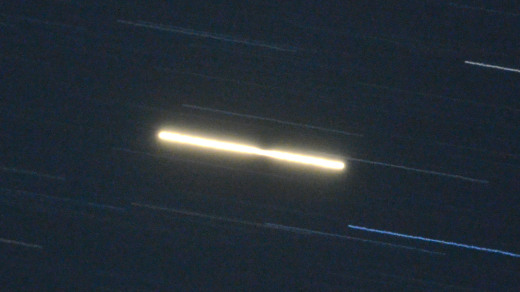
"You can notice the modest and brief drop in brightness of the star about halfway through the shot," says Melandri.
In Bursa, Turkey, astronomer Tunç Tezel says Betelgeuse dimmed by "two full magnitudes at least, but did not disappear. Apparently this was some kind of an annular eclipse, as Leona could not cover Betelgeuse completely."
Mohamad Sol positioned himself near the centerline in Hondón de las nieves, Spain, and took this video:
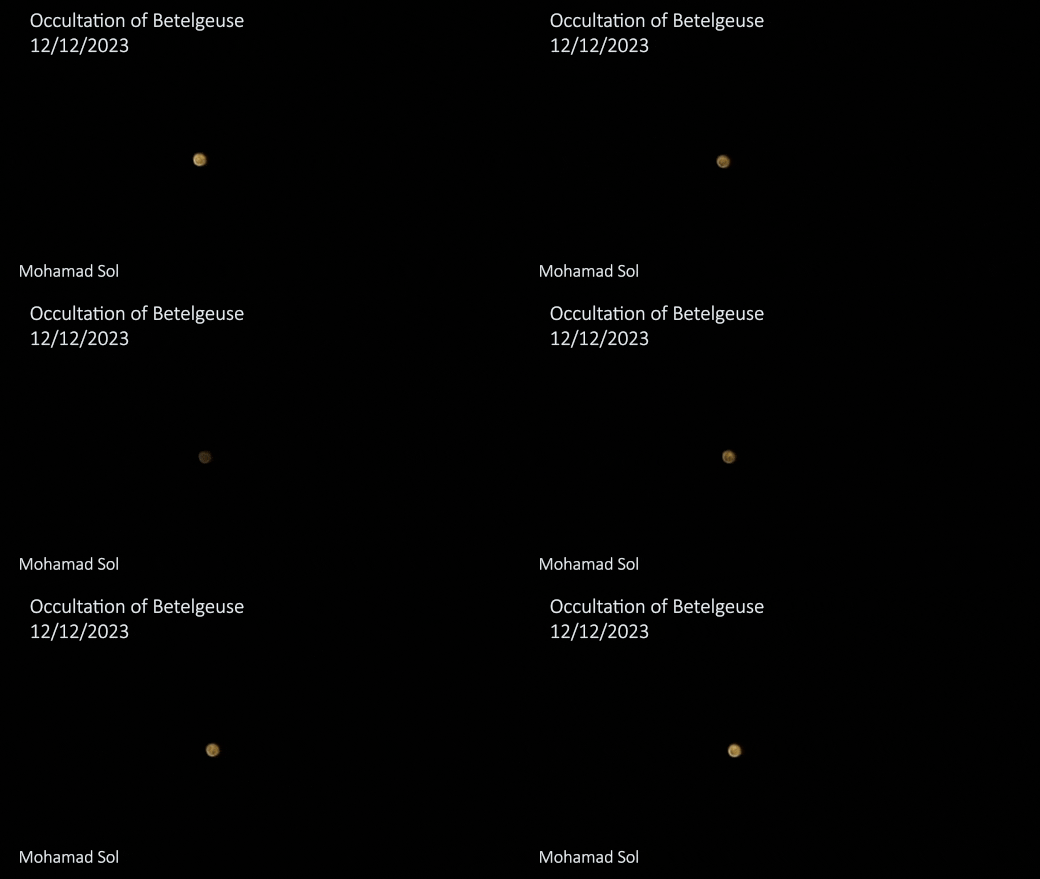
"With my naked eye, I could see a reduction in light from Betelgeuse for a maximum of two seconds," says Sol. "As the video shows, however, the star did not disappear."
Betelgeuse was supposed to dim at least 3 magnitudes when Leona passed in front of it. However, the rotating asteroid has an iregular shape, and probably did not cover as much of the star as expected. Stay tuned for reports from other observing sites. (Did you observe the occultation? Submit your images here.)
more images: from Antonio Piras of Assemini, Sardinia, Italy; from Sebastian Voltmer of Almodóvar del Río, Spain; from the Sormano Astronomical Observatory in Italy
Realtime Space Weather Photo Gallery
Free: Spaceweather.com Newsletter
CHRISTMAS GIFTS FROM THE EDGE OF SPACE: Christmas is coming. Are you looking for a far-out gift? Check out the Earth to Sky Store. It's filled with unique items that have flown to the edge of space onboard cosmic ray research balloons.
Carried aloft by giant helium balloons, these unique gifts have flown above 99.7% of Earth's atmosphere, experiencing space-like blasts of cosmic rays, extreme cold, and a wild ride parachuting back to Earth after the balloon explodes. Even Amazon doesn't carry items this far out.
Don't forget to enter coupon code "BUZZALDRIN" at checkout for a 10% holiday discount.
Far Out Gifts: Earth to Sky Store
All sales support hands-on STEM education
SUNDIVING COMET: By the time you finish reading this, the Solar System will have one less comet. SOHO coronagraphs caught the dirty snowball diving into the sun on Dec. 11th:
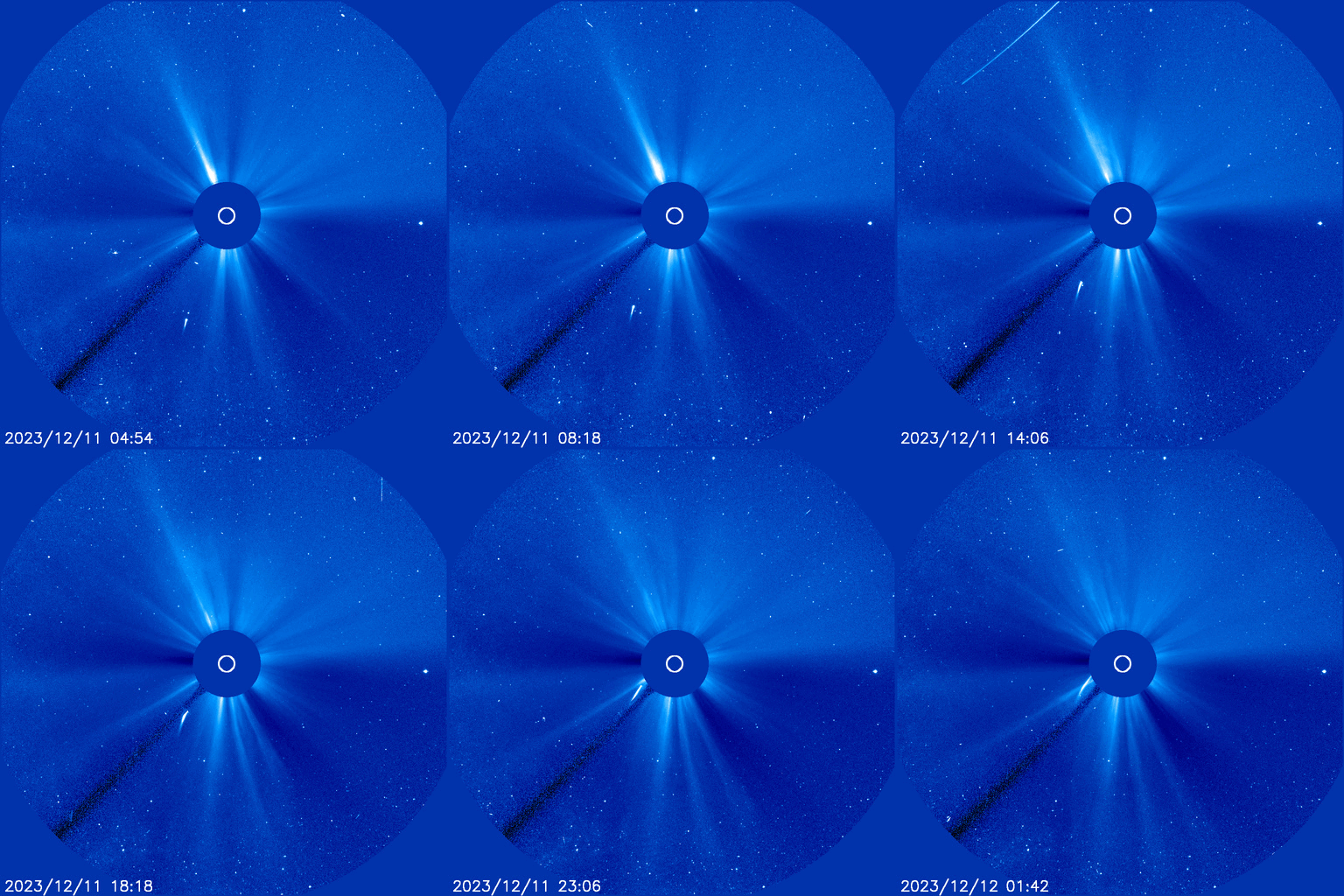
Note: The comet briefly dims when it passes behind a mechanical arm, which supports the coronagraph's occulting disk
The kamikaze comet is a member of the Kreutz sungrazer family. Named after a 19th century German astronomer who studied them in detail, Kreutz sungrazers are fragments from the breakup of a giant comet at least 2000 years ago. Several of these fragments pass by the sun and disintegrate every day. Most are too small to see. This fragment is a big exception.
By now the comet has been vaporized. The next batch of SOHO data will probably show a small cloud of debris and a decapitated tail emerging from behind the sun. R.I.P. comet!
Realtime Comet Photo Gallery
Free: Spaceweather.com Newsletter
Realtime Aurora Photo Gallery
Free: Spaceweather.com Newsletter
Realtime Comet Photo Gallery
Free: Spaceweather.com Newsletter