CHANCE OF FLARES TODAY: Don't be surprised if there is an M-class solar flare today. At least three sunspots have unstable magnetic fields teetering on the edge of explosion: AR3519, AR3521, AR3529. NOAA forecasters peg the odds of an M-flare at 40%. Any explosions today will probably be geoeffective; two of the sunspots are directly facing Earth. Solar flare alerts: SMS Text
BEST DISPLAY OF PSCs IN DECADES: Here at Spaceweather.com, we've been covering polar stratospheric clouds (PSCs) for almost 25 years. This week's outbreak may be the best in decades. "This evening I have for the first time witnessed my first ever polar stratospheric clouds, which are so incredibly rare here in Denmark," reports Ruslan Merzlyakov. "I rushed to the other side of the Limfjord to capture this mesmerising phenomenon!"

Limfjord's latitude is +56N, a full 10 degrees south of the Arctic Circle where the clouds are normally contained. Indeed, PSCs have been sighted outside the Arctic Circle for more than 4 days in a row, making the outbreak remarkably long-lasting and sustained.
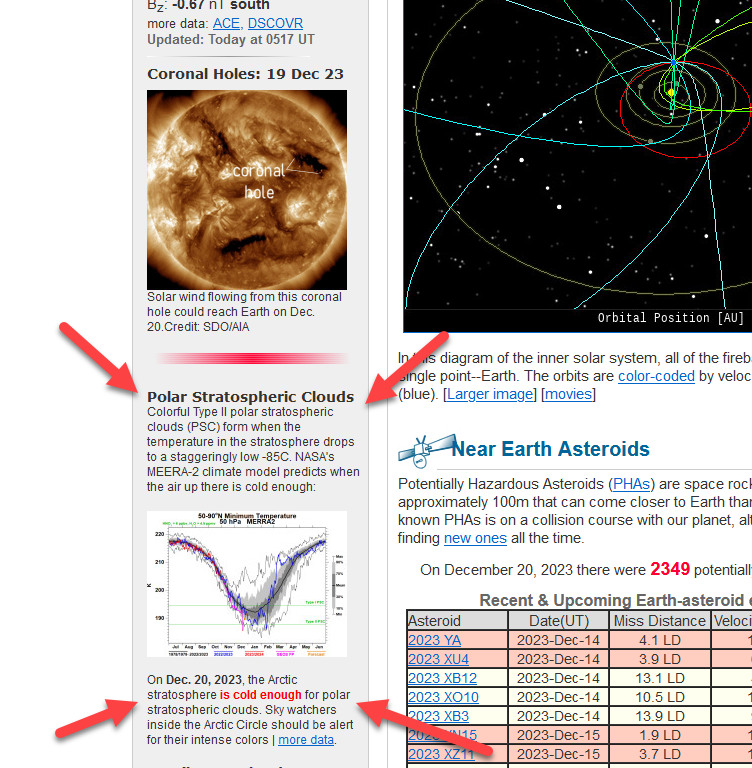
Polar stratospheric clouds are a sign of extreme cold. They form when the temperature in the Arctic stratosphere drops to a staggeringly-low -85 C. Then, and only then, can widely-spaced water molecules in the dry stratosphere coalesce into tiny ice crystals. High-altitude sunlight shining through the crystals creates intense iridescent colors that rival auroras.
"I have never seen them so large and vividly colorful before," reports Ronny Tertnes, who sends this sunrise photo from Bergen, Norway:
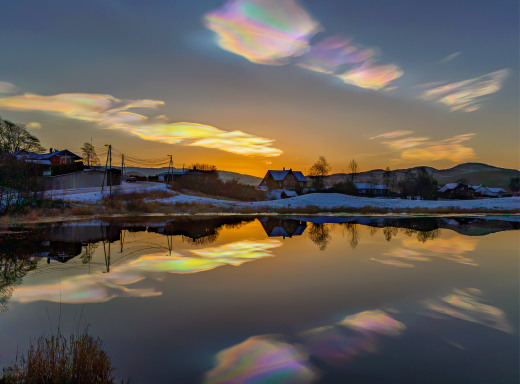
"The photos don't really justify the wonderful sight," he says.
During a typical Arctic winter, PSCs appear no more than a handful of times, and the first sightings usually come in January. This week's apparition marks an early start, and may herald many more PSCs to come.
Something new: For the rest of this northern winter season, we will publish daily predictions of temperatures in the Arctic stratosphere. This will help sky watchers know when to look for these rare clouds. The predictions are right here.
more images: from Ian Carstairs of Harleston, Norfolk, UK; from Stu Nock of Manchester, UK; from Shaun Greenwell of Newcastle upon Tyne, UK; from Alan C Tough of Elgin, Moray, Scotland; from Lesley Robertson of Black Isle, Scotland; from Sheri Karl of Aberdeen, Scotland; from Jamie McBean of Herne Bay, Kent, UK; from Tomas of Perthshire, Scotland; from Gordon Ward of Hightown Castleford UK; from Les Brooks of East Shore Village, County Durham, UK; from Michael Horne of Luncarty, Scotland; from Steve Brown of North Yorkshire, UK;
Realtime Space Weather Photo Gallery
Free: Spaceweather.com Newsletter
CHRISTMAS GIFTS FROM THE EDGE OF SPACE: Are you looking for a far-out Christmas gift? Check out the Earth to Sky Store. It's filled with unique items that have flown to the edge of space onboard cosmic ray research balloons.
Carried aloft by giant helium balloons, these unique gifts have flown above 99.7% of Earth's atmosphere, experiencing space-like blasts of cosmic rays, extreme cold, and a wild ride parachuting back to Earth after the balloon explodes. Even Amazon doesn't carry items this far out.
Don't forget to enter coupon code "BUZZALDRIN" at checkout for a 10% holiday discount.
Far Out Gifts: Earth to Sky Store
All sales support hands-on STEM education
Realtime Aurora Photo Gallery
Free: Spaceweather.com Newsletter
Realtime Comet Photo Gallery
Free: Spaceweather.com Newsletter