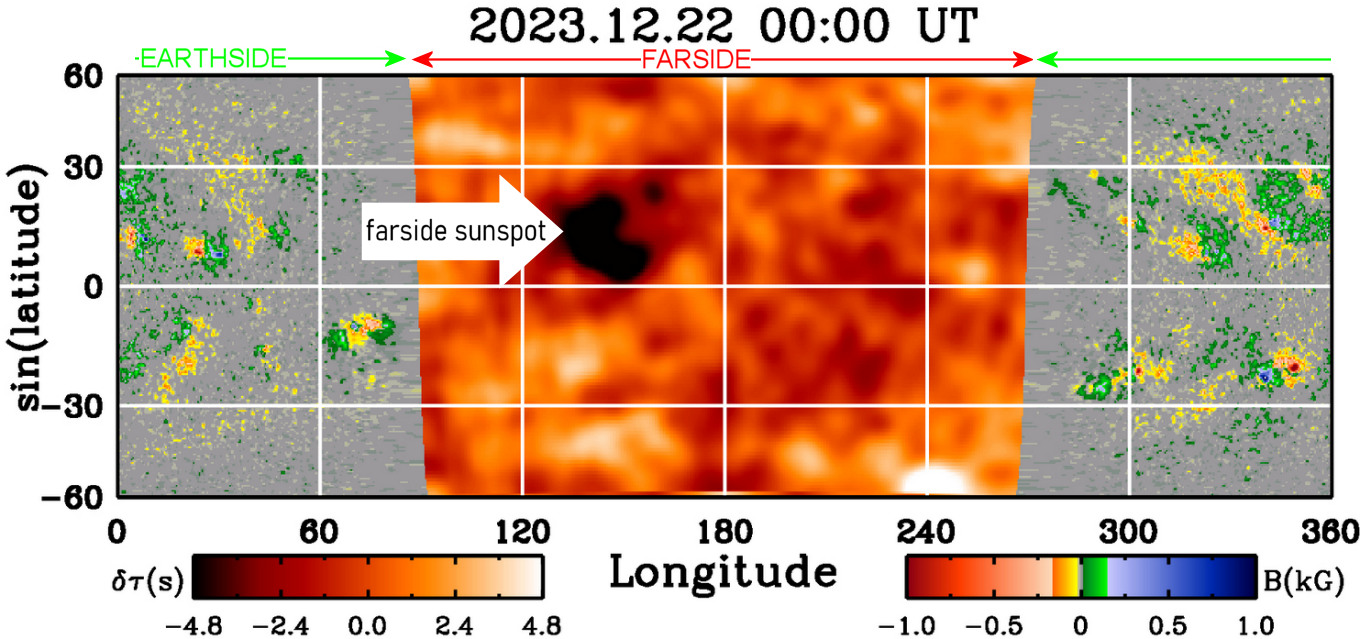
LARGE FARSIDE SUNSPOT: There is a sunspot on the farside of the sun so large it is affecting the way the whole sun vibrates. Helioseismologists have pinpointed its echo, right here. The active region is about one week from rotating onto the Earthside of the sun. Meanwhile, stay tuned for some impressive farside halo CMEs. CME alerts: SMS Text
RECORD-COLD WEATHER IN THE STRATOSPHERE: Now we know why polar stratospheric clouds (PSCs) have suddenly exploded. According to NASA's MERRA-2 climate model, temperatures in the Arctic stratosphere just hit a 40-year record low for the month of December:
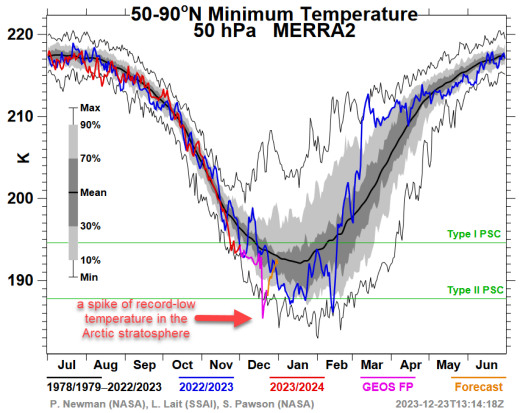
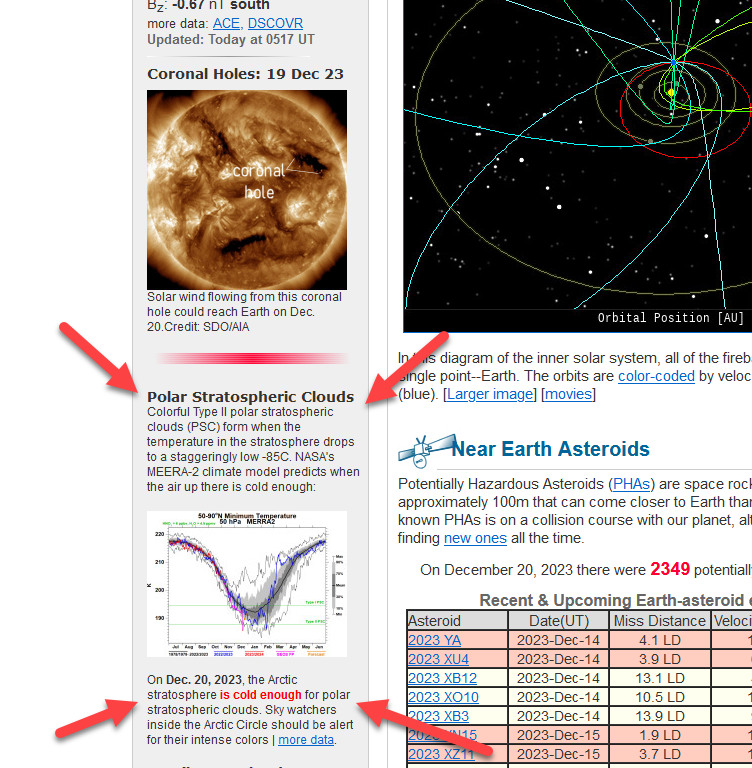
Cold air in the stratosphere is exactly what PSCs require. Normally, the stratosphere has no clouds at all. But when the temperature drops to a staggeringly-low -85 C, widely-spaced water molecules coalesce into ice crystals and PSCs begin to form. Their aurora-like colors make them the most beautiful clouds on Earth.
PSCs are normally confined to the Arctic where the stratosphere is coldest. During this week's extreme cold wave, the clouds descended all the way to mid-latitudes. Here they are over Locarno,Switzerland (+46N):
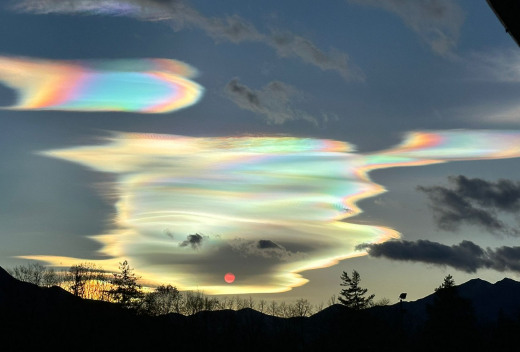
"I saw these clouds for the first time on Dec. 22nd," says photographer Branca Cristina. "The colors were amazing!"
At the same time, the clouds were sighted in Torun, Italy (+45N); the next morning they appeared again in Lausanne, Switzerland (+47N). These are extraordinary excursions from normal PSC habitat.
The season for PSCs usually starts in January. The current cold wave has given the season an early start, and could herald many more clouds in the weeks to come. To help sky watchers catch these rare clouds, we will henceforth publish daily predictions of temperatures in the Arctic stratosphere. When the air is cold, it's time to look! Look here for the forecast.
Realtime Space Weather Photo Gallery
Free: Spaceweather.com Newsletter
AMBER DRAGONFLY SPACE PENDANT: This dragonfly has touched space. On Nov. 28th, the students of Earth to Sky Calculus launched it to the stratosphere onboard a cosmic ray research balloon, 109,228 feet above California's Sierra Nevada:

You can have it for $179.95. Made of genuine Baltic Amber with a sterling silver exoskeleton, the pendant measures 1 1/4 inch and comes with a matching 18-inch sterling silver chain. The wings of the dragonfly include four pieces of natural amber colored Cognac, Olive Green and Honey Yellow.
The students are selling space pendants to pay the helium bill for their cosmic ray ballooning program. Each one comes with a greeting card showing the jewelry in flight and telling the story of its trip to the stratosphere and back again.
Far Out Gifts: Earth to Sky Store
All sales support hands-on STEM education
Realtime Aurora Photo Gallery
Free: Spaceweather.com Newsletter
Realtime Comet Photo Gallery
Free: Spaceweather.com Newsletter