GEOMAGNETIC STORM WATCH (G1): 2024 could begin with a geomagnetic storm. NOAA forecasters say that minor G1-class storms are possible on Jan. 1st when a co-rotating interaction region (CIR) is expected to hit Earth's magnetic field. CIRs are transition zones between fast- and slow-moving solar wind streams. They contain CME-like shock waves that do a good job sparking Arctic auroras. Aurora alerts: SMS Text

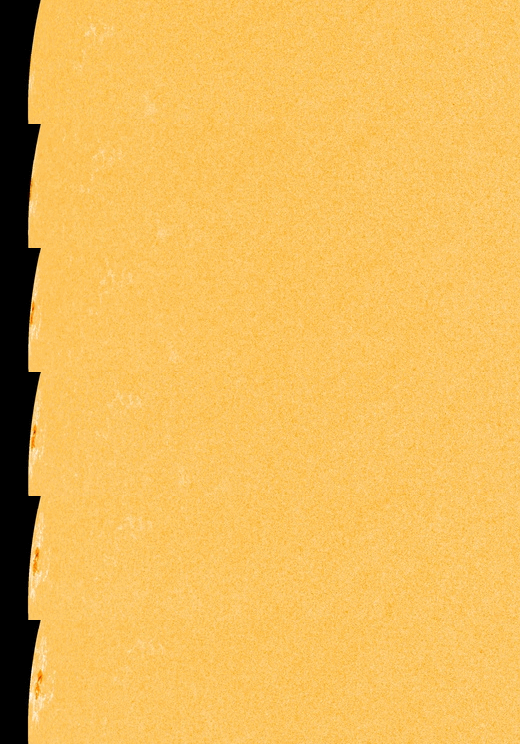
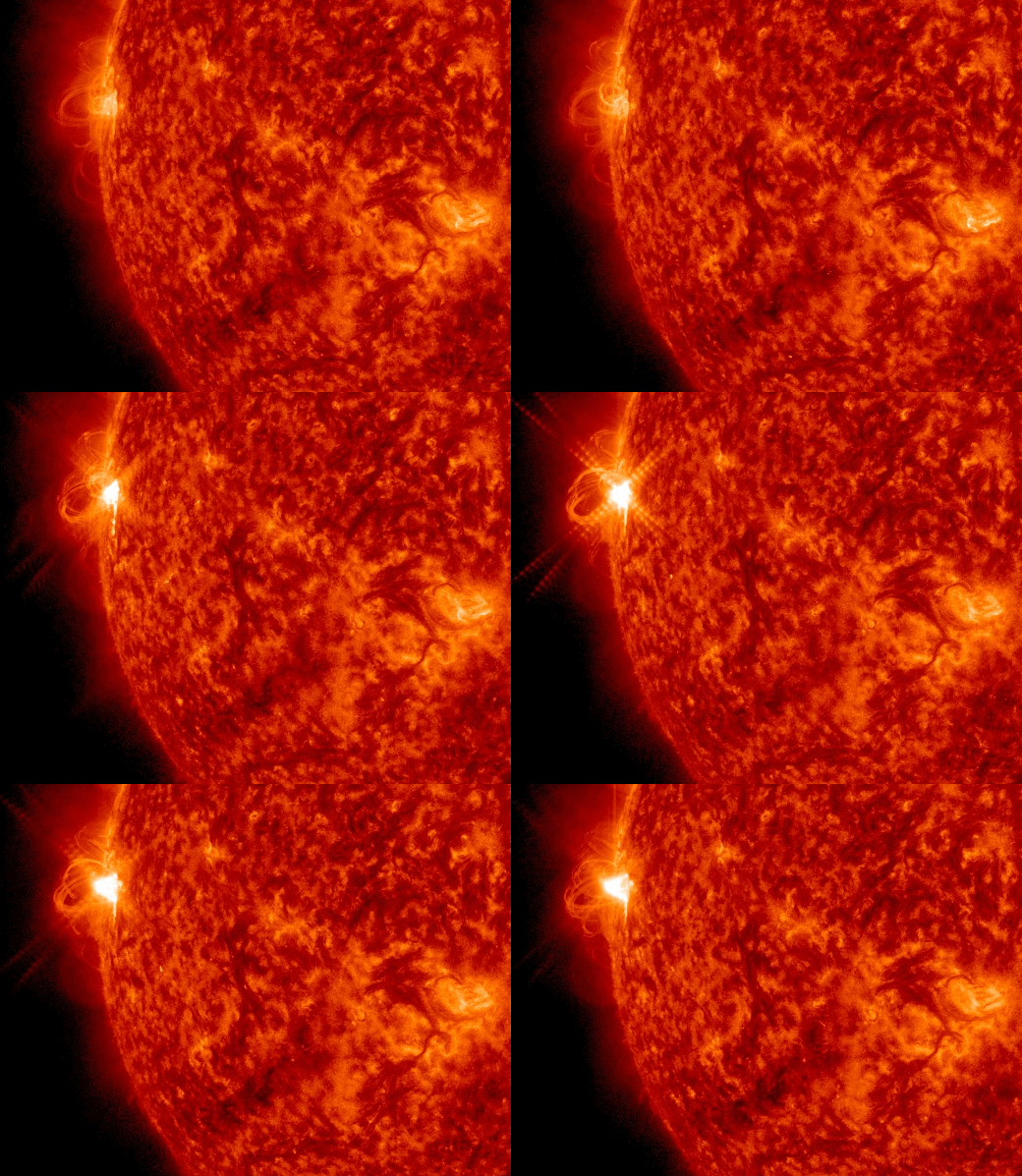
MAJOR X-CLASS SOLAR FLARE: Mere hours after emerging over the sun's eastern limb on Dec. 31st, big sunspot AR3536 erupted, producing a major X5-class solar flare. NASA's Solar Dynamics Observatory recorded the extreme ultraviolet flash:

This is the strongest flare of Solar Cycle 25 (so far) and the most powerful eruption the sun has produced since the great storms of Sept. 2017.
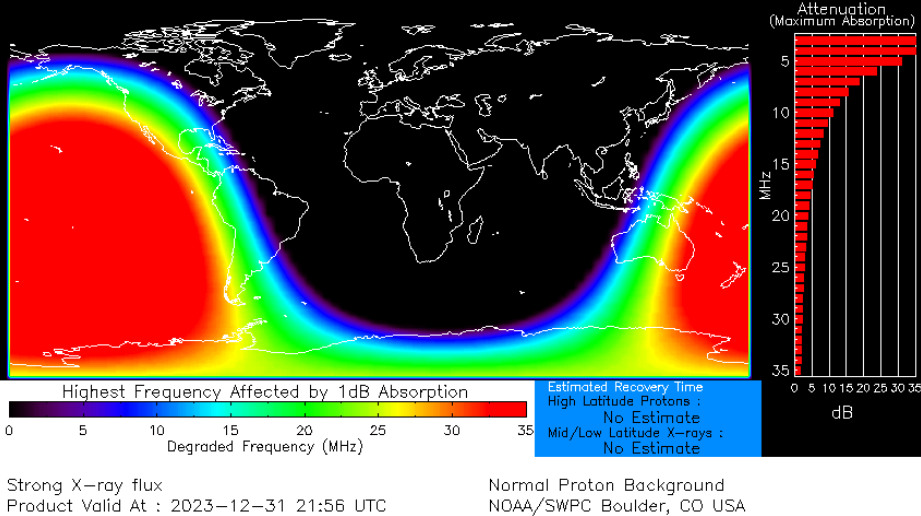
Radiation from the flare has caused a deep shortwave radio blackout over the Pacific Ocean: blackout map. Ham radio operators may notice loss of signal at all frequencies below 30 MHz for more than 60 minutes after the flare's peak (2155 UT).
It's too soon to know for sure, but this explosion probably launched a coronal mass ejection (CME) into space. Because the blast site is located near the extreme eastern edge of the sun, the CME is unlikely to have a significant Earth-directed component, but stay tuned. Solar flare alerts: SMS Text
Update: This explosion caused a solar tsunami. You can see the shock wave in this animation from NASA's Solar Dynamics Observatory.
SUDDEN STRATOSPHERIC WARMING: During the week before Christmas, a near-record cold wave hit the Arctic stratosphere. Temperatures as low as -75C created aurora-like polar stratospheric clouds (PSCs) seen as far south as Italy. Now the opposite is happening. Suddenly, the Arctic stratosphere is warming:

NASA satellite data show the stratospheric temperature rapidly spiking, with above normal temperatures expected in the next few days. This is called a sudden stratospheric warming (SSW) event. When the stratosphere warms in this way, it's a sign that the polar vortex is weakening, and might even change directions. Cold air bottled up in the Arctic can suddenly break free and spill down to lower latitudes. The famous Beast from the East coldwave that hit the UK in 2018 was caused by an SSW, albeit stronger than the one we're seeing now.
For sky watchers, this means no PSCs will be visible while the warming is in progress. The stratosphere is simply too hot for the icy clouds to form. Don't give up hope, though. This warming event is happening early in the season; there is plenty of time for another PSC-producing cold wave before northern winter is finished.
Realtime Space Weather Photo Gallery
Free: Spaceweather.com Newsletter
AMBER DRAGONFLY SPACE PENDANT: This dragonfly has touched space. On Nov. 28th, the students of Earth to Sky Calculus launched it to the stratosphere onboard a cosmic ray research balloon, 109,228 feet above California's Sierra Nevada:

You can have it for $179.95. Made of genuine Baltic Amber with a sterling silver exoskeleton, the pendant measures 1 1/4 inch and comes with a matching 18-inch sterling silver chain. The wings of the dragonfly include four pieces of natural amber colored Cognac, Olive Green and Honey Yellow.
The students are selling space pendants to pay the helium bill for their cosmic ray ballooning program. Each one comes with a greeting card showing the jewelry in flight and telling the story of its trip to the stratosphere and back again.
Far Out Gifts: Earth to Sky Store
All sales support hands-on STEM education
Realtime Aurora Photo Gallery
Free: Spaceweather.com Newsletter
Realtime Comet Photo Gallery
Free: Spaceweather.com Newsletter