QUADRANTID METEOR SHOWER: If you see a fireball on Jan. 4th, it's probably a Quadrantid. These meteors come from extinct comet 2003 EH1. Earth is expected to cross the narrow stream of debris between 0900 UT and 1500 UT, producing dozens of meteors per hour. Because the shower's radiant is high in the northern sky, it is a winter shower that few sky watchers see despite its intensity. [sky map]

ANOTHER STRONG SOLAR FLARE (UPDATED): Demonstrating its continued potency, sunspot AR3536 produced another strong flare today. The M4-class explosion peaked on Jan. 4th at 0155 UT, and hurled a streamer of plasma into space:

Extreme ultraviolet radiation from the flare ionized the top of Earth's atmosphere, causing a shortwave radio blackout over Australia and the surrounding Pacific Ocean. Mariners may have noticed loss of signal at frequencies below 20 MHz for more than 30 minutes after the flare's peak.
Update: Newly-arriving images from SOHO coronagraphs show no significant Earth-directed CME. This explosion will not be geoeffective. CME impact alerts: SMS Text
Realtime Space Weather Photo Gallery
Free: Spaceweather.com Newsletter
POLAR CAP ABSORPTION EVENT (UPDATED): The X5-flare that happened on New Year's Eve is still affecting Earth five days later. A polar cap absorption event (PCA) is underway, shown here in a shortwave radio blackout map from NOAA:
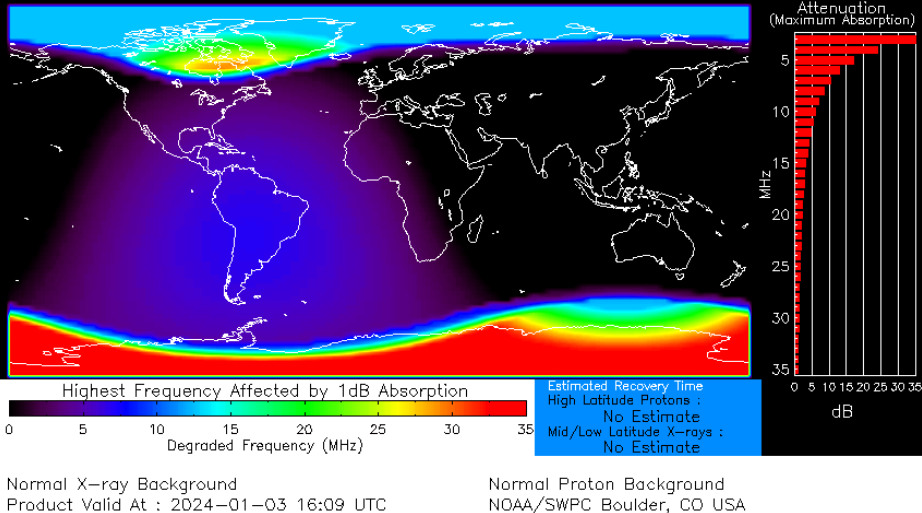
Red zones in this global map show where radio transmissions are being absorbed. Frequencies below 10 MHz are almost completely blacked out, while anything below 35 MHz is being attentuated, at least a little.
What's causing this? Protons accelerated by the New Year's Eve explosion (and subsequent lesser flares from the same sunspot) are hitting our planet. Earth's magnetic field funnels these particles toward the poles where their ionizing effect causes the absorption of shortwave radio. This can affect international aviators flying polar routes.
The absorption event could last for days; you can can monitor its progress here.
Realtime Space Weather Photo Gallery
Free: Spaceweather.com Newsletter
SIERRA MOONRISE SPACE PENDANT: Valentine's Day is coming. Are you looking for a far-out gift? Consider the Sierra Moonrise Pendant. It flew to the edge of space onboard a cosmic ray balloon, shown here 117,400 feet above the Sierra Nevada mountains of California:
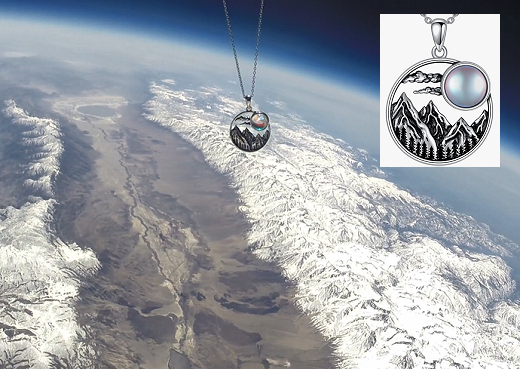
You can have it for $142.95. The sterling silver pendant shows the craggy Sierra range with a full Moonstone rising overhead. It makes a great Valentine's, birthday, or anniversary present.
The students of Earth to Sky Calculus are selling space pendants to support their cosmic ray ballooning program. Each one comes with a greeting card showing the pendant in flight and telling the story of its journey to the stratosphere and back again
Far Out Gifts: Earth to Sky Store
All sales support hands-on STEM education
Realtime Aurora Photo Gallery
Free: Spaceweather.com Newsletter
Realtime Comet Photo Gallery
Free: Spaceweather.com Newsletter