NASA IS ABOUT TO GO TO EUROPA: The most exciting space mission of 2024 is undoubtedly the Europa Clipper. This October, NASA will launch the spacecraft on a 7-year mission to Jupiter's ocean moon, where it will make 44 close flybys of Europa's icy crust. A magnetometer will probe the depth and salinity of Europa's inner ocean, while infrared cameras search for hot spots where water seeps up through the surface. Future missions may land near these spots to search for evidence of alien life. Read all about it.
THE POLAR VORTEX WOBBLED IN DECEMBER: Last month, sky watchers in Europe saw something rare and beautiful. A giant bank of polar stratospheric clouds (PSCs) escaped the Arctic Circle, and for more than a week they filled skies with rainbow color as far south as Italy. In the Italian comune of Sanfrè (latitude +45N), Pablo Javier Lucero was able to photograph the clouds at all hours of the day:
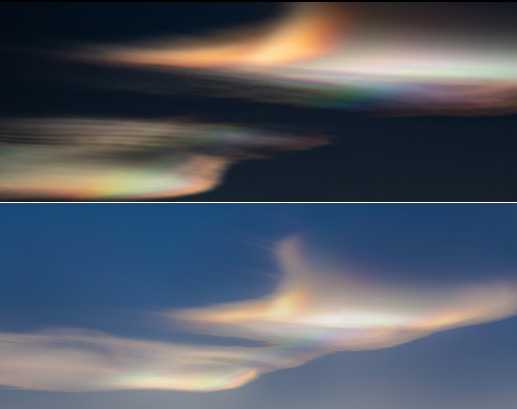
"Utterly incredible!" says Lucero. "I first saw the clouds at sunset on Dec. 22nd. After talking with a friend of mine, Jorgelina Alvarez, a meteorologist, we realized that these weren't ordinary iridescent clouds, but rather Type II polar stratospheric clouds. My surprise was gigantic."
Surprise is the correct reaction. Normally, Earth's stratosphere has no clouds at all. Only when the temperature drops to a staggeringly-low -85 C can widely-spaced water molecules assemble into icy polar stratospheric clouds. With colors that rival auroras, PSCs are considered to be the most beautiful clouds on Earth.
During the outbreak, Spaceweather.com received hundreds of photos of PSCs. Curiously, they all came from Europe. Not a single cloud was sighted in North America or Asia. Why not?
Amy Butler of NOAA's Chemical Sciences Laboratory has the answer: "The polar vortex can wobble like a top, and in December it was displaced towards Europe," she explains. "You can see this in the figure below from Zac Lawrence's website stratobserve.com."
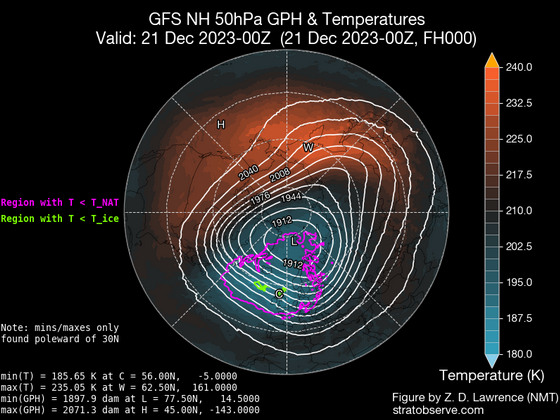
Cold air normally contained over the poles was carried by the wobbling vortex to mid-latitudes. Purple and green contours in the figure show where temperatures were cold enough for Type I and Type II PSCs, respectively.
Since the December outbreak of PSCs, which ended around Christmas, the polar stratosphere has warmed more than 30 degrees Celsius. Butler says this is probably the result of "a strong planetary wave breaking in the stratosphere." Wave energy warmed the air and dispersed the rainbow-colored clouds.
The clouds might return. As January unfolds, the polar stratospheric vortex is still tilted toward mid-latitudes in Europe. If the stratosphere cools again, PSCs could re-appear over many populated areas. You can monitor the situation with daily temperature reports right here on Spaceweather.com.
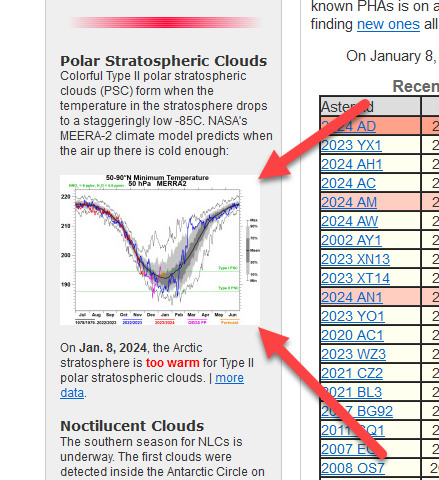
Recommended: Amy Butler writes a great Polar Vortex Blog for NOAA. Check it out!
Realtime Space Weather Photo Gallery
Free: Spaceweather.com Newsletter
"TOTAL ECLIPSE OF THE HEART" PENDANT: This is a rare and precious item. On Aug. 21, 2017, the students of Earth to Sky Calculus launched 11 space weather balloons into the Great American Solar Eclipse. This premium pendant went along for the ride, 101,004 feet high, where it was swallowed by the shadow of the Moon at the edge of space:

You can have it for $299.95. During the 2.5 hour flight, the pendant was wrapped in the Moon's shadow for more than two minutes, experiencing a spooky darkness colder than -50 C.
The pendant's blue Swarovski crystal is wrapped in a sterling silver frame engraved with the words "I ♥ u to the Moon and Back." It comes with a unique gift card showing the jewelry passing through the Moon's shadow and telling the story of its flight.
Far Out Gifts: Earth to Sky Store
All sales support hands-on STEM education
Realtime Aurora Photo Gallery
Free: Spaceweather.com Newsletter
Realtime Comet Photo Gallery
Free: Spaceweather.com Newsletter