GEOMAGNETIC STORM WATCH--CANCELED: Although the official NOAA forecast still calls for a G1-class geomagnetic storm today, the odds of such a storm are rapidly declining. A veritable blizzard of CMEs expelled by the sun earlier this week appears to have been 100% off target. There's still a slight chance of a tardy CME strking Earth on Jan. 26th; if so, NOAA forecasters will be proved correct. CME impact alerts: SMS Text

THE STRATOSPHERE IS GETTING COLD AGAIN: Yesterday in Europe, sky watchers in several countries saw colorful forms in the sky strongly resembling Type II polar stratospheric clouds (PSCs). For example, these iridescent bands appeared over Slovenia:
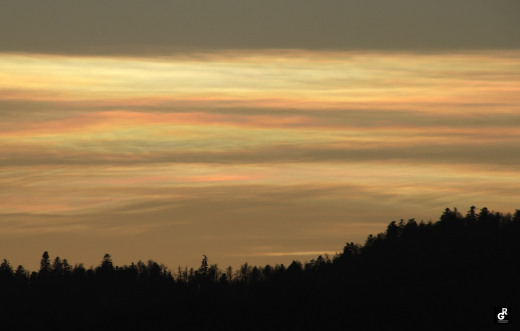
"I saw them at sunset over the Planina disappearing lake, and thought they might be PSCs," says photographer Giorgio Rizzarelli. "The colors were unusual." Similar displays were seen in Switzerland and Italy.
Normally the stratosphere has no clouds at all. But on rare occasions when the temperature drops to a staggeringly low -85 C, widely-spaced water molecules in the stratosphere coelesce to form icy clouds. Because of their vivid iridescent colors, PSCs are considered to be the most beautiful clouds on Earth.
Is the stratosphere actually cold enough to make these clouds? Maybe. NASA's MERRA2 climate model suggests that the north polar stratosphere has indeed been cooling this week. However, according to the model, it's still a few degrees to warm for the icy clouds to form.

Sky watchers may be seeing something else. There is another type of PSC made of nitric and sulphuric acids: Type I PSCs form at a slightly warmer temperature (-78 C) and, while colorful, are not as beautiful as the colder Type II PSCs. Or--here's a completely different alternative--this might be an episode of unusually intense iridescence in the troposphere.
Monitoring is encouraged. Got a picture? Submit it here.
more images: from Liselotte Kahns of Vendsyssel, Northern Jutland, Denmark; from the Sormano Astronomical Observatory in Sormano CO Italy; from Myriam Jordan of Lausanne, Switzerland; from Piero Armando of Turin, Italy; from Fabio Scherrer of Muzzano, Switzerland;
Realtime Space Weather Photo Gallery
Free: Spaceweather.com Newsletter
18K GOLD CUPID'S COMPASS: Are you looking for a romantic gift? Consider Cupid's Compass. This premuim 18K gold-filled pendant flew to the stratosphere on Jan. 6th onboard an Earth to Sky Calculus cosmic ray research balloon:
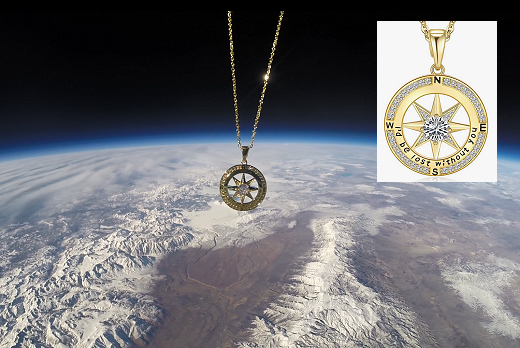
You can have it for $259.95. Engraved with the words "I'd be lost without you", the hypoallergenic pendant has a 5-star cubic zirconia crystal in the middle surrounded by a ring of equally high-grade 5A cubic zirconia nuggets. It is a visually striking pendant that makes a once-in-a-lifetime Valentine's, anniversary or birthday gift.
The students are selling space pendants to pay the helium bill for their cosmic ray ballooning program. Each one comes with a greeting card showing the jewelry in flight and telling the story of its trip to the stratosphere and back again.
Far Out Gifts: Earth to Sky Store
All sales support hands-on STEM education
Realtime Aurora Photo Gallery
Free: Spaceweather.com Newsletter
Realtime Comet Photo Gallery
Free: Spaceweather.com Newsletter