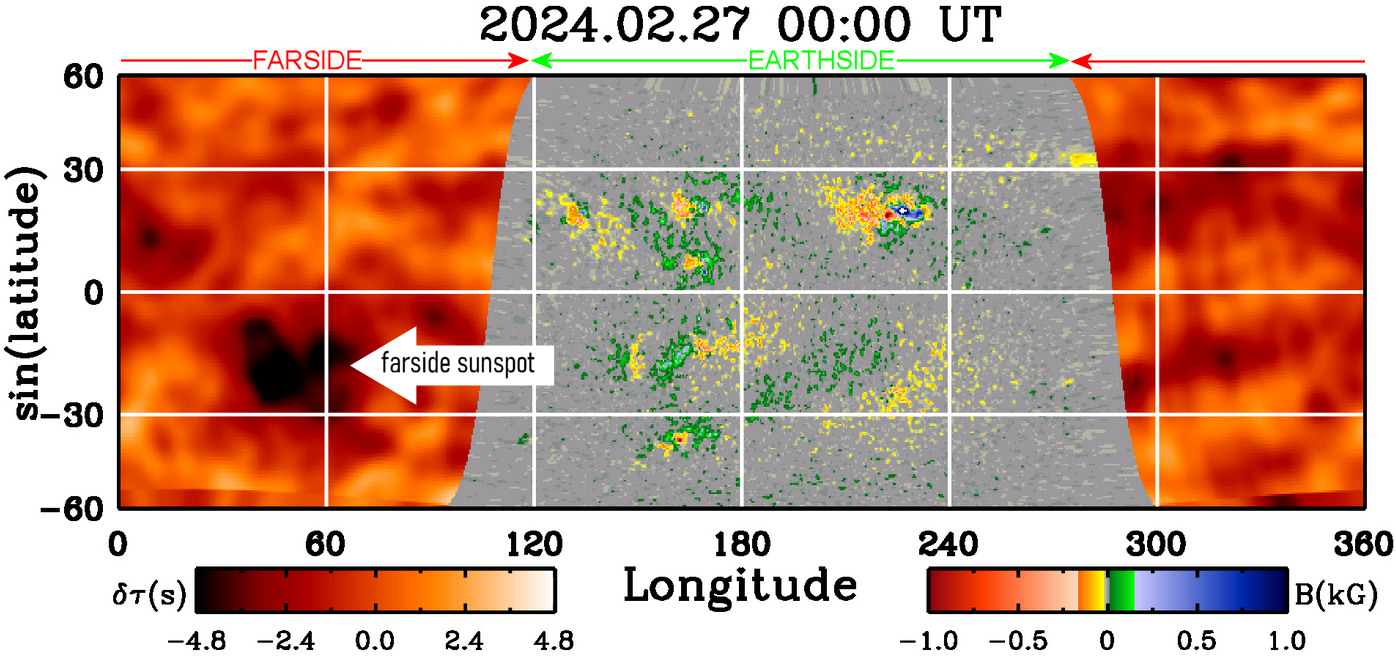
BIG FARSIDE SUNSPOT: Helioseismic images of the farside of the sun reveal a large sunspot on the sun's southern hemisphere. It will turn to face Earth this weekend, possibly bringing an uptick in solar activity. Aurora alerts: SMS Text
NASA'S STRIKE ON ASTEROID DIMORPHOS--NEW RESULTS: This is not what NASA expected to happen. Back in Sept. 2022, the space agency's DART spacecraft slammed into asteroid-moon Dimorphos, blasting huge streamers of debris into space and changing its orbit around Didymos. Mission planners figured there must be a crater where the spacecraft struck, but new research published this week in Nature Astronomy suggests something completely different happened.

"Our simulations indicate that the DART impact caused a global deformation and resurfacing of Dimorphos," the authors write. "ESA's upcoming Hera mission may find a reshaped asteroid rather than a well-defined crater."
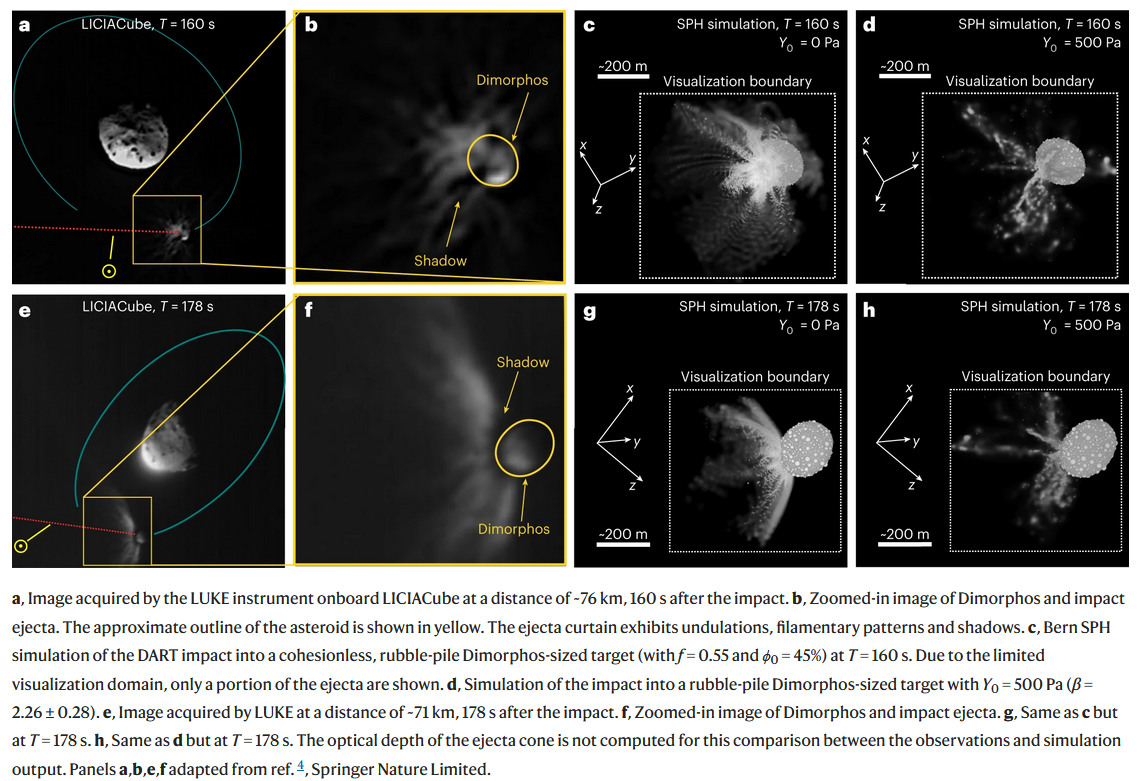
Above: Observations and simulations of the DART strike on Dimorphos. [full caption] [source]
Led by Sabina Raducan, a postdoc at the University of Bern's Physics Institute in Switzerland, the team of researchers modeled DART's impact using Bern's hydrodynamics shock physics code. The software has successfully reproduced other impacts such as the time in 2019 when Japan dropped a copper impactor into asteroid Ryugu.
After running more than 250 simulations, the team concluded that Didymos is a rubble pile--a loose mixture of dust, stones, and boulders "with a cohesive strength less than a few pascals." DART's impact ejected more than 10 million kg of this material. Instead of producing a crater, DART changed the shape of the entire pile.
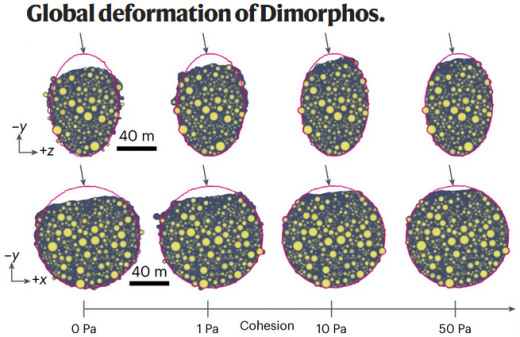
Above: Computer simulations of the global reshaping of Dimorphos. [full caption] [source]
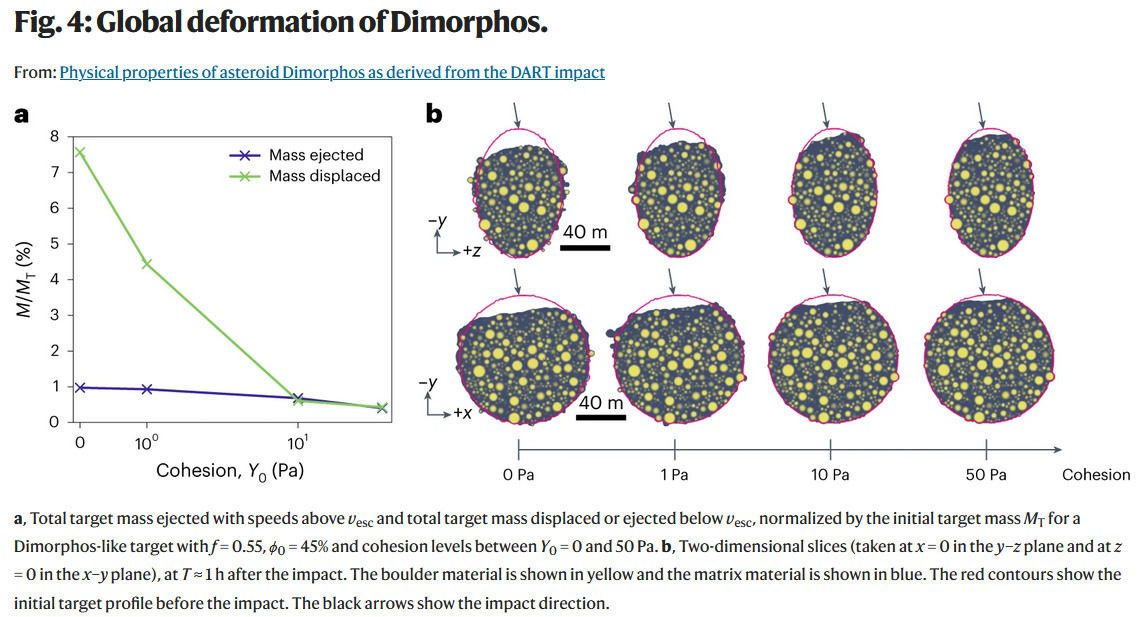
"Our findings serve as crucial evidence regarding the origin of Dimorphos as a secondary in a double asteroid system," the authors say.
Their results suggest that Dimorphos is a loose collection of debris from the rapidly-spinning parent Didymos. Whenever something flies off Didymos, because of, say, a meteorite collision, it tends to settle on Dimorphos, a process which can take several days to years.
Hera's visit to Dimorphos in 2028 may confirm these findings. If so, it will give NASA something to think about as the space agency tries to figure out how to deflect potentially dangerous asteroids in the years ahead.
For more information, read the original research here.
Realtime Space Weather Photo Gallery
Free: Spaceweather.com Newsletter
THIS SUN HALO IS NOT SUPPOSED TO BE HERE YET: Residents of the US midwest have been experiencing strange weather this week. Winter isn't over, but it feels like spring. People are playing golf in shortsleeves, flowers are blooming, and pollen is in the air. Indeed, there's so much pollen it's making halos around the sun:

Mike S. Nomine photographed this example yesterday in Jefferson City, Missouri. "I was driving home at dusk when I noticed this pollen halo," he says. "There were multiple rings of light around the setting sun."
This halo isn't supposed to be here yet. It's only February! Pollen halos usually wait for spring.
In fact, February does have sun halos, but they're made of ice. Frozen crystals in winter clouds refract sunlight to create a wide 22-degree circle around the sun. Pollen halos (also known as "pollen coronas") distinguish themselves from ice halos by their pastel color and tight clustering around the sun. If you live in the midwest, watch for them this week as the strange weather continues.
Realtime Space Weather Photo Gallery
Free: Spaceweather.com Newsletter
18K GOLD "LOVE YOU TO THE MOON" LOCKET: This is a very special locket. It's heart-shaped, plated with 18K gold, and we will fly it again during this year's total eclipse of the sun. Keep reading...
On Jan. 26, 2024, the students of Earth to Sky Calculus launched this locket to the stratosphere onboard a cosmic ray research balloon. At the apex of the flight, it floated 111,535 feet above the Sierra Nevada mountains of central California:
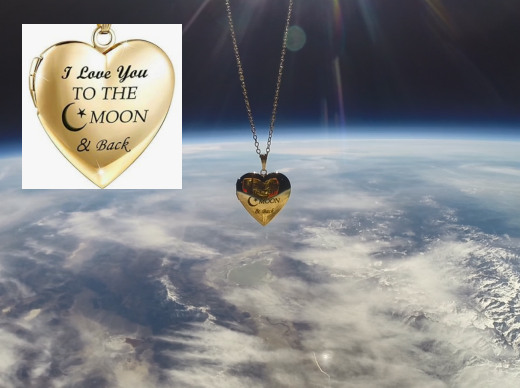
Buy it now for $149.95, and we'll fly it again--FOR FREE--during the total solar eclipse on April 8, 2024. The students will be launching multiple balloons from the path of totality in Texas. Your pendant will go along for the ride, touching the shadow of the Moon at the edge of space. (Simply type "FLY IT AGAIN" in the comments box at checkout.)
The locket, which opens to hold a personal photo or other small item, comes with a greeting card showing the jewelry in flight and telling the story of its journey to the edge of space.
Far Out Gifts: Earth to Sky Store
All sales support hands-on STEM education
Realtime Aurora Photo Gallery
Free: Spaceweather.com Newsletter
Realtime Comet Photo Gallery
Free: Spaceweather.com Newsletter