MARCH IS THE BEST MONTH OF THE YEAR FOR AURORAS: Did you know that March is the best month of the year for auroras? It's true. A 75-year study shows that March has more geomagnetically active days than any other month of the year. (October is a close second.) This is due to the Russell-McPherron effect. In short, cracks tend to form in Earth's magnetosphere during weeks around equinoxes, allowing solar wind to spark Northern Lights. Aurora alerts: SMS Text

A NEW SPACEX SPIRAL: Update: SpaceX is to blame. Last night, a luminous blue spiral appeared in the night sky over Lofoten, Norway. Bettina Begtoft photographed the apparition on March 5th as it sank into the Barents Sea:
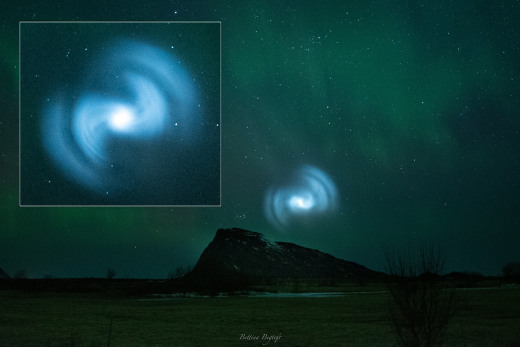
"I noticed it at 2:02 am local time," says Begtoft. "To the naked eye it looked white, but my Nikon D750 camera revealed the beautiful blue color."
Begtoft witnessed a "SpaceX spiral." About an hour earlier (Sunday, March 4th at March 4th at 22:05 UT), SpaceX launched a Falcon 9 rocket from California's Vandenberg Space Force Base. It carried 53 small satellites to Earth-orbit, a mission known as Transporter-10. When the rocket's discarded 2nd stage passed over Barents sea, it performed a de-orbit burn. A bit of spin turned the exhaust into a spectacular spiral.
Aurora photographer Shang Yang saw the same spiral from Iceland:
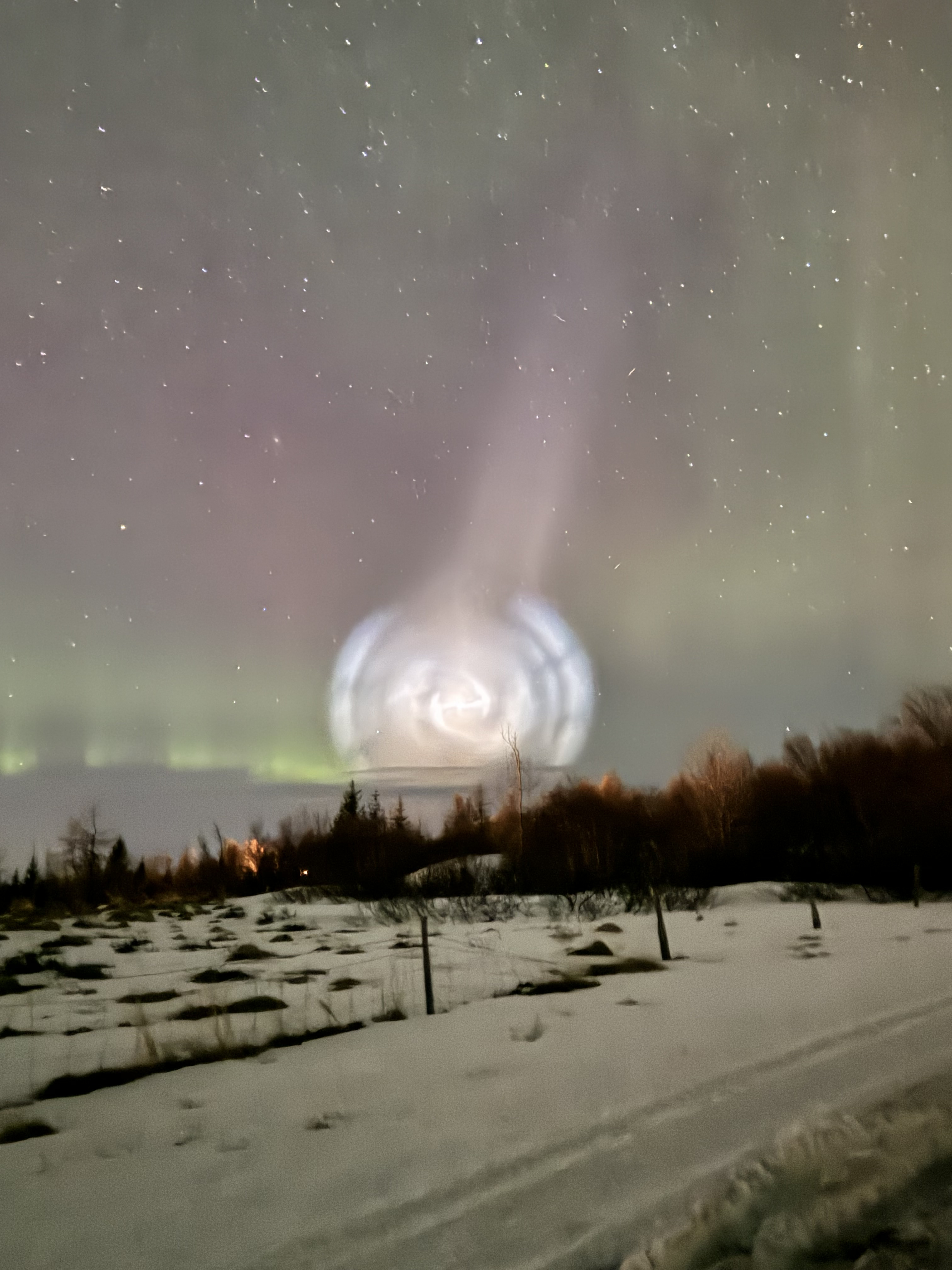
"I caught this in Akureyri around 1 a.m. local time on March 5th," says Yang. "It looked otherworldly against the Northern Lights!"
As strange as they appear, these spirals are a routine by-product of SpaceX operations. Similar blue swirls have been seen after many Falcon 9 launches including this one over New Zealand, another over east Africa, two more above Hawaii, and most famous of all, this specimen over Alaska.
Astronomer Olivier Staiger actually predicted the March 5th spiral, and he explains why it has a spiral shape: "On rideshare missions like Transporter-10, the numerous satellites from various clients have different destinations. SpaceX must rotate stage 2 for deployment. As a result, stage 2 is still rotating when they do the de-orbit burn and thus creates a spiral."
Bouyed by last night's success, Staiger is predicting another spiral in October. "The Transporter-12 mission in October could be epic with excellent equinox auroras, Comet Tsuchinshan-ATLAS, and the Draconid and Orionid meteor showers," he says. "See you in Iceland!"
Readers, did you see the spiral? Submit your photos here.
Realtime Space Weather Photo Gallery
Free: Spaceweather.com Newsletter
COMET 12P IS COMING TO LIFE: With a new ice-geyser outburst on Feb. 29th, Comet 12P/Pons-Brooks has crossed the threshold of binocular visibility. "It is now a 6th-magnitude object," reports Michael Jaeger, who made this 1-hour animation on March 2nd:
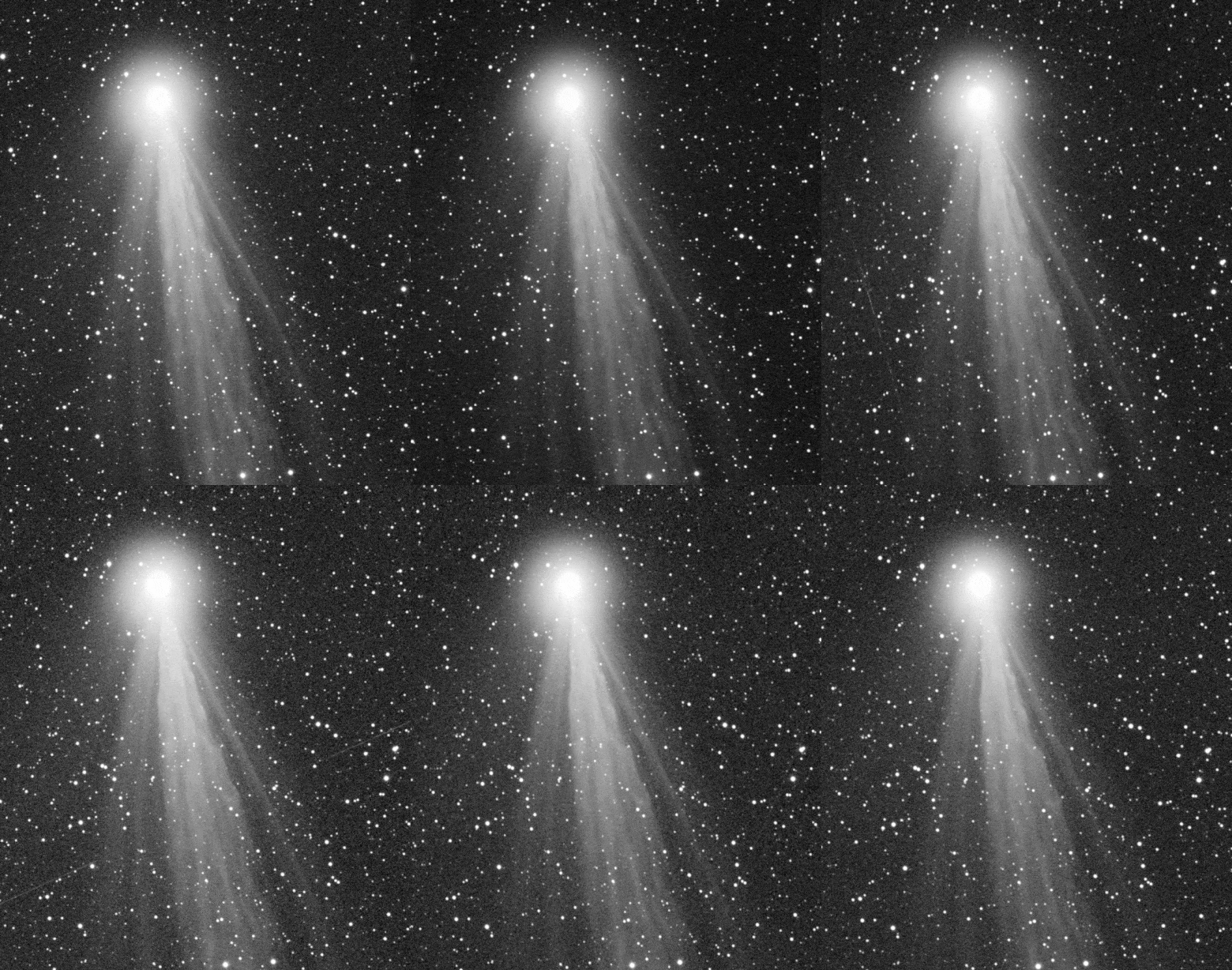
"It was easy to see in my 6x30 viewfinder," he says. "The view reminded me of galaxy M13 with a 0.5° tail."
Comet 12P/Pons-Brooks is "cryovolcanic." Its surface is dotted with geysers which spew a mixture of liquid hydrocarbons and dissolved gasses when they are warmed by sunlight. There have been at least 6 significant eruptions since last December, one of them an incredible 5 magnitudes: light curve.
Right now, 12P is approaching the sun for a close encounter in April. Between now and then, forecasters expect 12P to brighten 10- to 15-fold, making it a naked-eye object at 3rd to 4th magnitude. This would be true even without any special geyser activity; the whole comet is sizzling as it approaches the sun. If any geysers do erupt in the weeks ahead, it could push the comet to even greater brightness.
Comet 12P has received a lot of attention because it could be visible during the April 8th solar eclipse. During totality, the comet will be close to Jupiter, both about 30 degrees from the eclipsed sun:
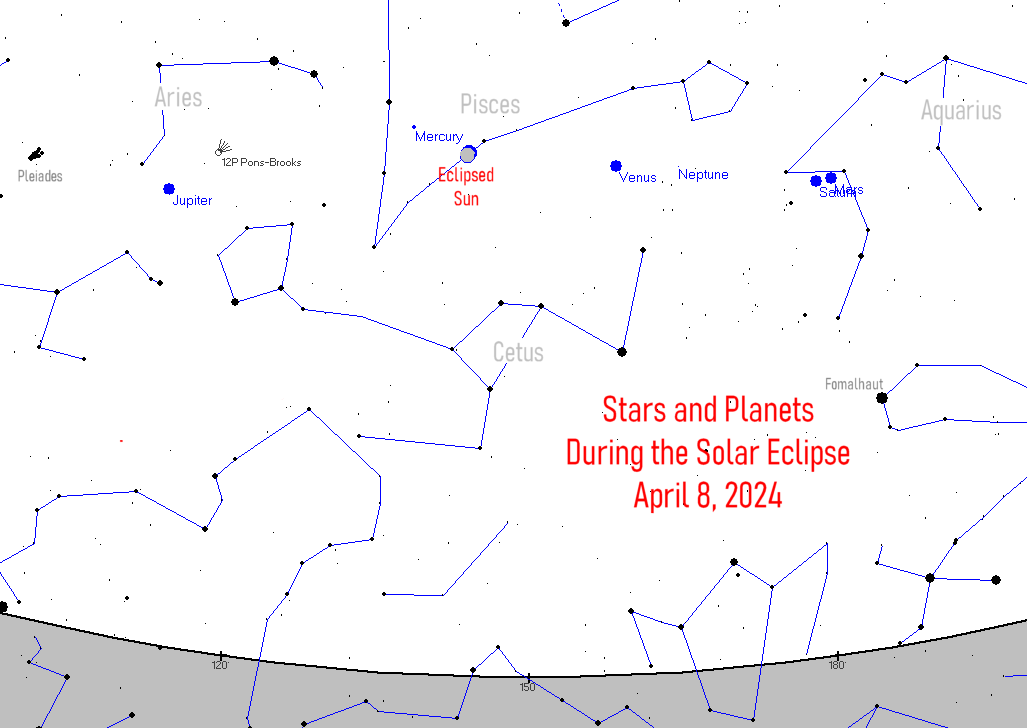
If the brightness of 12P peaks around 3rd or 4th magnitude, as predicted, it will not be visible to the naked eye in the twilight-darkness of the Moon's shadow. However, it should be an easy target for cameras. Indeed, many people taking wide angle photos of the eclipse will catch it by accident. May it continue to brighten!
more images: from Georg Klingersberger of Kobernaußen, Austria; from Gerald Rhemann of Nerpio, Spain; from the Association Astronomique de l'Indre of Le Poinconnet, Indre, Centre Val de Loire, France; from Chris Schur of Happy Jack, AZ; from José J. Chambó of Nerpio, Spain; from Glen Wurden of Los Alamos, New Mexico; from Michael Fleenor on February 1, 2024 @ Los Alamos, NM
Realtime Space Weather Photo Gallery
Free: Spaceweather.com Newsletter
18K GOLD "LOVE YOU TO THE MOON" LOCKET: This is a very special locket. It's heart-shaped, plated with 18K gold, and we will fly it again during this year's total eclipse of the sun. Keep reading...
On Jan. 26, 2024, the students of Earth to Sky Calculus launched this locket to the stratosphere onboard a cosmic ray research balloon. At the apex of the flight, it floated 111,535 feet above the Sierra Nevada mountains of central California:
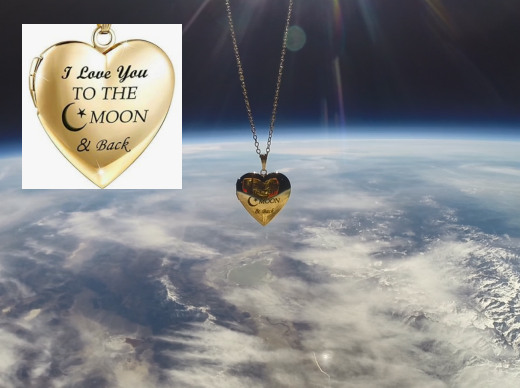
Buy it now for $149.95, and we'll fly it again--FOR FREE--during the total solar eclipse on April 8, 2024. The students will be launching multiple balloons from the path of totality in Texas. Your pendant will go along for the ride, touching the shadow of the Moon at the edge of space. (Simply type "FLY IT AGAIN" in the comments box at checkout.)
The locket, which opens to hold a personal photo or other small item, comes with a greeting card showing the jewelry in flight and telling the story of its journey to the edge of space.
Far Out Gifts: Earth to Sky Store
All sales support hands-on STEM education
Realtime Aurora Photo Gallery
Free: Spaceweather.com Newsletter