THE MARTIAN SUNSPOT REPORT: NASA's Mars rover Perseverance has a good view of the farside of the sun. Today, the rover's MASTCAM is seeing three farside sunspots, two of them large. The biggest one is an old friend: giant sunspot AR3590, which has spent the last two weeks transiting the farside of the sun. It will return to the Earthside later this week; stay tuned! Solar flare alerts: SMS Text

THE SPIRAL CORE OF COMET 12P: Around the world, astronomers are monitoring Comet 12P/Pons-Brooks as it approches the sun for a close encounter in April. Most cameras are focused on the comet's magnificent tail, which is growing longer every night. Norwegian astronomer Jan Erik Vallestad decided instead to take a closer look at the comet's core--and there he found a spiral:
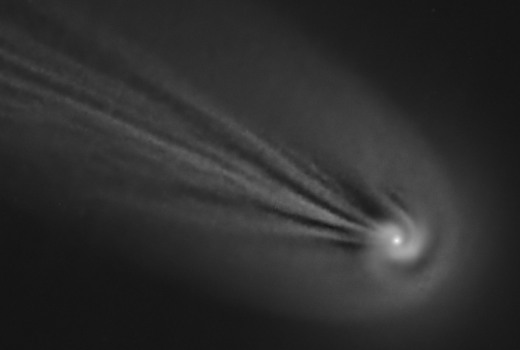
"The image has been processed in Pixinsight with moderate stretching to reveal structure in the core," explains Vallestad. "This is doable because the core itself was not blown out (saturated) in the original data." Other astronomers have also noticed the spiral or "yin-yang shape" of the comet's core; it appears to be real.
Evidence is mounting that 12P is "cryovolcanic." The comet's surface is peppered with geysers which spew plumes of dust and icy gas into space when fragile vents are exposed to sunlight. These exhaust plumes naturally form spirals as the comet rotates.
Realtime Comet Photo Gallery
Free: Spaceweather.com Newsletter
A SNEAKY-DANGEROUS SUNSPOT: Sunspot AR3599 doesn't look dangerous. It is relatively small and has a simple, bipolar morphology--two factors which usually add up to "harmless." Yet yesterday (March 10 @ 1213 UT), it produced a strong M7.4-class solar flare:
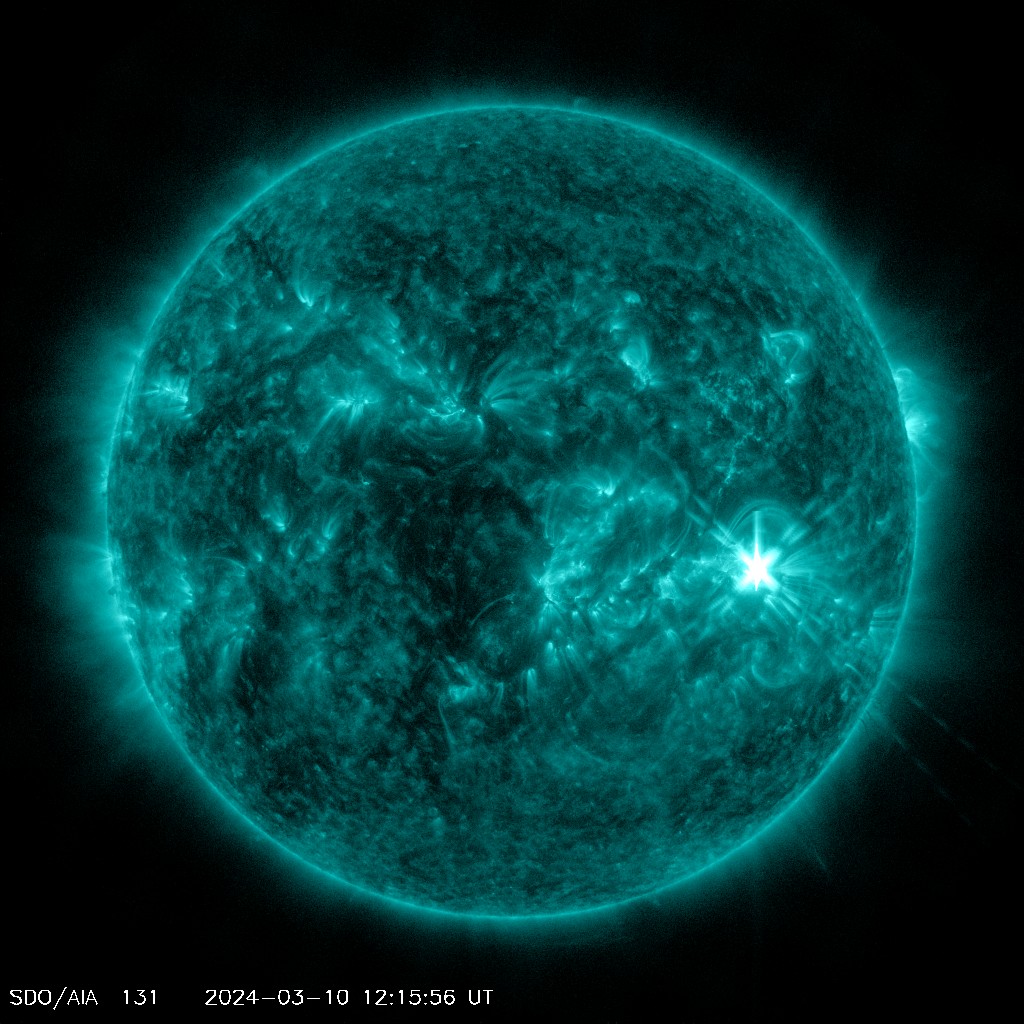
Extreme ultraviolet radiation radiation from the flare ionized the top of Earth's atmosphere, causing a strong shortwave radio blackout over Africa and the South Atlantic: map. Mariners and ham radio operators may have noticed loss of signal for as much as 30 minutes after the flare.

Update: The explosion did produce a CME traveling ~750 km/s (1.7 million mph). The faint cloud will mostly miss Earth, passing ahead of our planet in its orbit. However, a NASA model suggests there could be a glancing blow late on March 13th. Minor G1-class geomagnetic storms are possible on that date. Aurora alerts: SMS Text


Realtime Space Weather Photo Gallery
Free: Spaceweather.com Newsletter
18K GOLD "LOVE YOU TO THE MOON" LOCKET: This is a very special locket. It's heart-shaped, plated with 18K gold, and we will fly it again during this year's total eclipse of the sun. Keep reading...
On Jan. 26, 2024, the students of Earth to Sky Calculus launched this locket to the stratosphere onboard a cosmic ray research balloon. At the apex of the flight, it floated 111,535 feet above the Sierra Nevada mountains of central California:

Buy it now for $149.95, and we'll fly it again--FOR FREE--during the total solar eclipse on April 8, 2024. The students will be launching multiple balloons from the path of totality in Texas. Your pendant will go along for the ride, touching the shadow of the Moon at the edge of space. (Simply type "FLY IT AGAIN" in the comments box at checkout.)
The locket, which opens to hold a personal photo or other small item, comes with a greeting card showing the jewelry in flight and telling the story of its journey to the edge of space.
Far Out Gifts: Earth to Sky Store
All sales support hands-on STEM education
Realtime Aurora Photo Gallery
Free: Spaceweather.com Newsletter
Realtime Comet Photo Gallery
Free: Spaceweather.com Newsletter