QUIET WITH A SLIGHT CHANCE OF STORMS: Today, geomagnetic activity is low and the forecast calls for no bright auroras. However, a change may be in the offing. NOAA forecasters say that a CME might graze Earth's magnetic field on March 14th. A minor G1-class geomagnetic storm could result from the low-probability impact. Aurora alerts: SMS Text

MANMADE NOCTILUCENT CLOUDS: When the Space Age began, only Mother Nature made noctilucent clouds (NLCs). They formed every summer above Earth's poles, an electric-blue mixture of water vapor and meteor dust; you had to approach the Arctic Circle to see them. Seventy years of space travel have changed things, though. On March 4, 2024, sky watchers saw NLCs in Texas--and they were anything but natural.
"I was leaving for work about 6:30am CST when I noticed the clouds," reports Craig Harris from Lubbock, Texas (+33.6N). "To me, they looked like NLCs, but I know I am at the wrong latitude, and this is not correct season for them to appear. Could these really be noctilucent clouds?"
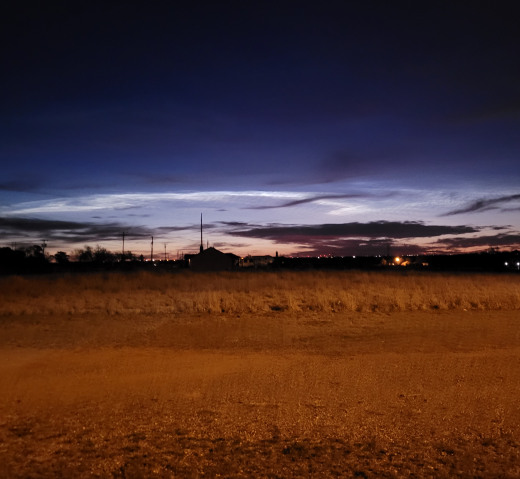
The answer is yes, but Mother Nature was not responsible. These clouds were created by SpaceX.
Approximately 8 hours before Craig left for work, a Falcon 9 rocket blasted off from Cape Canaveral carrying astronauts to the International Space Station. The engines burned through the atmosphere, emitting a spray of watery exhaust. About 80 km above Earth's surface, molecules of H2O began sticking to specks of meteor dust, seeding the formation of noctilucent ice crystals.
James G. Rodriguez of Midland, Texas (+32.0N) saw them, too:
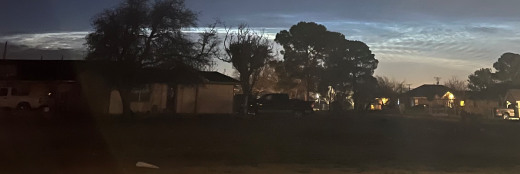
"The NLCs appeared low in the eastern horizon just before sunrise," says Rodriguez. "They were so bright I was able to photograph them using my iPhone."
Why Texas? The rocket was launched in Florida. "Winds high in the atmosphere could have easily blown some of the rocket exhaust from Florida to Texas, where the clouds formed," explains Cora Randall, an expert in NLCs at the University of Colorado. "I'm not surprised."
This isn't the first time onlookers have caught rockets creating noctilucent clouds. Space shuttle launches in the 1990s produced some of the first widely-noticed "rocket NLCs." The shuttle program ended in 2011, but the phenomenon continued. Recent studies led by Michael Stevens of the Naval Research Lab confirm a strong correlation between modern rocket launches and the abundance of NLCs as far south as +56N.
"Space traffic has a strong influence on the interannual variability of these bright mesospheric clouds," the researchers concluded in a 2022 paper.
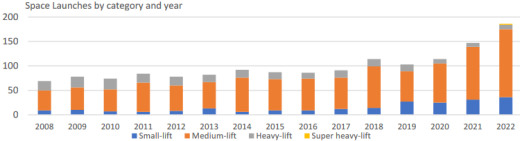
According to the US International Trade Commission, the annual rate of rocket launches has almost quadrupled since 2008. Every year breaks the previous year's record, a trend driven mainly by SpaceX. The Texas sightings highlight how much things have changed. The latitude of those clouds was just above 30 degrees, thousands of miles from the Arctic.
NLCs aren't just a polar phenomenon any more. They can appear anywhere rockets go. Check the SpaceX launch schedule, and be alert for NLCs.
Realtime Space Weather Photo Gallery
Free: Spaceweather.com Newsletter
18K GOLD "LOVE YOU TO THE MOON" LOCKET: This is a very special locket. It's heart-shaped, plated with 18K gold, and we will fly it again during this year's total eclipse of the sun. Keep reading...
On Jan. 26, 2024, the students of Earth to Sky Calculus launched this locket to the stratosphere onboard a cosmic ray research balloon. At the apex of the flight, it floated 111,535 feet above the Sierra Nevada mountains of central California:
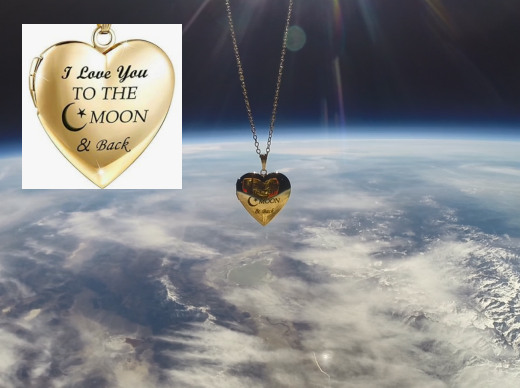
Buy it now for $149.95, and we'll fly it again--FOR FREE--during the total solar eclipse on April 8, 2024. The students will be launching multiple balloons from the path of totality in Texas. Your pendant will go along for the ride, touching the shadow of the Moon at the edge of space. (Simply type "FLY IT AGAIN" in the comments box at checkout.)
The locket, which opens to hold a personal photo or other small item, comes with a greeting card showing the jewelry in flight and telling the story of its journey to the edge of space.
Far Out Gifts: Earth to Sky Store
All sales support hands-on STEM education
Realtime Aurora Photo Gallery
Free: Spaceweather.com Newsletter
Realtime Comet Photo Gallery
Free: Spaceweather.com Newsletter