QUIET WITH A CHANCE OF FLARES: The sun has not produced a significant solar flare in more than a week. The best chance for a break in the quiet is sunspot AR3633; it has a 'beta-gamma' magnetic field that harbors energy for M-class explosions. NOAA forecasters say there is a 25% chance of an M-flare today. Solar flare alerts: SMS Text
THIS COMET DID NOT SURVIVE THE ECLIPSE: Astronomer Karl Battams of the Naval Research Lab predicted that a sungrazing comet might be visible during Monday's total eclipse. He was right. Chinese amateur astronomer Lin Zixuan was in New Hampshire for the eclipse, and he photographed the disintegrating comet:
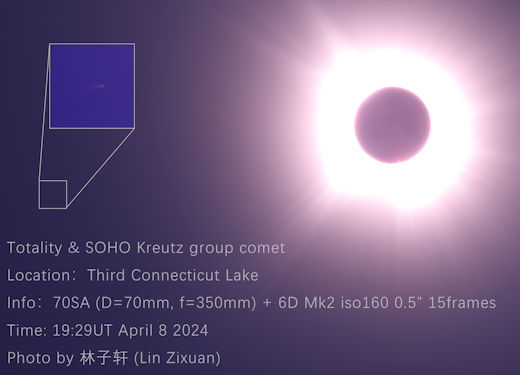
Named "SOHO-5008", the comet had been discovered earlier the same day by amateur astronomer Worachate Boonplod, who noticed it in SOHO coronagraph images. Battams quickly realized that the comet might be bright enough to photograph in the otherworldly twilight of the Moon's shadow.
"Ground-based observations of sungrazing comets are extremely rare, so this would be a great opportunity to see an eclipse comet!" says Battams.
Soon after Zixuan photographed the comet, it disintegrated. SOHO has seen this happen more than 5000 times. Most doomed sungrazers (including this one) are members of the Kreutz family. Named after a 19th century German astronomer who studied them in detail, Kreutz sungrazers are fragments from the breakup of a giant comet ~2000 years ago. Several fragments pass by the sun and disintegrate every day, although most are too small to see.
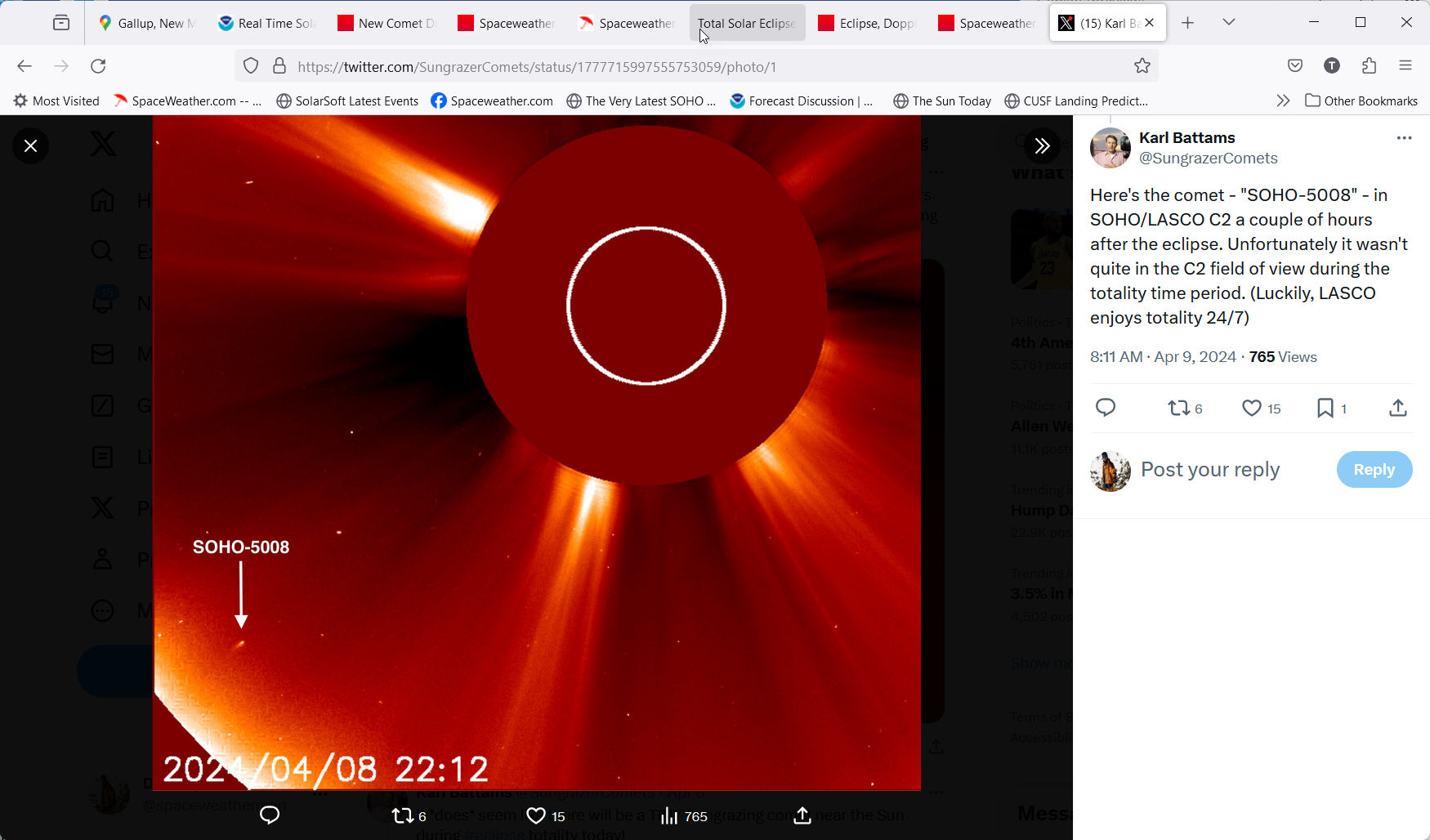
A SOHO coronagraph image of the disintegrating comet
Battams can recall only two other examples of sungrazers seen during a solar eclipse-- one in 2020 (also a Worachate Boonplod discovery) and another in 2008. " I think with modern imaging equipment and techniques, seeing a sungrazer during an eclipse is no longer hugely challenging, but it does require one crucial ingredient: the right comet at the right time. We got lucky this week!" he says.
Realtime Solar Eclipse Photo Gallery
Free: Spaceweather.com Newsletter
AMBER DRAGONFLY SPACE PENDANT: This dragonfly has touched space. The students of Earth to Sky Calculus launched it to the stratosphere onboard a cosmic ray research balloon, 109,228 feet above California's Sierra Nevada:
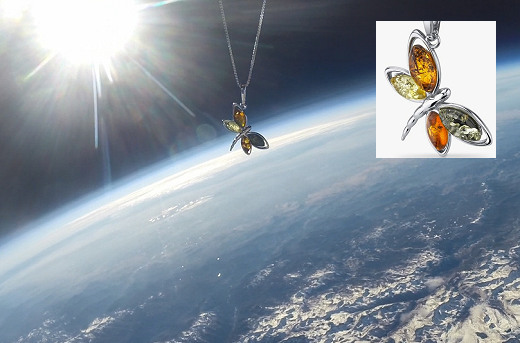
You can have it for $179.95. Made of genuine Baltic Amber with a sterling silver exoskeleton, the pendant measures 1 1/4 inch and comes with a matching 18-inch sterling silver chain. The wings of the dragonfly include four pieces of natural amber colored Cognac, Olive Green and Honey Yellow.
The students are selling space pendants to pay the helium bill for their cosmic ray ballooning program. Each one comes with a greeting card showing the jewelry in flight and telling the story of its trip to the stratosphere and back again.
Far Out Gifts: Earth to Sky Store
All sales support hands-on STEM education
Realtime Aurora Photo Gallery
Free: Spaceweather.com Newsletter
Realtime Space Weather Photo Gallery
Free: Spaceweather.com Newsletter
Realtime Comet Photo Gallery
Free: Spaceweather.com Newsletter