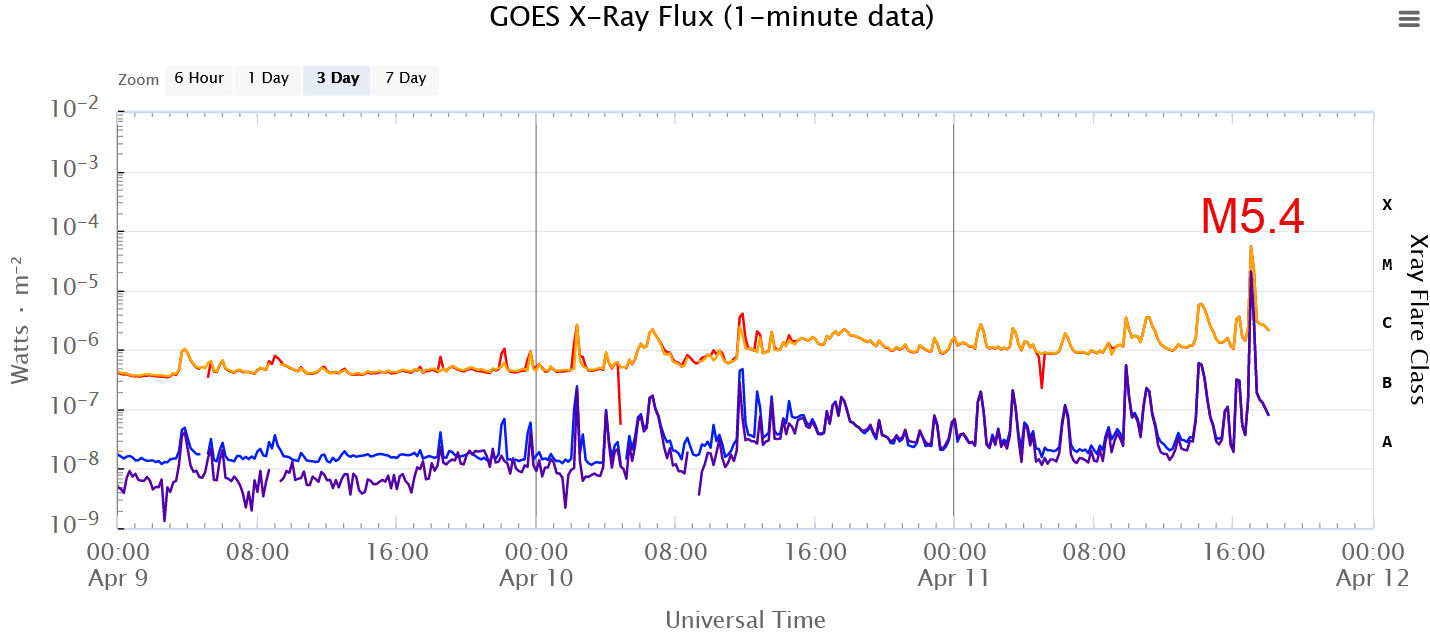
THE QUIET HAS ENDED: After more than a week of relative quiet, the sun produced an impulsive M5.4-class solar flare on April 11th (1706 UT). The source of the blast was just behind the sun's northeastern limb. This means an active sunspot may be hiding behind the edge of the solar disk, turning to face Earth this weekend. Solar flare alerts: SMS Text
VOLCANIC VORTEX RINGS: Mount Etna in Italy is doing domething rare and beautiful. "It is blowing smoke rings," reports Marcella Giulia Pace, who photographed the phenomenon on April 6th:
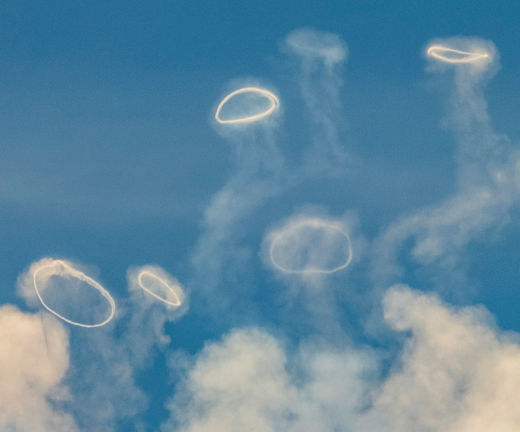
"A continuous jet of rings is dancing around the craters until they dissolve into the sky--a phenomenon of extreme rarity," she says.
Mount Etna has produced vortices before, but nothing like this. In April 2024 Etna "has broken all previous records," according to Boris Behncke of the National Institute of Geophysics and Volcanology of Catania. Tourists are flocking to the mountain to witness the display.
The rapid-fire puffs are coming from a newly-opened vent, which is blowing rings of volcanic gas similar to how dolphins blow bubble rings in water.
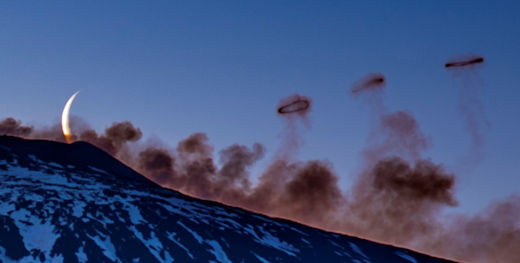
Volcanic vortices and the crescent Moon over Mount Etna. Credit: Marcella Giulia Pace
The gas rings are composed of 80 percent water vapor, with the remaining 20 percent mostly made of sulfur dioxide and carbon dioxide. It is the water vapor that gives the rings their white hue, making them resemble Gandalf-like smoke rings.
Realtime Space Weather Photo Gallery
Free: Spaceweather.com Newsletter
THIS COMET DID NOT SURVIVE THE ECLIPSE: Astronomer Karl Battams of the Naval Research Lab predicted that a sungrazing comet might be visible during Monday's total eclipse. He was right. Chinese amateur astronomer Lin Zixuan was in New Hampshire for the eclipse, and he photographed the disintegrating comet:
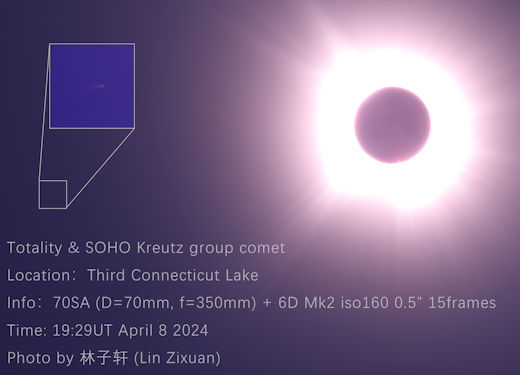
Named "SOHO-5008", the comet had been discovered earlier the same day by amateur astronomer Worachate Boonplod, who noticed it in SOHO coronagraph images. Battams quickly realized that the comet might be bright enough to photograph in the otherworldly twilight of the Moon's shadow.
"Ground-based observations of sungrazing comets are extremely rare, so this would be a great opportunity to see an eclipse comet!" says Battams.
Soon after Zixuan photographed the comet, it disintegrated. SOHO has seen this happen more than 5000 times. Most doomed sungrazers (including this one) are members of the Kreutz family. Named after a 19th century German astronomer who studied them in detail, Kreutz sungrazers are fragments from the breakup of a giant comet ~2000 years ago. Several fragments pass by the sun and disintegrate every day, although most are too small to see.
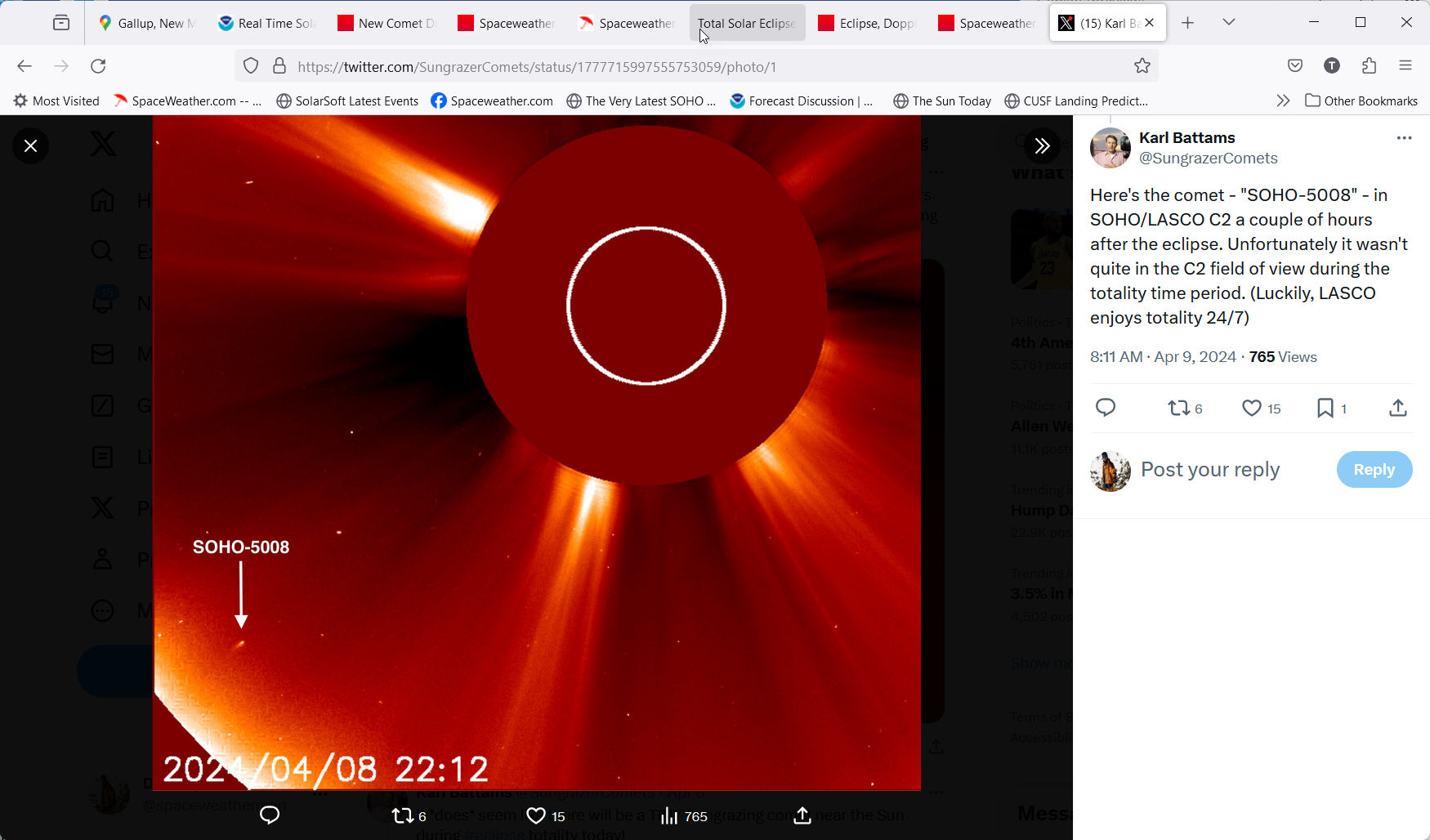
A SOHO coronagraph image of the disintegrating comet
Battams can recall only two other examples of sungrazers seen during a solar eclipse-- one in 2020 (also a Worachate Boonplod discovery) and another in 2008. " I think with modern imaging equipment and techniques, seeing a sungrazer during an eclipse is no longer hugely challenging, but it does require one crucial ingredient: the right comet at the right time. We got lucky this week!" he says.
Realtime Solar Eclipse Photo Gallery
Free: Spaceweather.com Newsletter
AMBER DRAGONFLY SPACE PENDANT: This dragonfly has touched space. The students of Earth to Sky Calculus launched it to the stratosphere onboard a cosmic ray research balloon, 109,228 feet above California's Sierra Nevada:
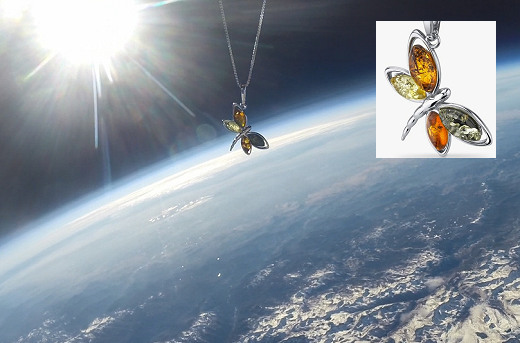
You can have it for $179.95. Made of genuine Baltic Amber with a sterling silver exoskeleton, the pendant measures 1 1/4 inch and comes with a matching 18-inch sterling silver chain. The wings of the dragonfly include four pieces of natural amber colored Cognac, Olive Green and Honey Yellow.
The students are selling space pendants to pay the helium bill for their cosmic ray ballooning program. Each one comes with a greeting card showing the jewelry in flight and telling the story of its trip to the stratosphere and back again.
Far Out Gifts: Earth to Sky Store
All sales support hands-on STEM education
Realtime Aurora Photo Gallery
Free: Spaceweather.com Newsletter
Realtime Comet Photo Gallery
Free: Spaceweather.com Newsletter