GEOMAGNETIC STORM WATCH (G1): A geomagnetic storm is possible on April 14th when two minor CMEs are expected to graze Earth's magnetic field. The storm clouds were hurled toward Earth by magnetic filament eruptions on April 11th and 12th. Neither CME is particularly potent, but their combined effect could cause a G1-class geomagnetic storm with high latitude auroras. Aurora alerts: SMS Text

A RED BLOB IN THE NIGHT SKY: Sometimes it pays to stay up late. Most people in Texas were sound asleep on April 10th at 2:14 a.m. when amateur astronomer Abdur Anwar looked up and saw a bright red blob glide over Big Bend National Park. "I photographed it using my Google Pixel 6a phone in night mode," he says.
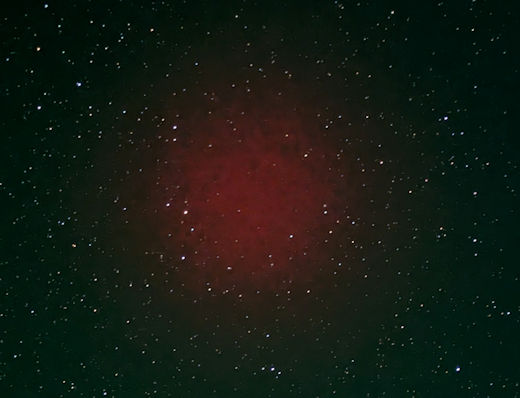
"Is this a new aurora phenomenon?" he asks.
No, it's just SpaceX.
About 90 minutes before the red blob appeared, a Falcon 9 rocket lifted off from the Cape Canaveral Space Force Station in Florida, carrying 23 Starlink satellites to low-Earth orbit (Starlink Group 6-48). After the satellites were deployed, the rocket's second stage executed a de-orbit burn, creating the red blob.
It's not the first time sky watchers have noticed this phenomenon. "We are seeing 2 to 5 of them each month," says Stephen Hummel of the McDonald Observatory in Texas, who photographed a spectacular example last November.
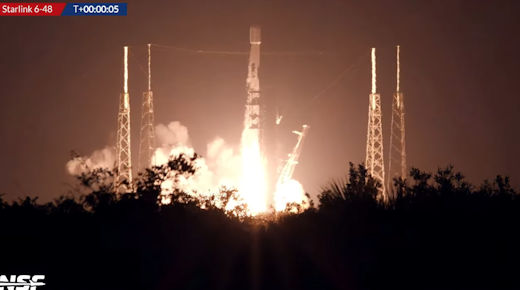
Above: The launch of Starlink 6-48 ninety minutes before the red blob appeared over Texas.
The blob is created by a chemical reaction. The de-orbiting rocket engine sprays water (H2O) and carbon dioxide (CO2) into the upper atmosphere--as much as 400lbs of exhaust gasses. A complicated series of charge exchange reactions between these molecules and O+ atoms produces red light at a wavelength of 6300 Å–coincidentally, the same color as red auroras.
Texas seems to be a great place to observe the blobs; it's where most of them have been seen. Texas is favored because, for Starlink missions launched from Florida, it's the correct place for a de-orbit burn to splash the rocket's second stage into the South Atlantic. The burns happen about 90 minutes after launch--just when Anwar saw the blob.
Realtime Space Weather Photo Gallery
Free: Spaceweather.com Newsletter
AMBER DRAGONFLY SPACE PENDANT: This dragonfly has touched space. The students of Earth to Sky Calculus launched it to the stratosphere onboard a cosmic ray research balloon, 109,228 feet above California's Sierra Nevada:
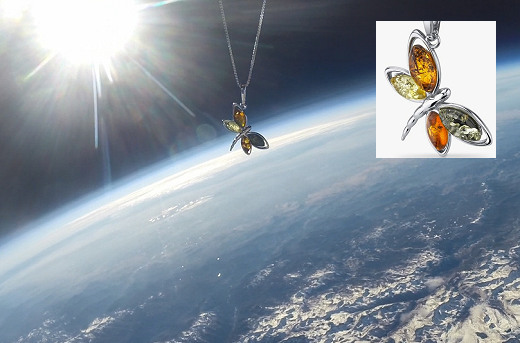
You can have it for $179.95. Made of genuine Baltic Amber with a sterling silver exoskeleton, the pendant measures 1 1/4 inch and comes with a matching 18-inch sterling silver chain. The wings of the dragonfly include four pieces of natural amber colored Cognac, Olive Green and Honey Yellow.
The students are selling space pendants to pay the helium bill for their cosmic ray ballooning program. Each one comes with a greeting card showing the jewelry in flight and telling the story of its trip to the stratosphere and back again.
Far Out Gifts: Earth to Sky Store
All sales support hands-on STEM education
Realtime Aurora Photo Gallery
Free: Spaceweather.com Newsletter
Realtime Comet Photo Gallery
Free: Spaceweather.com Newsletter