GEOMAGNETIC STORM WATCH (G1): Multiple CMEs have left the sun this week, perhaps more than a dozen. The majority are on a trajectory due south of Earth. If the edge of even one grazes Earth's magnetic field, it could spark a G1-class geomagnetic storm. Potential impacts are likely to begin on April 25th. CME impact alerts: SMS Text
A SUPER-SYMPATHETIC SOLAR FLARE: What are the odds? This morning, April 23rd (0330 UT), NASA's Solar Dynamics Observatory watched four regions on the sun separated by hundreds of thousands of kilometers explode almost simultaneously. Play the movie and pay attention to the circled areas:
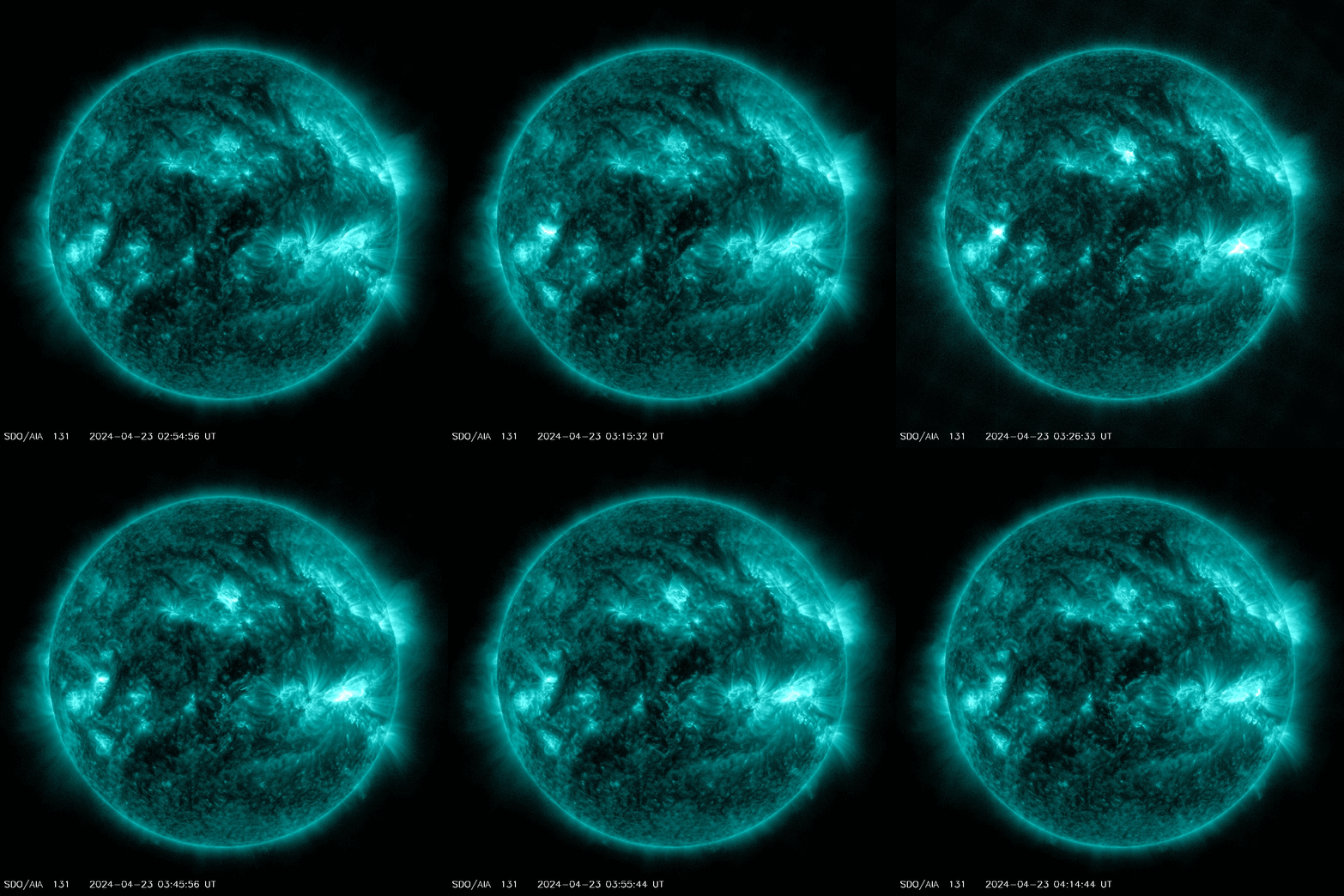

The quadruple blast included three sunspots (small circles) and a magnetic filament (big circle), all erupting within minutes of one another. (The filament eruption is more obvious in this 304 Å movie.) Their combined X-ray output added up to category M3.6.
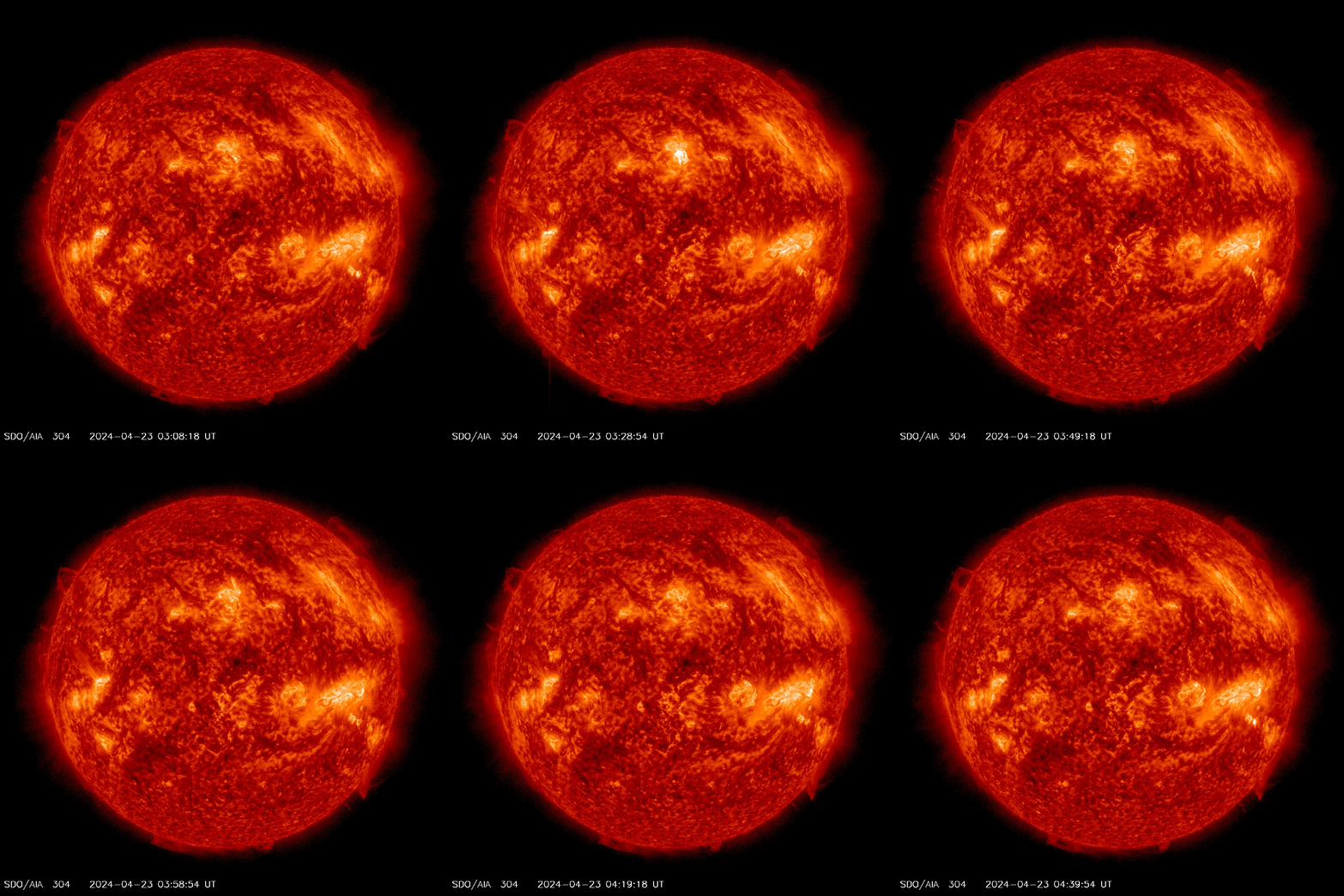
Events like this are called "sympathetic solar flares"--pairs of explosions that occur almost simultaneously in widely-spaced active regions. Long ago, researchers assumed the eruptions were just freak coincidence, but a 2002 study proved otherwise. Some sunspots are linked by nearly-invisible magnetic loops in the sun's corona. Instabilities can rapidly travel from one to another, creating a chain reaction of explosions.
Today's sympathetic flare was not a simple pair but a complex quartet covering much of the sun's Earth-facing hemisphere. This makes it "super-sympathetic." It is reminiscent of the Great Eruption of August 1, 2010, which included more than a dozen shock waves, flares, and filament eruptions spanning 180 degrees of solar longitude.
Will any of the debris hit Earth? SOHO coronagraph images of the blast are now available, but the results are unclear Many faint overlapping CMEs can be seen leaving the sun in the hours after the quadruple eruption. If any are heading our way (a big IF), they would arrive on or about April 26th. CME impact alerts: SMS Text
Realtime Space Weather Photo Gallery
Free: Spaceweather.com Newsletter
A POTENTIALLY GOOD (OR EVEN GREAT) COMET: Comets are famously unpredictable. For every one that becomes a naked-eye object, there are dozens that fizzle and disappoint. Despite this track record, astronomers have a standard formula they regularly use to predict the brightness of incoming comets, and according to that formula, this dim fuzzball could become a good (or even great) comet later this year:
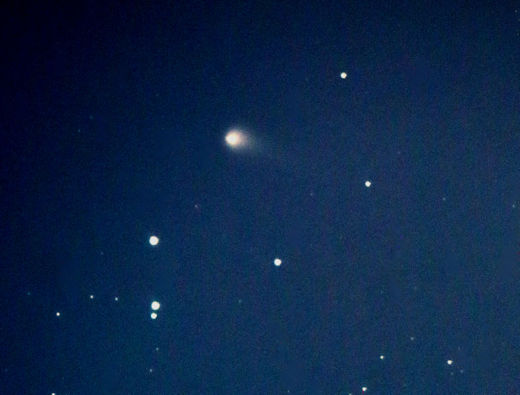
"This is Comet Tsuchinshan-ATLAS (C/2023 A3) sporting a short tail as it makes it's way toward the sun," says photographer Johnny Barton of Robinson, Texas. "At the moment it is faint. For comparison, the brightest star in the triangle below the comet is magnitude 9.6."
If the most optimistic estimates are correct, this comet could become as bright as Sirius or even Venus when it passes near Earth in October 2024. This rosy forecast depends in part on forward scattering to boost the comet's brightness. Forward scattering happens when a comet is almost directly between Earth and the sun. Dust in the comet's atmosphere can scatter sunlight toward Earth, making the comet seem extra bright. The same thing happened to Comet McNaught in 2007, making it visible in broad daylight.
Adding to the unpredictability is Comet Tsuchinshan-ATLAS's origin. It comes from the Oort cloud and is visiting the sun for the first time. Fresh comets are the most unpredictable of all. We can't be sure how they will respond to their first dose of intense sunlight; a previous Comet ATLAS completely fell apart. So go ahead and mark your calendar for October 2024, but maybe use pencil.
Meanwhile, amateur astronomers are encouraged to monitor Comet Tsuchinshan-ATLAS. It is shining like a 10th magnitude star in the constellation Virgo. Observing tips!
Realtime Comet Photo Gallery
Free: Spaceweather.com Newsletter
A FAR-OUT MOTHER'S DAY GIFT: Mother's Day is less than 3 weeks away. Are you looking for a far-out gift? Mom will love Snoopy at the Edge of Space. Here is the hand-crafted figurine floating 112,505 feet above Earth's surface on Jan. 30, 2024:
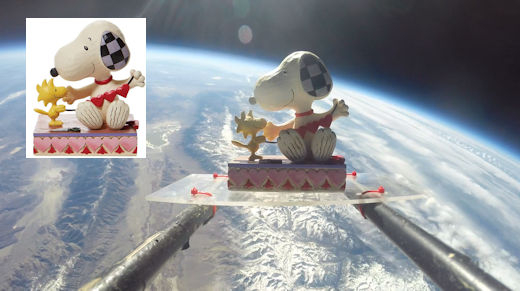
You can have it for $159.95. The students of Earth to Sky Calculus launched the figurine to the stratosphere onboard a cosmic ray research balloon. It spent more than 2 hours floating at the top of Earth's atmosphere while cosmic ray sensors gathered data. Snoopy had a wild ride, and the students got great data for their atmospheric radiation monitoring program.
Far Out Gifts: Earth to Sky Store
All sales support hands-on STEM education
Realtime Aurora Photo Gallery
Free: Spaceweather.com Newsletter
Realtime Comet Photo Gallery
Free: Spaceweather.com Newsletter