GEOMAGNETIC STORM WATCH (G1): One or more CMEs could graze Earth on April 25-26, sparking a minor G1-class geomagnetic storm. The CMEs were hurled into space earlier this week by explosive activity in sunspot super-group AR3638-50. CME impact alerts: SMS Text

GLOBAL AURORAS ON MARS: Earth isn't the only planet with auroras. Mars has them, too--on a global scale.
"Mars is experiencing its greatest level of auroral activity in the past 10 years," says Nick Schneider of the University of Colorado's Laboratory for Atmospheric and Space Physics (LASP). "In February alone, there were three episodes of global auroras--an 'aurora hat trick' we've never seen before."
Orbiting high above Mars, NASA's MAVEN spacecraft recorded the auroras on 3-4 Feb, 7-10 Feb and 15-16 Feb. This animation shows the last two of these episodes in a looping time series:
Spaceweather.com actually predicted some of these events, prompted by SOHO coronagraph observations of CMEs heading toward Mars. "Your predictions came true!" says Schneider.
Schneider leads the team for MAVEN's Imaging Ultraviolet Spectrograph (IUVS), the instrument that detected the auroras. All the purple pixels in the animation are a false color representation of the aurora's ultraviolet glow. Martian auroras probably have a visible light component, too, but MAVEN's cameras are not able to see them.
Here on Earth we would love it if auroras were global. Seeing Northern Lights with equal ease from the equator and the poles would check off a lot of bucket lists. Be careful what you wish for, though. Martian auroras can be global because the Red Planet has almost no protection from solar storms. It lacks an Earth-like magnetic field, so particles from the sun penetrate its atmosphere with ease--everywhere.
The dramatic auroras of February 2024 were caused by "SEPs"--solar energetic particles. SEPs are accelerated by shock waves within approaching CMEs. When they strike Mars's atmosphere, they cause it to glow.
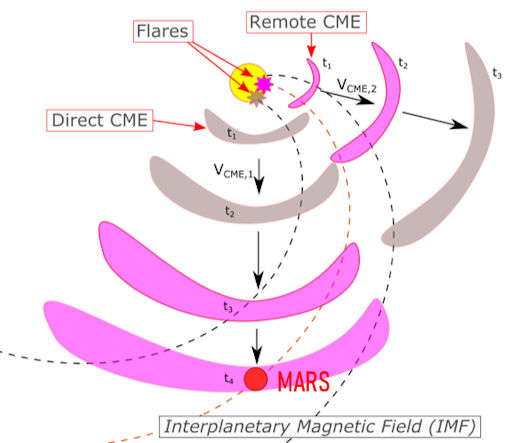
"Mars is currently getting hit by roughly 1 to 2 CMEs every month, bringing a hefty supply of SEPs," says Rebecca Jolitz, a member of the MAVEN Solar Energetic Particle (SEP) instrument team at UC Berkeley's Space Sciences Lab. "However, a CME doesn't actually have to hit to be effective. SEPs coming in sideways from 'remote CMEs' can light up the skies as well."
Schneider and Jolitz are looking forward to the months ahead. "Solar Cycle 25 is far from over, and we expect many more CME strikes," Schneider says. "This will give us a chance to study how solar storms affect the atmosphere of Mars--a key goal of the MAVEN mission. It's the kind of fun we've been waiting for!"
Extra: Schneider notes that SEPs aren't the only way to make auroras on Mars. Protons in the solar wind and magnetic reconnection can do the trick, too, producing their own forms and colors. Stay tuned for more stories about the rich variety of Martian auroras as Solar Cycle 25 unfolds.
Realtime Aurora Photo Gallery
Free: Spaceweather.com Newsletter
TAHITIAN BLACK SOLAR ECLIPSE PEARL: It came from Tahiti, and now it has touched the shadow of the Moon. On April 8, 2024, the students of Earth to Sky Calculus launched this black pearl into a total eclipse of the sun over Texas. Riding on a cosmic ray research balloon, the pearl was 86,564 feet high when lunar darkness swallowed it for 3 minutes 45 seconds:
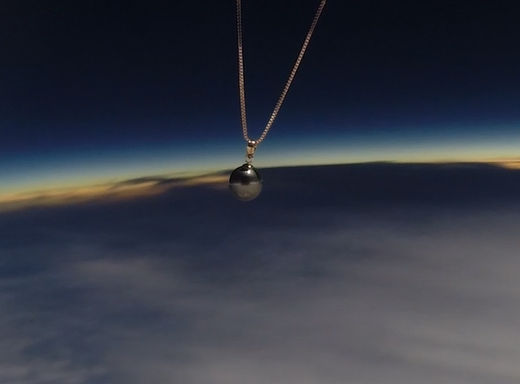
You can have it for $299.95. Measuring 9 mm in diameter, this genuine Tahitian pearl has an 18K rose gold clasp and is suspended from a matching 925 Sterling Silver chain. It comes with a greeting card showing the pearl in flight and telling the story of its journey to the edge of space during the 2024 total eclipse.
Far Out Gifts: Earth to Sky Store
All sales support hands-on STEM education
A SUNSPOT SUPER-GROUP: A remarkable "super group" has formed in the sun's southern hemisphere. Just south of the equator, five sunspots are crowded together in close proximity with shifting areas of magnetic connection. The behemoth is crackling with solar flares:
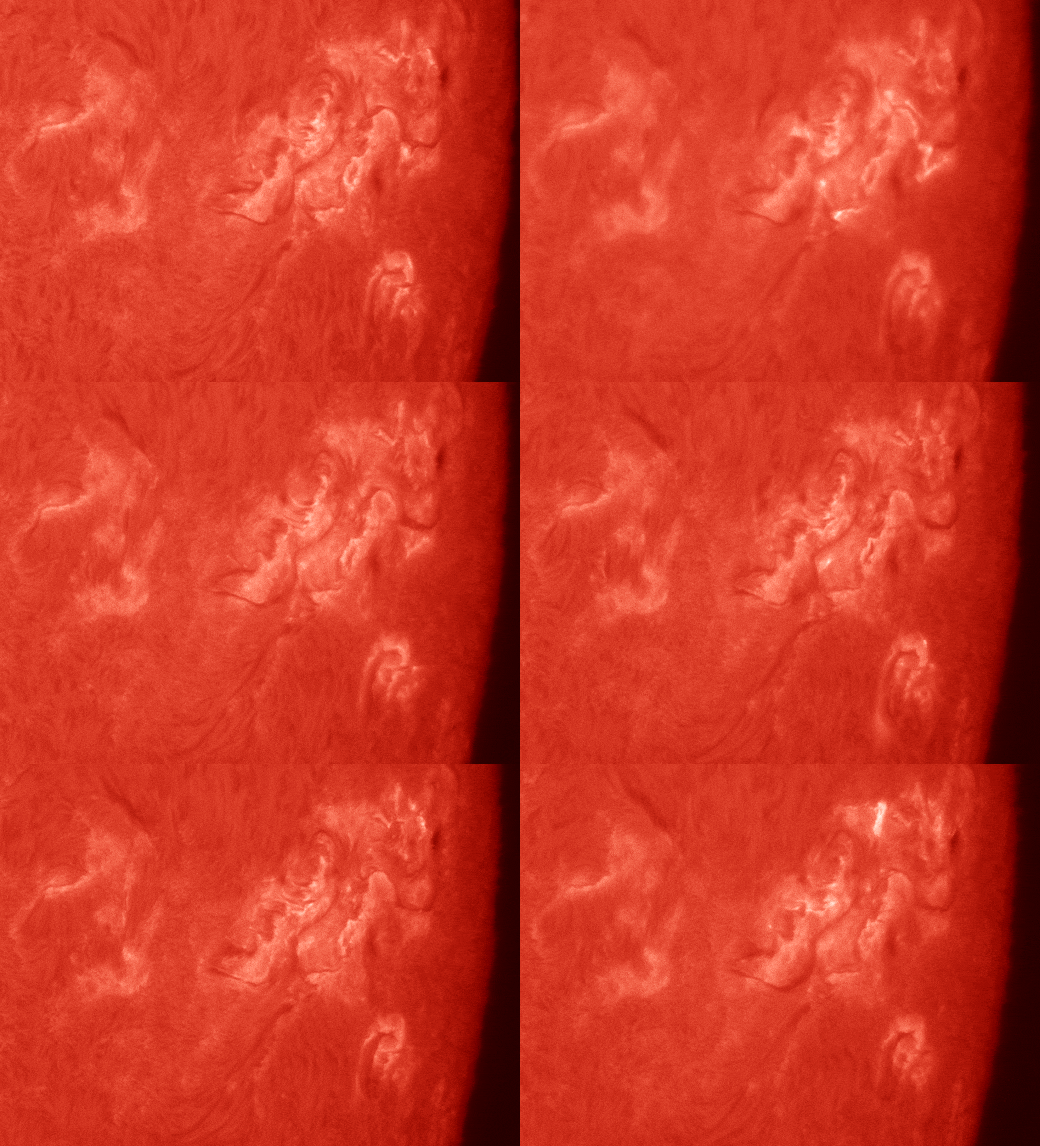
Amateur astronomer Andy Devey sends this movie from Mojacar, Spain: "I filmed the complex area consisting of five separate active regions between 10:00 and 12:35 UT on April 24th," he says. "Several C-class and almost M-class flares can be seen."
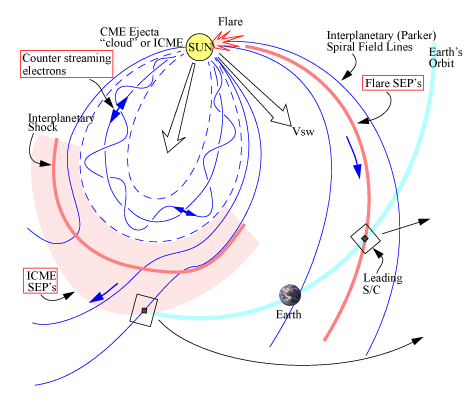
The five sunspots are AR3638, AR3643, AR3645, AR3647 and AR3650. Bumping together, they have jointly produced three to five M-flares per day all week long. This activity is expected to continue as the super-group rounds the western limb of the sun where, for a day or so, it will be magnetically connected to Earth via the Parker Spiral. Debris (especially energetic protons) guided by the spiral to Earth could cause radiation storms on April 26-28. Stay tuned! Solar flare alerts: SMS Text
Realtime Space Weather Photo Gallery
Free: Spaceweather.com Newsletter
Realtime Comet Photo Gallery
Free: Spaceweather.com Newsletter