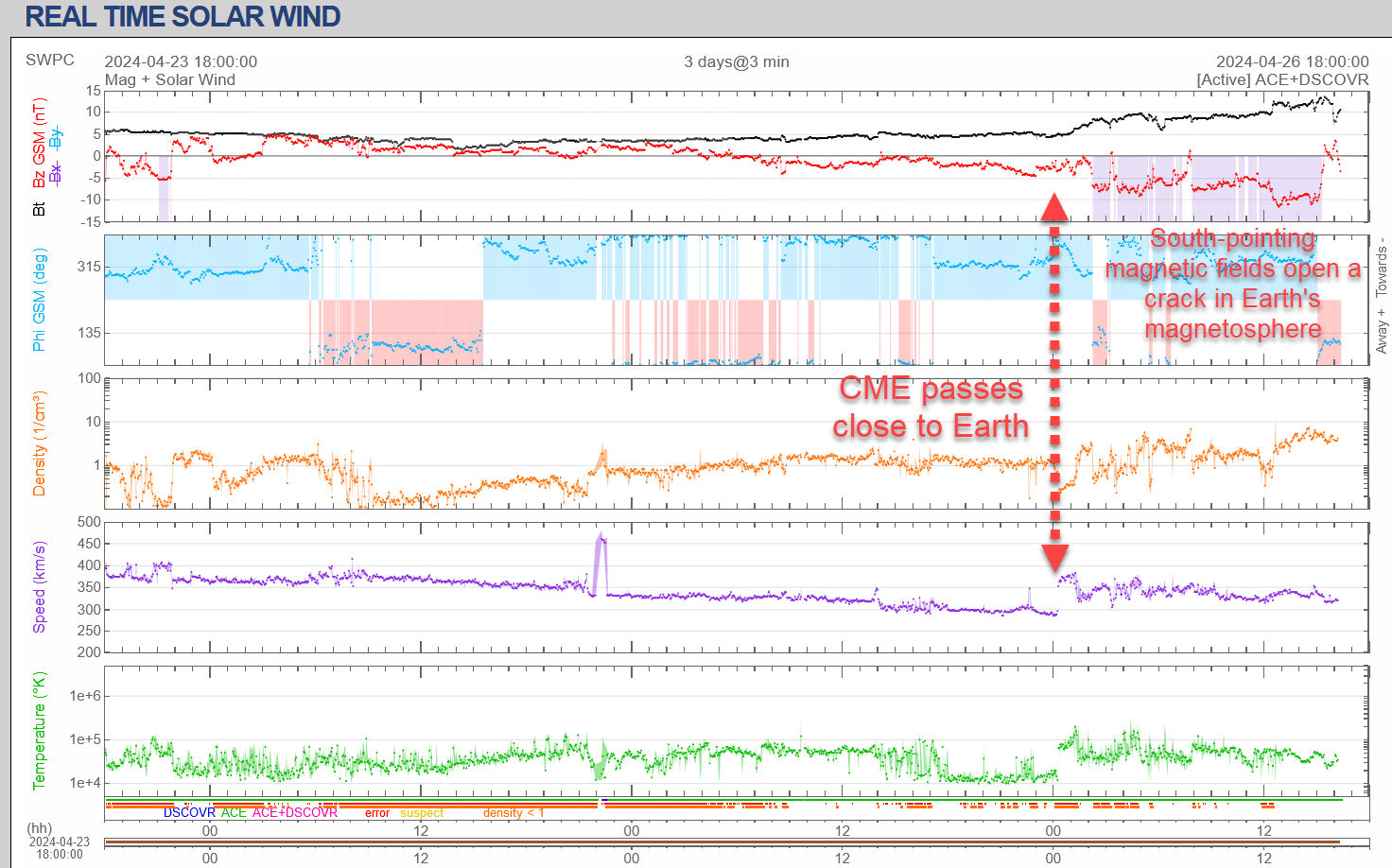
GEOMAGNETIC STORM WATCH (G1): NOAA forecasters say that multiple CMEs could pass close to Earth this weekend. As the events of April 26th show, CMEs don't have to make a direct hit to cause a geomagnetic storm--see below. G1-class storms are possible on April 27th and 28th. CME impact alerts: SMS Text

BLUE-SKY AURORAS (AND STEVE): A CME passed close to Earth on April 26th. It missed, but it was still effective. Magnetic fields in the CME's wake connected themselves to Earth's magnetic field, opening a crack where solar wind could penetrate. The resulting G1-class geomagnetic storm ignited auroras bright enough to photograph in blue sky over Norway:

"Interestingly, STEVE was also present," notes Geir Birkeland Øye, who photographed the display from Ørsta. "A faint mauve colored ribbon was observed from about UTC 21.02 to 21.34."
STEVE looks like an aurora, but it is not. The purple glow is caused by hot (3000°C) ribbons of gas flowing through Earth's magnetosphere at speeds exceeding 6 km/s (13,000 mph). Øye's photo shows that even near-miss CMEs can produce the phenomenon. CME impact alerts: SMS Text
Realtime Aurora Photo Gallery
Free: Spaceweather.com Newsletter
PARTING SHOT FROM A SUPER SUNSPOT: A colossal cluster of five sunspot groups is rotating over the western limb of the sun this weekend. German amateur astronomer Harald Paleske was watching its departure on April 26th when he caught this parting shot:
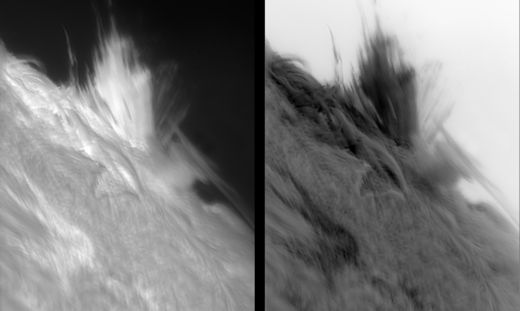
"It was only a small outburst, but it filled the camera chip on my Unigraph solar telecope," says Paleske. "The many months of adjustment work on the instrument have paid off and I am looking forward to the next few months of high solar activity."
So are we. Solar Max has arrived, and it is expected to continue for at least another 1 to 2 years. Not all of the outbursts Paleske catches will be "small." Stay tuned!
Realtime Aurora Photo Gallery
Free: Spaceweather.com Newsletter
TAHITIAN BLACK SOLAR ECLIPSE PEARL: It came from Tahiti, and now it has touched the shadow of the Moon. On April 8, 2024, the students of Earth to Sky Calculus launched this black pearl into a total eclipse of the sun over Texas. Riding on a cosmic ray research balloon, the pearl was 86,564 feet high when lunar darkness swallowed it for 3 minutes 45 seconds:
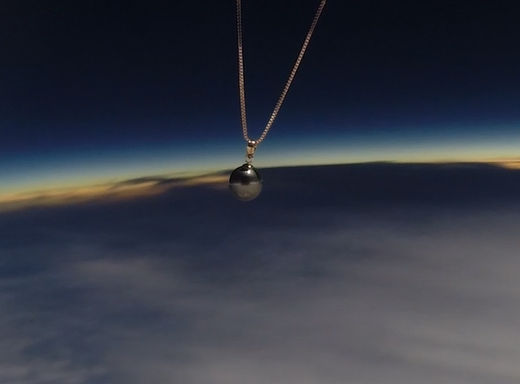
You can have it for $299.95. Measuring 9 mm in diameter, this genuine Tahitian pearl has an 18K rose gold clasp and is suspended from a matching 925 Sterling Silver chain. It comes with a greeting card showing the pearl in flight and telling the story of its journey to the edge of space during the 2024 total eclipse.
Far Out Gifts: Earth to Sky Store
All sales support hands-on STEM education
Realtime Space Weather Photo Gallery
Free: Spaceweather.com Newsletter
Realtime Comet Photo Gallery
Free: Spaceweather.com Newsletter