GEOMAGNETIC STORM WATCH--CANCELLED: Multiple CMEs that might have grazed Earth's magnetic field this weekend have so far failed to do so. Their late arrival (or, more likely, bad aim) reduces the chance of a geomagnetic storm. The current watch is cancelled. CME impact alerts: SMS Text
12P IS STILL THE BRIGHTEST COMET IN THE SKY: Last week, Comet 12P/Pons-Brooks made its closest approach to the sun in 71 years. Sunlight made it practically impossible for groundbased observers to watch 12P's perihelion, but now the comet is emerging from the glare. Ian Griffin photographed it today from Strath Taieri, Otago, New Zealand:
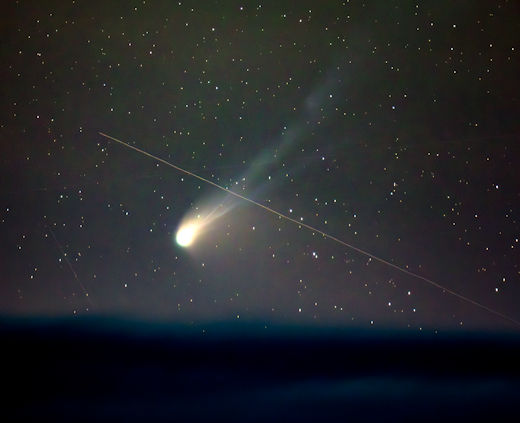
"Comet Pons-Brooks is becoming visible in the southern hemisphere!" says Griffin. "It has a lot of beautiful structure in its tail" probably caused by the buffeting of the solar wind.
Until now, Comet 12P was a northern hemisphere object. Post-perihelion, it will transition to the south. Griffin's photo is among the first of many to come from astronomers south of the equator.
Recent estimates place the comet's brightness near magnitude +4.5, which means 12P/Pons-Brooks is still the brightest comet in the sky. Where is 12P? Amateur astronomers can find it heading south in the constellation Taurus.
Realtime Comet Photo Gallery
Free: Spaceweather.com Newsletter
SHORTWAVE RADIO BLACKOUT IN HAWAII: Yesterday, April 27th, shortwave radio listeners in Hawaii may have noticed a sudden interruption in their favorite stations. An M3-class solar flare from sunspot AR3654 caused a blackout nearly centered on the Pacific island chain:
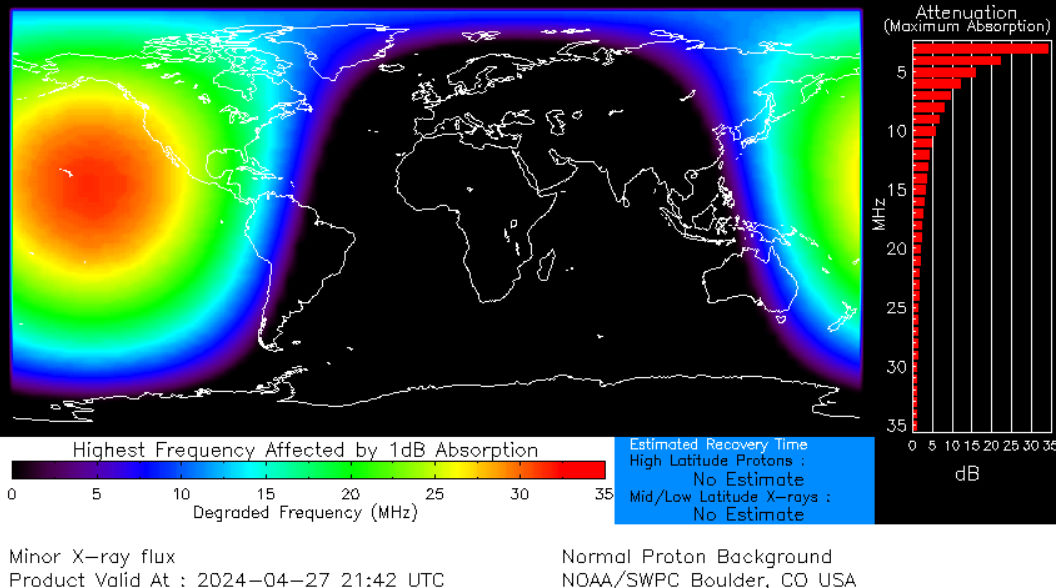
Radiation from the flare at 2140 UT ionized the top of Earth's atmosphere, interfering with the normal propagation of signals below 20 MHz. Ham radio operators, mariners and aviators may have noticed the fade as far away as the Society islands to the south and California to the east.
Sunspot AR3654 has an unstable 'beta-gamma' magnetic field that harbors energy for more strong flares. Additional radio blackouts are therefore possible this week. Solar flare alerts: SMS Text
Realtime Space Weather Photo Gallery
Free: Spaceweather.com Newsletter
TAHITIAN BLACK SOLAR ECLIPSE PEARL: It came from Tahiti, and now it has touched the shadow of the Moon. On April 8, 2024, the students of Earth to Sky Calculus launched this black pearl into a total eclipse of the sun over Texas. Riding on a cosmic ray research balloon, the pearl was 86,564 feet high when lunar darkness swallowed it for 3 minutes 45 seconds:

You can have it for $299.95. Measuring 9 mm in diameter, this genuine Tahitian pearl has an 18K rose gold clasp and is suspended from a matching 925 Sterling Silver chain. It comes with a greeting card showing the pearl in flight and telling the story of its journey to the edge of space during the 2024 total eclipse.
Far Out Gifts: Earth to Sky Store
All sales support hands-on STEM education
Realtime Space Weather Photo Gallery
Free: Spaceweather.com Newsletter
Realtime Aurora Photo Gallery
Free: Spaceweather.com Newsletter