EARTH-DIRECTED CME--CONFIRMED: Today's X-class solar flare (described below) did indeed produce a CME, and it has an Earth-directed component. NASA and NOAA forecast models suggest the southern flank of the CME will arrive on May 5th after 1800 UT. The impact could cause G1 to G2-class geomagnetic storms on May 5th and 6th. Aurora alerts: SMS Text




X-CLASS SOLAR FLARE (UPDATED): New sunspot AR3663 erupted this morning, May 3rd @ 0222 UT, producing an X1.6-class solar flare. NASA's Solar Dynamics Observatory captured the extreme ultraviolet flash:

Radiation from the flare ionized the top of Earth's atmosphere and caused a deep shortwave radio blackout over Australia, Japan, and much of China: map. Ham radio operators may have noticed loss of signal below 30 MHz for a half an hour after the flare's peak.

Update: Shortly after the flare, the US Air Force reported a Type II solar radio burst, a type of natural radio signal emitted by shocked gas at the leading edge of a CME. Drift rates within the burst indicate a launch speed of 960 km/s (3.6 million mph). SOHO coronagraph images have since confirmed the existence of a CME. The bulk of the cloud will pass north of our planet, with its southern flank delivering a glancing blow late on May 5th. G1 to G2-class geomagnetic storms are possible when the CME arrives. CME alerts: SMS Text
Realtime Space Weather Photo Gallery
Free: Spaceweather.com Newsletter
GLOWING SPIRAL SIGHTED DURING GEOMAGNETIC STORM: Last night, sky watchers in Europe went outside to observe the fading glow of a strong (G3) geomagnetic storm. "I was looking for aurora borealis after sunset, when suddenly a bright yellow spiral appeared near Polaris," reports Gabriel Murawski from Dusia Lake, Lithuania. This is what he saw:
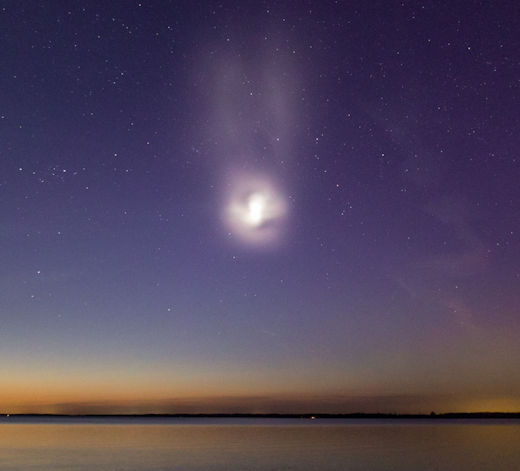
"It looked amazing!" says Murawski. "The spiral gliding next to the violet aurora borealis made a spectacular scene."
What caused this? We're still not sure. At first it appeared to be a 'SpaceX spiral,' an increasingly common form in the night sky produced by the deorbit burns of Falcon 9 rockets. If the rocket's second stage is spinning, it twists the exhaust into a spiral. This happens all the time.
Indeed, there was a SpaceX launch earlier the same night. On May 2nd at 10:37 pm EDT (May 3rd at 02:37 UT), a Falcon 9 rocket left Cape Canaveral carrying 23 Starlink satellites to orbit, and its second stage performed the required burn. However, the details don't add up. The deorbit burn was observed in Arizona, far to the west of Europe, and it did not have a spiral shape.
This is a mystery we are still investigating. Stay tuned!
Update: This might be a SpaceX spiral, after all. The company launched another Falcon 9 rocket on May 2nd (1948 UTC) from Vandenberg Space Force Base--the Worldview Legion mission. The orbit passes over Europe and may account for the spiral.
more images: from Petr Horálek of Zahorice, Czech Republic; from David Blanchard of Flagstaff, AZ; from Andrzej Błoński of Subcarpathia, Poland;
TAHITIAN BLACK SOLAR ECLIPSE PEARL: It came from Tahiti, and now it has touched the shadow of the Moon. On April 8, 2024, the students of Earth to Sky Calculus launched this black pearl into a total eclipse of the sun over Texas. Riding on a cosmic ray research balloon, the pearl was 86,564 feet high when lunar darkness swallowed it for 3 minutes 45 seconds:
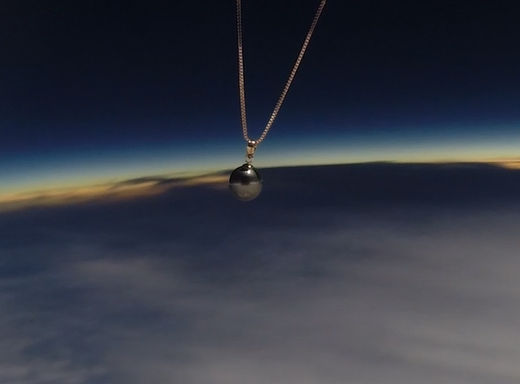
You can have it for $299.95. Measuring 9 mm in diameter, this genuine Tahitian pearl has an 18K rose gold clasp and is suspended from a matching 925 Sterling Silver chain. It comes with a greeting card showing the pearl in flight and telling the story of its journey to the edge of space during the 2024 total eclipse.
Far Out Gifts: Earth to Sky Store
All sales support hands-on STEM education
Realtime Comet Photo Gallery
Free: Spaceweather.com Newsletter
Realtime Aurora Photo Gallery
Free: Spaceweather.com Newsletter