DON'T BE SURPRISED IF A CME VISITS EARTH THIS WEEK: CMEs don't need to hit Earth to be effective. Example: A near miss on May 5th sparked auroras as far south as the Czech Republic in Europe. With this in mind, high-latitude photographers should be alert for auroras in the nights ahead. At least one CME is expected to pass close to Earth between now and May 9th--a result of the recent fusillade of solar flares from active sunspot AR3663. CME impact alerts: SMS Text
THE CHANCE OF FLARES JUST DOUBLED: There are now two dangerous sunspots facing Earth. In the past 24 hours, AR3664 has more than doubled in size, becoming one of the largest sunspots of the current solar cycle. It is inset in this magnetic map of the sun from NASA's Solar Dynamics Observatory:
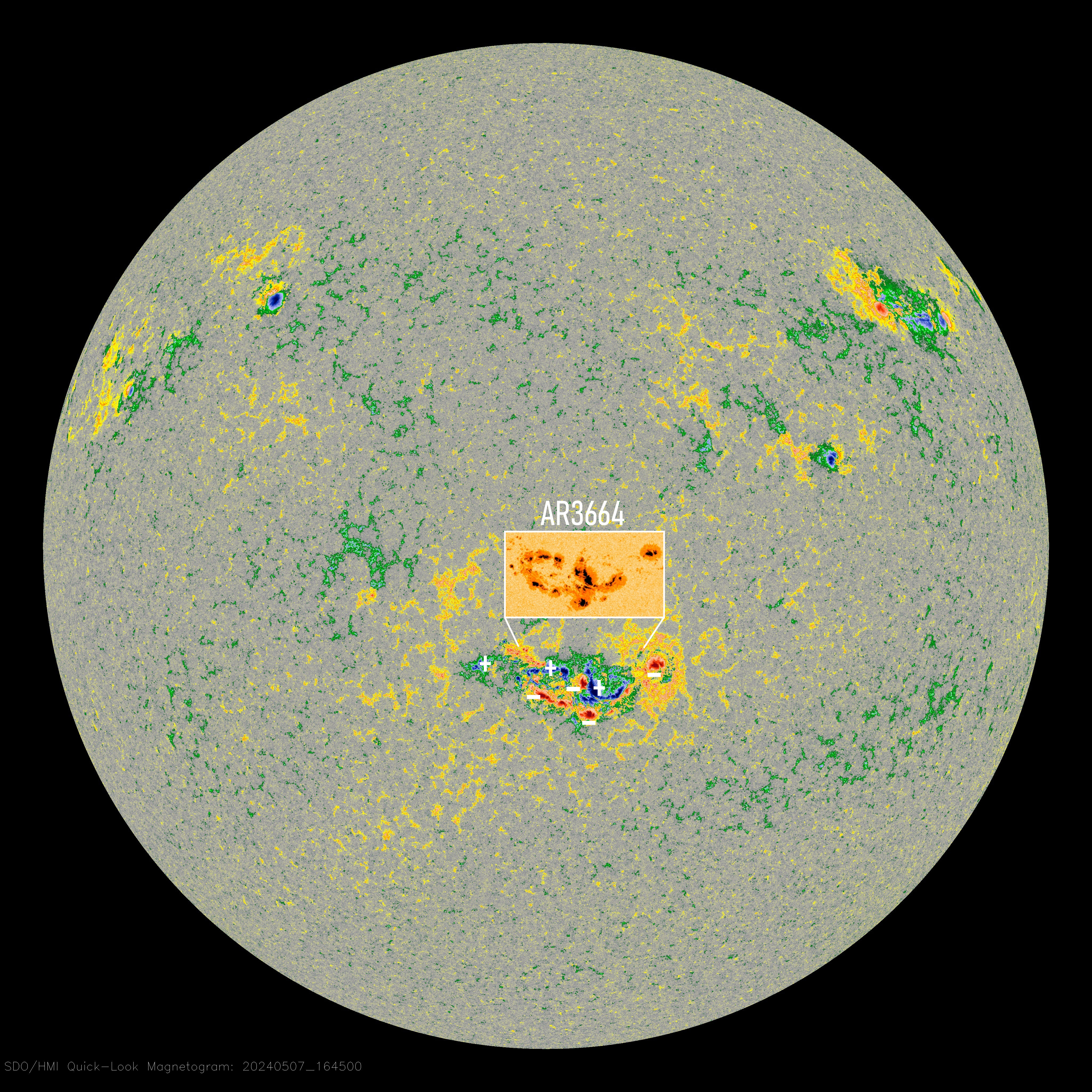
Among the sunspot's dark cores, magnetic poles of opposite polarity are bumping together in explosive proximity. As a result, AR3664 now poses a threat for X-flares like its more active cousin AR3663 in the northern hemisphere.
Do you have eclipse glasses left over from April 8th? Use them to look at the sun today. AR3663 is ten times wider than Earth and can be seen with no magnification. Solar photographers, submit your images here! Solar flare alerts: SMS Text
Realtime Space Weather Photo Gallery
Free: Spaceweather.com Newsletter
STARLINK VS. COMET 12P/PONS-BROOKS: Over the past few years, astronomers have expressed a growing sense of alarm about the threat Starlink satellites pose to astronomy. Are they exaggerating? A picture is worth a thousand words:
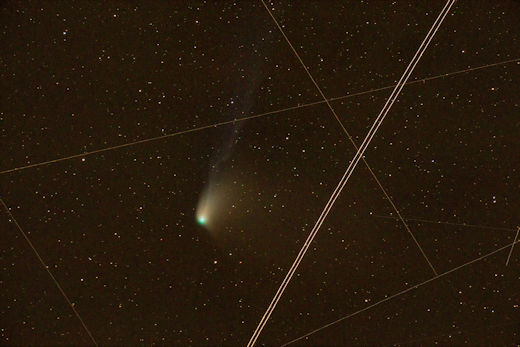
"Words can't describe the destruction Starlink is causing the nocturnal environment, but this single one-minute exposure of Comet 12/Pons-Brooks, taken on May 4th, might," says photographer Ian Griffin of Otago, New Zealand. "I hope everyone is enjoying their satellite broadband."
Full disclosure: We at Spaceweather.com do enjoy our Starlink internet, especially during cosmic ray balloon recoveries in remote parts of the Sierra Nevada mountains where cell service is unavailable. It's great. But there is no question that SpaceX is conducting a giant uncontrolled experiment by filling low-Earth orbit with unprecedented numbers of satellites. Bright lines criss-crossing astrophotos aren't the only problem. Harmful changes to Earth's atmosphere and ecosystems are possible, too, along with catastrophic cascade collisions in Earth orbit.
According to the IAU, the number of Starlink-like satellites launched by SpaceX and competitors could grow from the current value near 5800 to more than 500,000 in the years ahead. Is that really a good idea? 
Realtime Aurora Photo Gallery
Free: Spaceweather.com Newsletter
TAHITIAN BLACK SOLAR ECLIPSE PEARL: It came from Tahiti, and now it has touched the shadow of the Moon. On April 8, 2024, the students of Earth to Sky Calculus launched this black pearl into a total eclipse of the sun over Texas. Riding on a cosmic ray research balloon, the pearl was 86,564 feet high when lunar darkness swallowed it for 3 minutes 45 seconds:
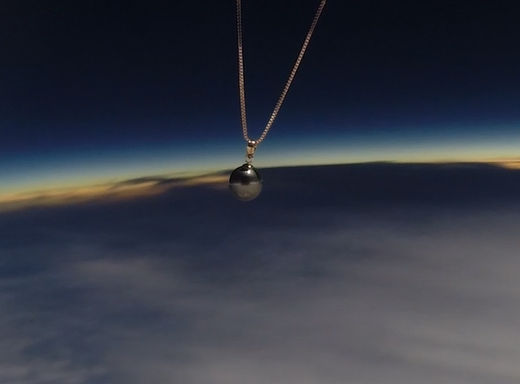
You can have it for $299.95. Measuring 9 mm in diameter, this genuine Tahitian pearl has an 18K rose gold clasp and is suspended from a matching 925 Sterling Silver chain. It comes with a greeting card showing the pearl in flight and telling the story of its journey to the edge of space during the 2024 total eclipse.
Far Out Gifts: Earth to Sky Store
All sales support hands-on STEM education
Realtime Comet Photo Gallery
Free: Spaceweather.com Newsletter
Realtime Aurora Photo Gallery
Free: Spaceweather.com Newsletter